


Further down sits the top half of the line as a ready trip: Hanoi, the mountain roads of Sapa and Ha Giang, then Hue, Hoi An and a flight home from Da Nang, with the hours, the fares and where to book each leg.
Plan Vietnam in Stippl
Day-by-day planning, stays and budget in one app, with every place from this guide already on the map.
Download the appHow to plan a trip to Vietnam: the short version
Pick your month first, because the north, the centre and the south have their dry season at different times, and let it tell you which end of the line to favour. Then choose a direction and book an open jaw flight: into one end, out of the other. Decide how much of the line your days can carry: two weeks covers one half well, three weeks the whole length. Ride the short hops by sleeper bus or train and fly the long ones. Last, set a budget in dong, book the legs that sell out, invite whoever you travel with, and download the trip so it opens on a mountain pass with no signal. For the apps that do the work once you land, from Grab to Zalo, see our guide to the best apps for Vietnam.
| Step 1 | Pick the end of the line your month favours |
| Step 2 | Choose your direction and fly in and out of different cities |
| Step 3 | Decide how much of the line fits your days |
| Step 4 | Ride the short hops, fly the long ones |
| Step 5 | Budget in dong, book, share and go offline |
Plan Vietnam as a line: five decisions with Stippl
Open a trip in the Stippl itinerary planner and drop in your two airports first, the one you land at and the one you leave from. Every stop you add after that falls somewhere on the line between them, which is exactly how Vietnam wants to be planned.
Step 1: pick the end of the line your month favours
There is no single best month for Vietnam, because a line this long runs through three climates. The north (Hanoi, Sapa, Ha Giang, Ha Long) is dry from November to April, with real mountain cold in December and January. The centre (Hue, Hoi An, Da Nang) is dry from January to August and gets its monsoon from September to November, with Hoi An flooding in October. The south (Ho Chi Minh City, the Mekong, the islands) is dry from November to April and wet from May to October, mostly as short daily downpours.
February to April is the only window when all three are dry at once, which makes March the safest single month. Outside it, you choose: in October the north is at its best and the centre is not, in July the central beaches shine while the mountains are wet. Give your nights to the end that is dry and pass quickly through the rest. One date to plan around: Tet, the Lunar New Year, falls on 6 February 2027, and for about a week transport books out, restaurants close and prices climb.
Our guide to the best time to visit Vietnam goes month by month, and rainy season in Vietnam shows where it rains when.
Step 2: choose your direction and fly open jaw
Both ends of the line have an international airport, Hanoi in the north and Ho Chi Minh City in the south, with Da Nang in the middle. So the standard move is to fly into one and out of another. It saves you the long way back: Hanoi to Ho Chi Minh City is about 2 hours in the air and more than 30 hours by train. Search for a multi city ticket rather than a return, and add both airports to your Stippl trip so the route stays one line from the first night to the last.
Which direction? Start where it is dry in your first week, and let the cheaper inbound flight break a tie. Going north to south in March, you get the mountains while they are cool and clear and finish on a warm southern beach. Going south to north works just as well: flip the order of the stops and the legs flip with them.
Da Nang is the quiet third option. It has central Vietnam's international airport, yet it opens only about one Vietnam trip in 20 planned with Stippl: travellers land there and start the trip somewhere else. As the end point of a top half route it works well, which is how the sample route below uses it.
Step 3: decide how much of the line fits your days
Two weeks covers one half of the line well, the north and the centre or the centre and the south, and three weeks covers the whole length. Most travellers take longer than that: across more than 128,000 Vietnam trips planned with Stippl, a typical trip runs about a month across nine stops, because fewer than one in four is Vietnam only.
The stops tell you how to spend the days. Hanoi is on more than eight in ten Vietnam trips, because nearly everything in the north leaves from it. A typical Vietnamese stop gets two nights, and one in four is a single night. Fewer than one stop in 25 is a day trip, against nearly one in ten in Japan: the stops are far apart, so people sleep where they stop. Hoi An gets three nights, the Ha Giang loop three or four, Hue two.
So count backwards. Fourteen nights at two or three per stop is five or six stops, which is one half of the line, not all of it. Set the nights per stop in Stippl and the trip recalculates your dates as you drag them, so you see at once whether the plan still reaches your flight home.
Step 4: ride the short hops, fly the long ones
On a line this long, the leg type is decided by distance and by mountains. Sapa and Ha Giang have no airport and no railway, so the far north runs on sleeper buses: near flat berths, shoes off at the door, fierce air conditioning, so bring a layer. The VIP tier costs a couple of euros more and is worth it.
The spine is a choice between rail and air. The Reunification Express runs the single track from Hanoi to Ho Chi Minh City in sleeper compartments, slow and scenic rather than cheap: Hanoi to Hue takes about 14 hours, and Hue to Da Nang, 2.5 to 3 hours along the sea, is called the most scenic rail ride in the country. A flight covers Hanoi to Hue in about 1 hour 20 minutes, and Da Nang to Ho Chi Minh City in another 1 hour 20 against 16 hours or more by road. Domestic flights are cheap enough to replace the worst overland legs; you need a credit card to book them.
A good rule: ride anything under about six hours, take the train where the view is the point, and fly any jump that would cost you a whole day. Book buses and trains on 12Go or through your accommodation, never from a shopfront, where operators are impersonated, logo and all. Put the train and the flight in as two versions of the same leg, compare what each does to your dates, and delete the loser. Our guide to transportation in Vietnam compares the main routes.
Step 5: budget in dong, book, share and go offline
Your money goes a long way here. A budget day of dorm bed, street food and sleeper buses runs €11-33 (₫330,000-1,000,000). Mid-range, with private rooms, restaurant meals and a domestic flight, runs €37-70 (₫1,130,000-2,130,000). Boutique hotels, private transfers and guided tours start around €85 (₫2,590,000) a day. Travellers who logged their spending in Stippl paid about €5.40 (₫165,000) for a typical dinner and €2.60 (₫80,000) for a taxi ride, and coffee was a line of its own at about €2 (₫60,000) a cup.
Set a daily budget in your trip and log every expense in dong at the stop where you paid it, with the total in your own currency beside it. Splitting a Ha Giang tour or a Ha Long cruise with others? Log it once in the budget planner with everyone's share, and the settling up at the end is done for you.
Budget
€11–33
dorm bed, street food, sleeper buses, free-to-cheap sights
Mid-range
€37–70
private rooms, restaurant meals, a Ha Long cruise, internal flight
High-end
€85+
boutique hotels, private transfers, guided caves and cruises
Book what sells out first: the open jaw flight, sleeper buses and trains in high season, and anything around Tet, when the whole country travels home. Check your entry rules early: most European passports get 45 days visa free, and everyone else uses the 90 day e-visa at the official portal, evisa.gov.vn, which takes three to five working days.
Then invite your travel friends, so everyone sees the same line and the same bus times, and open the trip in the app before you fly. Your itinerary, notes and bookings stay on your phone, so the plan still opens on a sleeper bus in the mountains.
Sample route: the top half of the line in two weeks, as planned in Stippl
Here is the top half of the line as a real trip in Stippl, flown open jaw: into Hanoi, out of Da Nang. North first while the mountains are clear, then one flight to the centre. It works best in March and April, when the north is dry and the central coast is past its rains. Fourteen nights, six stops, three bus legs, one flight and one short transfer.
| Stop and nights | Getting there | Time and price | Book with |
|---|---|---|---|
| Hanoi, 2 nights | Fly in, bus 86 or Grab to the Old Quarter | 45 to 60 min by bus, €1.30-1.50 (₫40,000-45,000) | Pay on board, or the Grab app |
| Sapa, 2 nights | Sleeper bus or VIP cabin bus from Hanoi | 5.5 to 6 hours, €8.50-21 (₫260,000-640,000) | 12Go or your hotel |
| Ha Giang, 4 nights | Bus from Sapa | about 6 hours | 12Go, bookable online |
| Hue, 2 nights | Bus back to Hanoi, then a flight to Phu Bai | 6 to 7 hours, then about 1 hour 20 (a long day, see below) | 12Go, then the airline |
| Hoi An, 3 nights | Bus or transfer, or the Hai Van Pass by motorbike | 3.5 to 4 hours direct, a full day over the pass | Your hotel or 12Go |
| Da Nang, 1 night | Bus LK02 or Grab | about 1 hour, €1.15 (₫35,000) by bus | Cash on the bus, or the Grab app |
The one awkward leg is Ha Giang to Hue, because the mountains and the centre have no direct link. Want the day by day for a longer trip? Our Vietnam itinerary for 3 weeks runs the full north to south, and the Vietnam 2 week itinerary adds the south instead of the mountains.
Hanoi, 2 nights
Base yourself in the Old Quarter around Hoan Kiem Lake, where everything is inside a twenty minute walk. Two nights fits how travellers actually use Hanoi: it is the busiest stop in Vietnam, yet nearly one stay in three is a single night, because it is where the north begins. If you have a spare day, Ninh Binh is two hours south by limousine van or train.





Sapa, 2 nights
The sleeper bus drops you in town after 5.5 to 6 hours; the night train goes only as far as Lao Cai, an hour below. Sapa is a trailhead more than a town, so the nights are for walking the rice terrace valleys. A two or three night trek from Hanoi, transport and meals included, runs €55-100 (₫1,670,000-3,040,000). Travellers split almost evenly between two and three nights here.
Ha Giang, 4 nights
The bus from Sapa takes about six hours and is the only link between the two. Ha Giang is a 350 to 400 km loop through the far north, and the four day version, which includes Du Gia, is the popular one: four to five hours of riding a day past the Ma Pi Leng pass and the Nho Que river. An all in tour of three or four days runs €124-220 (₫3,780,000-6,700,000). You need a border permit too, about €6.60-8.50 (₫200,000-260,000), usually arranged by your tour.
Editor's tip: Ride pillion on the Ha Giang loop unless you hold a 1968 Convention driving permit with a motorcycle category or a Vietnamese licence. Without one you are riding illegally and uninsured, and insurers decline claims on exactly that basis. A local driver who rides while you sit behind is the legal option, and the common one.

Base yourself in Ha Giang city for the first night; the loop nights are spent in villages along the way, such as Dong Van and Du Gia.
Hue, 2 nights
Be honest with yourself about this day: 6 to 7 hours on the bus back to Hanoi, a transfer to Noi Bai, then a flight of about 1 hour 20 minutes to Phu Bai, where VietJet and Vietnam Airlines fly many times a day. Doable with an evening flight, but brutal straight after four days on a motorbike. The kinder version takes one night of the Ha Giang loop and spends it in Hanoi, then flies to Hue the next morning. Prefer the rails? The Hanoi to Hue train takes about 14 hours and a soft sleeper is worth the difference. Two nights in Hue matches what travellers plan: one day for the citadel, one for the royal tombs strung along the Perfume River. The Imperial City stays open until 10 pm on Thursdays.

Hoi An, 3 nights
The direct bus or transfer to Hoi An takes 3.5 to 4 hours through the tunnel. If you have the day, go over the Hai Van Pass on the back of a motorbike with a local driver for about €45 (₫1,370,000), with your luggage sent ahead. Base yourself in the Ancient Town or along the river, or at An Bang Beach for something quieter, a 15 to 20 minute bicycle ride through the rice paddies. Three nights is right here: it is what travellers plan, and Hoi An has one of the lowest shares of one night stops in Vietnam.
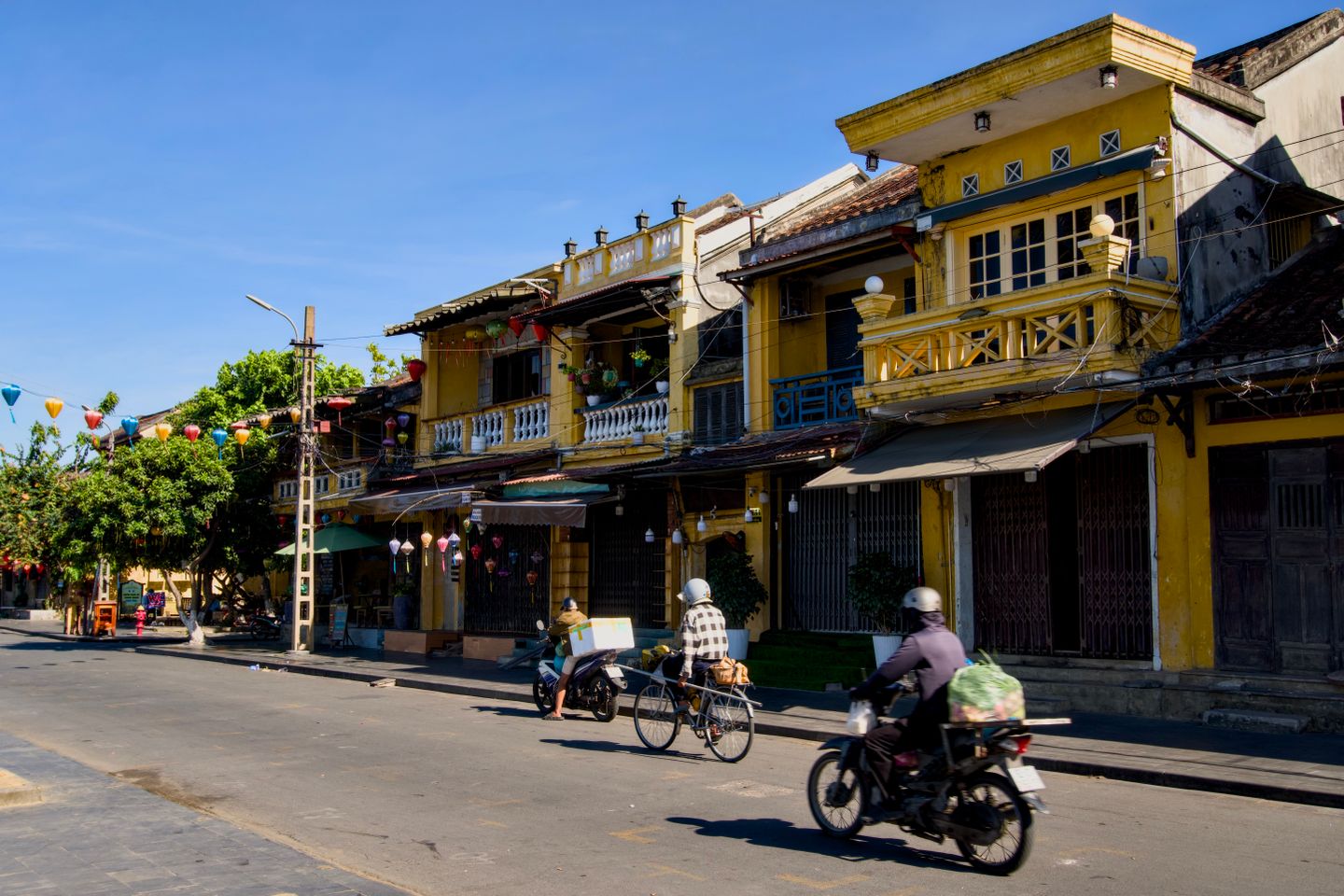
Da Nang, 1 night
Hoi An has no airport, so everything leaves through Da Nang, 30 km north. The LK02 bus costs €1.15 (₫35,000) in cash and takes about an hour; Grab takes 45 minutes for €11.50-14.80 (₫350,000-450,000). One night by the beach at An Thuong or My Khe takes the stress out of an early flight. Da Nang starts only about one trip in 20: the flights land here and the itinerary begins somewhere else.
Want the south too? Fly from Da Nang to Ho Chi Minh City in about 1 hour 20 minutes and add three nights, which is what travellers typically give it. That turns this route into a three week trip.
Turn these stops into a route
Pick your favourites and Stippl orders them, adds travel times and builds the day-by-day.
Open the route, change the nights, swap Sapa for Ninh Binh, and the legs and dates move with you.
How many days do you need for Vietnam?
The short answer from Step 3: two weeks for one half of the line, three weeks for all of it. Here is what each length buys you, from a city break to the full run.
Five days. Hanoi plus one trip out: a night on Ha Long Bay or two in Ninh Binh.
Seven days. The north sampler: Hanoi, one night on Ha Long Bay, two in Ninh Binh and a last night in Hanoi. It is a ready made one week trip in Stippl.
Ten days. Enough for one half of the line at an easy pace, or a sample of the whole if you fly twice: the north and Hanoi, then straight to Hoi An, or Hoi An and the south.
Two weeks. The sample route above, or the north plus the centre in any order you like.
Three weeks. The whole line, from the mountains to the Mekong, flown into Hanoi and out of Ho Chi Minh City, without dropping below two nights anywhere. This three week north to south trip adds Cat Ba and the caves of Phong Nha on the way down.
Describe your trip, get a Vietnam itinerary in seconds
Everything in this guide is already in Stippl. Tell the planner how long you have and what you like: it builds the route, the days and the travel times, and you edit whatever you want.
How much does a trip to Vietnam cost?
On a line this long, the total is decided by how you cover the distance. Each domestic flight you add instead of a sleeper bus costs more than several days of street food, and the two big paid extras, a Ha Giang tour and a Ha Long cruise, can each cost more than a week of budget rooms. Rooms come next. Street food and local buses stay cheap everywhere, so a bowl of pho never moves the number.
Price your flights and the two tours first, put them on their stops in Stippl, and the daily budget tells you what is left for everything else.
Vietnam travel tips for first timers
Five Vietnam specific traps, all of them easy to plan around.
Too many one night stops. One Vietnamese stop in four is a single night, and in a country this long those are the days spent on buses. Keep two nights as your floor, three where you want to slow down.
Trusting the map's travel times. Mountain roads are slow and traffic is the country's real hazard. Double any estimate on a road leg, and wear a helmet every time.
Planning the whole line in two weeks. Hanoi to the Mekong in fourteen nights means a bus or a flight every other day. Pick the half your month favours and save the other for the next trip.
Cash in the mountains. ATMs thin out around Sapa's villages, so draw dong in Hanoi, and switch your bank card to worldwide use before you fly.
Forgetting the neighbours. Most Vietnam trips carry a second country. Cambodia is the classic pairing: the Moc Bai to Bavet border connects Ho Chi Minh City with Phnom Penh, and our Vietnam and Cambodia itinerary lays out the route. Laos goes into the same trip the same way. Coming from Thailand, plan to fly: the land border between Thailand and Cambodia has been disrupted since the 2025 conflict, so check your government's travel advice before counting on the old bus route from Bangkok. In Stippl the next country is simply more stops and legs on the same trip.
Read more: things to do in Vietnam
Got your month? That tells you which end of the line to start at, and the rest of the plan follows from it.
Frequently asked questions about Vietnam
It depends on your stops and travel style. A budget day runs €11-33 (₫330,000-1,000,000) and mid-range €37-70 (₫1,130,000-2,130,000). Travellers who planned with Stippl logged about €5.40 (₫165,000) for dinner and €2.60 (₫80,000) for a taxi ride, and you can track the total in dong.
The north, the centre and the south have different seasons. February to April is the only window when all three are dry at once, which makes March the safest single month. Avoid the week of Tet if you can.
Two weeks covers the north and the centre, three weeks adds the south. Across more than 128,000 Vietnam trips planned with Stippl, a typical stop gets two nights, so two weeks means five or six stops.
Both work. Let your flights and the season decide: start where it is dry in your first week. Add every leg in Stippl and flip the route if that fits better.
Mountains first or beaches first, the line is the same. Open the north and centre route in Stippl, move Hanoi or Da Nang to whichever end your flights land at, and share it with whoever is coming along.