

Seville
Seville is flat, compact and walkable end to end, the hinge of every Andalusian route, and the one Spanish big city where transport is optional. Two nights, the Alcázar and the Cathedral booked, and nothing planned for a July afternoon.
Seville in a nutshell
Seville: what to expect
The numbers below come from 246,000+ planned stops in Spain on Stippl, and the rest from the guides we cross-check.
Seville takes two nights, and every Andalusian itinerary starts or finishes from it. The Royal Alcázar and its gardens, the Cathedral with the Giralda's thirty-five ramps, Plaza de España's tiled semicircle, the whitewashed lanes of Santa Cruz and flamenco in a Triana tablao all sit inside a flat, walkable core, with the Setas de Sevilla walkway as the one modern thing in the skyline. Most travellers give Seville 2 nights on Stippl.
Seville is Spain's third-most-planned place, and it belongs to long itineraries rather than weekends. The city takes 7.3% of every Spanish stop planned on Stippl, only 6.7% of Seville trips have no other stop, and its strongest partners are Córdoba, Granada, Ronda and Cádiz, all inside two hours and all far above the odds for Spain.
Sleep in Santa Cruz for walking distance or Triana for a neighbourhood, book the Alcázar and the Cathedral before the room, and walk the old quarter before nine. The airport bus does the arrival in half an hour, and a bike beats walking in the heat. Skip Seville in July and August unless the mornings are enough, because 36 degrees closes the afternoons, and skip Semana Santa and the Feria unless they are the point, since the rooms triple for both.
Plan Seville in Stippl
Day-by-day planning, stays and budget in one app, with every place from this guide already on the map.
Download the appWho Seville is for
Anyone doing Andalusia
Seville is the region's entry point in every itinerary, and Córdoba, Granada, Ronda and Cádiz all sit on its trips far above the odds for Spain.
Two-night stoppers
Most travellers give Seville 2 nights on Stippl, flat, compact and largely pedestrianised, the one Spanish big city where transport inside it is optional.
Moorish-architecture people
The Alcázar sells timed slots that go days ahead rather than months, which makes it the Alhambra without the ticket lottery.
Andalusian-register eaters
Cold soups, fried fish, sherry and jamón, ordered in rounds across several bars, at prices well under Barcelona's.
Cyclists
Seville built a segregated network before any other Spanish city, and a bike is the standard heat strategy rather than a novelty.
Long-route travellers
Seville trips carry about twelve stops against Spain's eight, of everyone who plans it on Stippl, so it belongs to itineraries rather than weekends.
Maybe not for you: anyone here in July or August for the sightseeing, because the afternoons are unusable rather than uncomfortable; and anyone who wants a beach, since the coast at Cádiz is an hour and a half away.
The best time to visit Seville
Cool and quiet
November to February
Mild days, some rain, the cheapest rooms and no queues at the Alcázar, with the orange trees in fruit and the Christmas lights on Calle Sierpes.
The spring window
March to May
The best of the year and the two big festivals inside it: Semana Santa and the Feria fill the city and triple the rooms for a fortnight, and the weeks either side are the sweet spot.
The unusable months
June to August
Thirty-two to 36 degrees, rainless and half the city on holiday; the mornings before eleven and the evenings after eight are the day.
The second window
late September to October
The heat breaks, the light is at its best, and October brings the year's heaviest rain in short bursts.
- July is the month most travellers plan Seville for on Stippl, and June to September takes 54.1% of the plans. That is the quarter the city itself avoids, so the spring and autumn windows are the ones with bearable afternoons.
- Most travellers plan Seville about 69 days ahead on Stippl, and 15.7% inside a fortnight. The Alcázar and the Cathedral sell timed slots days ahead in season, so the late plan works here where it fails at the Alhambra.
- Semana Santa fills every evening of Holy Week with processions. The hotels are full for the whole week at the year's highest rates, the streets close around the routes, and crossing a procession is genuinely difficult.
- Seville's Feria de Abril comes two weeks after Easter. A week of casetas, horses and flamenco dress on the fairground across the river, with the rooms booked out and the monuments half-empty.
- The bitter oranges flower in late March. The azahar scent over the whole city lasts about two weeks and is the one reason to time a spring trip to the start of the window rather than the end.
- The Bienal de Flamenco runs through September in even years. The flamenco calendar's anchor event, with the tablaos full and the big names in the theatres, and the city otherwise in its second window.
Add your Seville dates and we'll flag the weather
Stippl shows the season, crowds and prices for every stop on your route.
Describe your trip, get a Seville itinerary in seconds
Everything in this guide is already in Stippl. Tell the planner how long you have and what you like: it builds the route, the days and the travel times, and you edit whatever you want.
Things to do in Seville
 Photo by David Hertle via Unsplash
 Photo by Tânia Mousinho via Unsplash
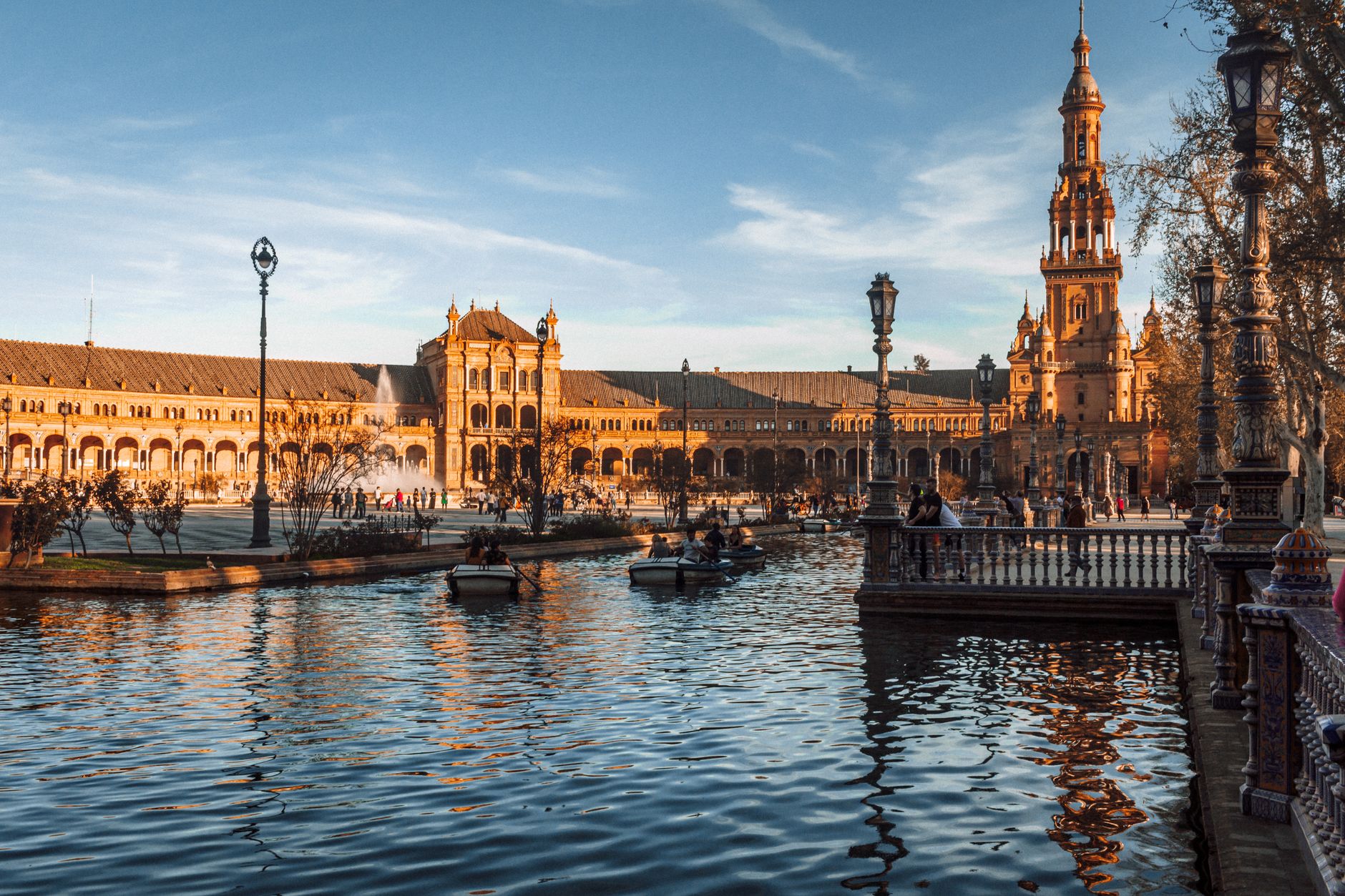 Photo by DANIEL YAMPOLSCHI via Pexels
The Royal Alcázar and its gardens
Mudéjar palace rooms, the Patio de las Doncellas and a walled garden with peacocks in it, on a timed slot booked days ahead; the Hall of Ambassadors is the room people come for.
Plaza de España
A 200-metre tiled semicircle built for the 1929 exposition, with a bench for each Spanish province, a moat you can row on and no entry fee, best in the low light of the evening.
Climbing the Giralda
Thirty-five ramps rather than stairs, built so a rider could go up the minaret on horseback, ending on the roofline of the largest Gothic cathedral in the world, on the Cathedral ticket.
Flamenco in Triana
In a tablao rather than a dinner show, in the barrio the form came out of, where the difference is audible; about an hour, booked the day before.
Sunset from the Setas de Sevilla
The largest wooden structure in the world, a walkway over the roofs of El Centro, and the one modern thing in a medieval skyline.
Santa Cruz at eight in the morning
Calle Judería, Calle Vida and Calle Susona empty and cool before the tour groups, then the Cathedral at opening.
The neighbourhoods of Seville
Barrio Santa Cruz
The former Jewish quarter
A labyrinth of whitewashed lanes, orange trees and small plazas beside the Alcázar, the most photographed streets in the city, quiet in the morning and packed after dark. For first visits and walking distance.
The Alcázar and the Cathedral minutes away, on the most expensive ground in Seville.
Triana
Across the river
A working riverside barrio that considers itself separate from Seville, the accepted birthplace of flamenco and still home to the azulejo tile workshops, with Calle Betis facing the cathedral skyline. For second visits and evenings.
A real neighbourhood and cheaper rooms, and a bridge to cross to every sight.
El Centro and Alfalfa
The commercial heart
Plaza del Salvador, the Setas and the shops on Calle Sierpes, with the city's densest tapas grid and mostly pedestrianised streets. For value and food.
The best compromise between price and walking distance, and the fullest streets on a Saturday.
El Arenal
The old port
Between the Cathedral and the river, the district the ships from the Americas sailed from, with the Maestranza bullring, the Torre del Oro and family tapas bars that fill with Sevillians. For food and nights out.
Local tapas bars and the river, and bullfight crowds on fight days.
Macarena
The northern walls
Long stretches of the old city wall, the basilica holding the Virgin most associated with Semana Santa and a Thursday flea market on Calle Feria, residential and cheap. For budgets.
The cheapest beds inside the walls, and twenty minutes' walk to the Cathedral each way.
Alameda de Hércules
The promenade
A long tree-lined promenade of bars, galleries and terraces, the bohemian and LGBTQ+ quarter, busy with students and the loudest part of the city after midnight. For nightlife.
The best terraces and the latest nights, and the noise that goes with them.
See every Seville neighbourhood on one map
Save the areas you like and Stippl plots your days so you're not crossing the city twice.
Where to stay in Seville
Sleep in Santa Cruz for walking distance or Triana for a neighbourhood, and the river between them is ten minutes wide on foot; El Centro is the value pick inside the ring. Most travellers give Seville 2 nights on Stippl, and from spring onwards air conditioning and a rooftop pool are a specification rather than a luxury. Avoid the blocks around Santa Justa station.
Barrio Santa Cruz
Boutique hotels in old palaces and small guesthouses in the lanes, €120 to €280 a double.
Triana
Apartments and small hotels on and behind Calle Betis, €80 to €180 a double.
El Centro and Alfalfa
Hostels and mid-range hotels around the Setas, €70 to €170 a double.
El Arenal
Hotels between the Cathedral and the river, €100 to €220 a double.
Macarena
The cheapest hostels and guesthouses in the city, €50 to €120 a double.
Alameda de Hércules
Hostels and design hotels on the promenade, €70 to €160 a double, and late noise.



What to eat in Seville
Two cold tomato soups: gazpacho thin and drinkable, salmorejo thick with bread, oil, egg and jamón. Summer staples, and salmorejo is the Andalusian one
Mixed small fish floured and flash-fried, eaten with the fingers and lemon. The Andalusian coast's dish, served inland here
Acorn-fed cured ham, sliced to order. Andalusia holds the Jabugo hills and the sources treat it as a regional rather than national product
Spinach and chickpeas with cumin and paprika: a Moorish leftover, meatless, and the city's signature tapa
Pork cheek braised until it collapses, usually in sherry
Fortified wine from the Jerez triangle an hour south; served cold and dry with tapas, not as a dessert wine
The bitter oranges on 14,000 street trees: inedible raw, and exported for marmalade
Discover food spots in Stippl
Find restaurants and markets on the map, save them to your itinerary, works offline too.
Seville customs and what not to do
Dinner is after nine
Kitchens fill between nine and eleven, and a restaurant busy at half past seven is a restaurant for visitors, so the main meal goes to lunch.
Cover up for the Cathedral
Shoulders and knees, signed at the door and enforced on the day, and the same applies in the smaller churches of Santa Cruz.
Tapas come in rounds
Ordered a few at a time and shared, with the bill settled at the bar at the end rather than at the table, and the next bar after that.
Semana Santa is not a parade
The processions are a religious event, watched in silence in places, and crossing one is genuinely difficult; plan the week around the routes.
Bullfighting is contested
The Maestranza is Spain's oldest ring and runs a season from April; the city holds both the guides to it and the objections.
Andalusian drops its endings
Final consonants go missing and the pace is fast, which is a comprehension issue for learners more than a courtesy one.
Do
- Book the Alcázar and the Cathedral before you book anything else
- Walk Santa Cruz before nine in the morning, when it is empty and cool
- Cross to Triana for at least one evening
- Eat standing, in rounds, across several bars
- Take the Monday free Alcázar slot if you are an EU citizen and can book the moment it opens
Don't
- Come in July or August expecting to sightsee in the afternoon
- Book a flamenco dinner show and call it flamenco
- Drive into the historic centre; it is restricted and the parking is underground and dear
- Turn up for dinner at seven and judge the city on who else is there
- Trust the older guides' ticket prices; the Cathedral's nearly doubled
What a Seville trip costs
Budget
€50–80
A hostel bed in El Centro or Macarena, market lunches and tapas in rounds, one paid monument, the airport bus.
Mid-range
€120–200
A boutique hotel or an apartment in Santa Cruz or Triana, sit-down meals, the Alcázar and the Cathedral, a tablao.
High-end
€300–650+
A palace hotel with a courtyard or a rooftop pool, booked restaurants, private guides.
Track what you actually spend
Set a daily budget per country and log expenses in any currency while you travel.
Fun facts about Seville
Seville Cathedral is the largest Gothic building in the world. Founded in 1403 on the site of a mosque, it holds the tomb of Christopher Columbus and keeps the mosque's minaret as its bell tower.
The Royal Alcázar of Seville is the oldest royal palace in Europe still in use. Its upper floors are reserved for the Spanish royal family, which is why the tour stops where it does.
The Giralda has thirty-five ramps instead of stairs. They were built so a rider could go up the minaret on horseback, which makes it far easier than most European bell towers.
Seville has about 14,000 bitter orange trees on its streets. The fruit is too sour to eat and is exported to Britain for marmalade and to the Cointreau distillery.
Plaza de España has a tiled bench for every Spanish province. It played Naboo in Attack of the Clones and appears in Lawrence of Arabia, and the count of benches is argued over.
The Alcázar's gardens were the Water Gardens of Dorne. Game of Thrones filmed there, and the peacocks were not added for the production.
Local tips for Seville
A walking city
Flat, compact and largely pedestrianised in the core, so transport inside Seville is optional and a bike is the heat strategy, on the densest segregated network in Spain.
The airport bus is the answer
Six euros one way from SVQ, about half an hour into the centre, with tickets sold on board; a taxi is the alternative and not much faster.
Córdoba is 45 minutes away
The fast train makes it Seville's single strongest travel partner, and the Mezquita a morning rather than a night away.
Pickpockets at the monuments
Seville is a safe city and the real risk is theft, concentrated around the Cathedral, Plaza de España and the Setas, so the bag stays in front.
Fine to walk at night
The centre is comfortable after dark, including for solo travellers, with the blocks around Santa Justa station the usual exception.
Two nights is the shape
Most travellers give Seville 2 nights on Stippl and 28.9% of stops are a single night, so the Alcázar gets the first morning and Triana the second evening.
Seville questions, answered
Two nights, three with a second palace or a Córdoba morning. Most travellers give Seville 2 nights on Stippl and 28.9% of stops are a single night, which covers the Alcázar and the Cathedral on booked slots, Santa Cruz early and a Triana tablao after dark.
The Royal Alcázar and the Cathedral, both timed and both gone on the day in season, though they go days ahead rather than the Alhambra's months. Plaza de España needs nothing and costs nothing, and the Setas and the tablaos can be booked the day before.
At the start or the hinge: Seville opens 19.9% of the trips it appears on, of everyone who plans it on Stippl, with Córdoba, Granada, Ronda and Cádiz as the partners. Put Seville into Stippl with two nights and the fast train to Córdoba as a morning, then ask people who have done the loop, in subreddits like r/spain.
Most travellers do both, and Granada sits on about two in five Seville trips. Seville for the walkable city and the base, Granada for the Alhambra, and the difference in planning is that the Alhambra needs booking months ahead where the Alcázar needs days.
July and August average around 36 degrees and the afternoons are unusable rather than uncomfortable, yet July is the month most travellers plan Seville for in the Spain trips people build on Stippl. The mornings before eleven, a rooftop pool and the evenings after eight make it work.
A tablao in Triana rather than a dinner show in Santa Cruz. Triana is the barrio the form came out of, the shows run about an hour, and the difference is audible. Book the day before, and the Bienal in September of even years is the calendar's anchor.
Every guide is written by the Stippl editors and checked against the trips our travellers actually plan. Spotted something out of date? Let us know.

Plan Seville in Stippl
Day-by-day planning, stays and budget in one app, with every place from this guide already on the map.
Download the app