First-timers on a Swiss circuit
Bern sits on the main rail line between Zürich, Lucerne, Interlaken and Geneva, and its old town, clock tower and cathedral fit into one day.
 SwitzerlandBern
1 night typical stay
Bern is the Swiss federal city you can walk in a day, much of it under about six kilometres of sandstone arcades. Mornings go to the Zytglogge and the bears, summer evenings to the Aare.
Plan your Bern days with AI

 Bern
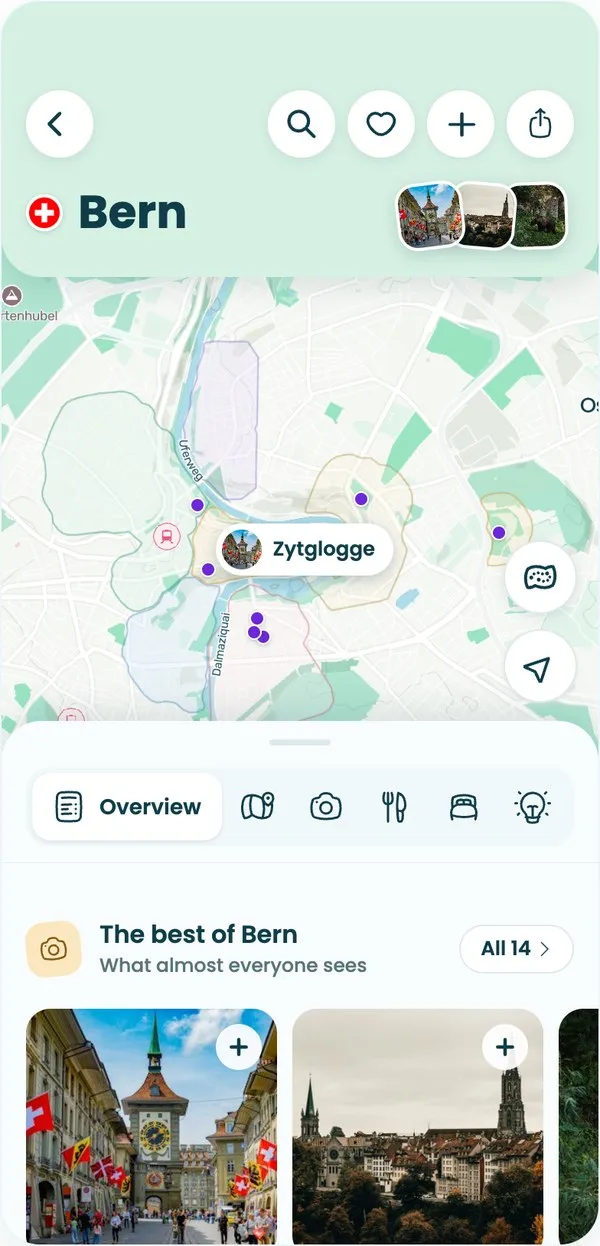
Bern in a nutshell
Updated October 2026 · Written by the Stippl editorsOur own data here is the 104,000+ stops travellers have planned across Switzerland on Stippl, Bern among them.
Bern earns a day or a night, because the whole UNESCO old town fits into one walk. The arcaded streets run east from the station on a bend of the Aare, past the Zytglogge's figures on the hour, the Münster tower, the Federal Palace and a line of Renaissance fountains, down to the BärenPark and the Nydegg bridge. Bern is on 9.7% of the Swiss trips planned on Stippl.
Bern is the stop people put in the middle of a Swiss route. On the Bern trips planned on Stippl that carry another Swiss destination, 49.7% put Bern neither first nor last. Bern trips are long Swiss trips, and a typical one takes in 3 Swiss destinations, with Lucerne and Interlaken added far more often than on Swiss trips in general.
One night between Zürich or Geneva and the Oberland is the right dose, or a long day with your bags in a station locker. The station sits at the western edge of the old town, Interlaken is under an hour away by train, and a night in the city includes the Bern-Ticket for trams and buses. Einstein's flat and the Zentrum Paul Klee fill a wet afternoon. Mountains outside the window and a big night out are an hour south; the city itself is calm and closes early.
 Bern
Plan Bern in Stippl
Day-by-day planning, stays and budget in one app, with every place from this guide already on the map.
Download the appFirst-timers on a Swiss circuit
Bern sits on the main rail line between Zürich, Lucerne, Interlaken and Geneva, and its old town, clock tower and cathedral fit into one day.
History and architecture lovers
Bern kept its medieval street plan almost intact, with sandstone arcades built after the fire of 1405 and Renaissance fountains along the main streets.
Einstein and art lovers
Einstein's flat on Kramgasse, the Einstein Museum and the Zentrum Paul Klee make a full day in Bern when the weather turns.
Summer river swimmers
On hot evenings the Bernese float down the Aare to the Marzili, a local habit for confident swimmers who learn the exit first.
Families with children
The BärenPark is free and open at all hours, and Kirchenfeld's museums, the Rosengarten and the Gurten hill fill a second day.
Travellers between two trains
Bern is the only Swiss stop on just 22.3% of its trips on Stippl, and station lockers make a few hours between trains easy.
Maybe not for you: mountain seekers, since the Alps are an hour away rather than outside the window; night owls, because the city is calm and closes early; and anyone with a week, which belongs in Interlaken or Lucerne.
Best time: May to September, and the old town works all year
River summer
Mid-June to August
The Aare is warm enough to float, the river pools open and the evenings run long on the Bundeshaus terrace. It is also the busiest stretch, and most summers now bring a heatwave or two.
Spring and autumn
April to May and September to October
The best light and the thinnest crowds, with the bears out of their dens and the Rosengarten in flower in May. The river is too cold for most swimmers.
Winter
November to March
Grey and cold, and the bears sleep in their dens, but the arcades keep rain and snow off the main streets. The Zibelemärit and the Christmas markets fill late November and December.
Add your Bern dates and we'll flag the weather
Stippl shows the season, crowds and prices for every stop on your route.
Everything in this guide is already in Stippl. Tell the planner how long you have and what you like: it builds the route, the days and the travel times, and you edit whatever you want.
The arcades from Zytglogge to Nydegg
Walk the four arcaded streets east from the clock tower to the Nydegg bridge, past the painted fountains. It is flat and covered, and takes about 90 minutes with stops.
The Zytglogge figures on the hour
Stand under the clock tower a few minutes before the hour to watch the mechanical figures, then book the guided tour inside for the clockwork and the 130-step view.
The Münster tower
Climb 344 steps to the top gallery of the cathedral tower for the whole old town and, on a clear day, the Oberland peaks. There is no lift, and entry is about €6.
The BärenPark and the Rosengarten
Walk down to the bears on the riverbank, free and open at all hours, then climb to the Rosengarten for the view back over the old town at sunset.
Einstein's flat and the museum
Give the small flat on Kramgasse, Einstein's home in his Bern years, about half an hour at opening time, then spend longer in the Einstein Museum inside the Historical Museum.
A summer float down the Aare
In July and August confident swimmers get in upstream at Eichholz or the Schönausteg and float about half an hour to the Marzili. Learn the exit first; there are no lifeguards.
Altstadt
Arcaded, sandstone, busy by day
The UNESCO core from the station to the Nydegg bridge, with the Zytglogge, the Münster and the fountains a few minutes apart. For first-timers and anyone staying one night.
Why visit: Everything on foot, and the busiest streets in the city.
Bahnhof and Länggasse
Practical, studenty, close to trains
The station quarter and the university district just west of it, with every train and the luggage lockers on the doorstep. For rail travellers with an early departure.
Why visit: The trains at your door, and a walk to the sights.
Kirchenfeld
Leafy, quiet, lined with museums
The residential quarter over the Kirchenfeld bridge, south of the old town, with the Historical Museum and the Tierpark close by. For families and longer stays.
Why visit: Calm nights and museums, but a bridge between you and the old town.
Bärengraben, Nydegg and Rosengarten
Riverside, hilly, old-town views
The old town's eastern end by the BärenPark, two river bridges and the hill up to the Rosengarten. For couples and anyone who wants the quieter end of the centre.
Why visit: The best view of the old town, and a steep walk back up.
Lorraine
Local, mixed, by the river
The north bank across the Aare, with apartments, a riverside pool and small restaurants away from the visitors. For budget stays and travellers who want a neighbourhood rather than a sight.
Why visit: Cheaper and local, but about 30 minutes on foot to the old town.
See every Bern neighbourhood on one map
Save the areas you like and Stippl plots your days so you're not crossing the city twice.
The Altstadt is the base: the station sits at its western edge, so you walk from the train to the room and on to every sight. Most Bern stops planned on Stippl are a single night (56.17%), and every overnight guest gets the Bern-Ticket for trams and buses, so a bed further out costs nothing extra to get around.
Historic three and four-star hotels above the arcades, about €185 to €265 a night, with a few five-star rooms higher.
Business hotels, two-star rooms and the city's budget beds near the station, from about €95 a night.
A few quiet hotels and apartments in residential streets, about €150 to €260 a night.
Bärengraben, Nydegg and Rosengarten
Small hotels and guesthouses at the old town's eastern end, about €150 to €260 a night.
Mostly apartments and a few small hotels, about €95 to €185 a night, the cheaper side of the centre.
Boiled and smoked pork cuts and sausage with sauerkraut or beans and potatoes, a meal for a hungry group, in the old town's traditional restaurants
Coarsely grated potato fried with bacon, often with an egg and cheese, the heartier version of the national dish
A warm onion tart, sold at stalls and bakeries on Zibelemärit, the fourth Monday of November
Crisp meringue with thick local cream, the Bernese dessert, at confiseries and cafés
From the old town's chocolatiers, in the city that claims the start of Lindt in 1879
From brewery taprooms and beer cafés, in a city billed as having more microbreweries than any other in Switzerland
Discover food spots in Stippl
Find restaurants and markets on the map, save them to your itinerary, works offline too.
Bundesplatz is a working square
The square before the Federal Palace holds the Tuesday and Saturday market, light shows and political rallies, so a fenced or crowded square usually means an event.
The main street is not car-free
Buses and trams still run through the arcaded streets of the old town, so look both ways when you step out from under the arches.
The bear is the city itself
The bear is on Bern's coat of arms, its shop signs and the fountain by the Zytglogge, and the keepers at the BärenPark enforce the feeding ban.
The Aare has its own rules
Swimmers and boaters follow separate signs along the river, the exit comes before the Dalmazibrücke, and nobody who grew up here takes the current lightly.
The clock sets the pace
Trains, trams and tours run to the minute, and the Zytglogge tour starts on time, so arrive a few minutes before it does.
Do
Don't
Budget
€106 to €158
A hostel or two-star room, a supermarket lunch, one cheap dinner, the free sights and the free Bern-Ticket transport.
Mid-range
€180 to €264
A three-star double, a restaurant meal a day, two paid sights and the Gurten funicular.
High-end
from €423
A four or five-star city hotel, restaurant dinners and private tours.
Typical prices
Track what you actually spend
Set a daily budget per country and log expenses in any currency while you travel.
Switzerland has never formally named Bern as its capital. The Constitution calls it the federal city, and the government sits here, which is why everyone treats Bern as the capital anyway.
Legend says Bern is named after a bear its founder caught. It was the first animal of his first hunt in the forest, and bears have been kept in the city for centuries since.
The BärenPark keeps a small family of brown bears on the bank of the Aare. The riverside park is far larger than the old bear pit beside it, and the bears roam right down to the water.
The fountain on the Bundesplatz has 26 jets, one for each canton. It plays on the square in front of the Federal Palace, the seat of the Swiss government.
The Marzili funicular is the shortest in Switzerland, climbing 32 metres. It joins the river quarter to the terrace beside the Federal Palace, and a single ride costs under €2.
Lindt chocolate was first made in Bern, in 1879 at the Wasserwerkgasse. Toblerone and Camille Bloch were also first made in the city, which keeps several chocolatiers in the old town.
The bed comes with a tram pass
Every overnight guest aged six and over in the city gets the Bern-Ticket, covering trams, buses and trains in zones 100 and 101 until five the morning after checkout.
Lockers make a no-night stop
On Stippl, 15.20% of Bern stops carry no night at all, and the station lockers hold bags for up to 72 hours between two trains.
Pad your train changes
The main station is being rebuilt, with platforms out of use, diversions in the underpass and roofs replaced at night, so give every change a few extra minutes.
Know the Marzili exit
Swimmers and boaters follow separate signs on the Aare, and the Marzili exit has to be taken before the Dalmazibrücke. Missing it is the classic mistake, and nobody is on lifeguard duty.
The Gurten is a tram ride away
Tram 9 reaches the Gurten funicular in about 20 minutes. The Bern-Ticket covers the ride up, while the Swiss Travel Pass only buys a reduced fare.
Drink from the fountains
Bern has about a hundred public fountains, and unless a sign says otherwise the water is drinkable, so a refillable bottle saves buying water all day.
Bern needs one night, and most Bern stops planned on Stippl are a single night (56.17%). A day covers the old town, the Zytglogge, the Münster and the Federal Palace, and the night adds the museums and the Rosengarten at sunset. A second night suits a trip out to Thun or up the Gurten.
Bern is rarely the first stop, because it is a middle stop more than a doorway. Only 39.5% of the trips that include Bern on Stippl make it the first Swiss stop, far fewer than for Zürich or Geneva, where the airports are. Most people reach Bern by train after one of them, on the line towards Interlaken and Lucerne.
A season ahead. Bern trips on Stippl are created 87 days before departure in the typical case, close to the Swiss pattern. Summer is the reason to plan early, since July and August are the busiest months in Bern and the Gurtenfestival fills the city in mid-July.
Start with the mountain base and put Bern on the line beside it. Lay the stops out in Stippl, with Bern as one night between Zürich or Geneva and Interlaken or Lucerne, and check what the days allow. That plan is worth putting in front of people who know Switzerland, in r/Switzerland or a Swiss travel group; mention your pace and your rail pass, and the answers get sharper.
Swimming the Aare in Bern is safe only for confident swimmers in summer. The river looks gentle at the Marzili and runs fast, cold and murky, with no lifeguards on the open water. Learn the exit before you get in, take it before the Dalmazibrücke, and never swim after heavy rain, alone or after drinking.
Rarely, because the bears in Bern's BärenPark sleep in their dens from about November to mid-March. The park itself stays free and open at all hours, and from spring to autumn the three bears are usually out along the riverbank below the old town. In winter the park's webcam is the likelier sighting.
Every guide is written by the Stippl editors and checked against the trips our travellers actually plan. Spotted something out of date? Let us know.
Day-by-day planning, stays and budget in one app, with every place from this guide already on the map.