

Florence
Florence is a Renaissance city that never grew, so the David, the Uffizi and the dome sit fifteen minutes apart on foot. Two nights, in the middle of the trip, and the hill towns in reach.
Florence in a nutshell
Florence: what to expect
This is what 59,000+ planned stops in the city on Stippl say about Florence.
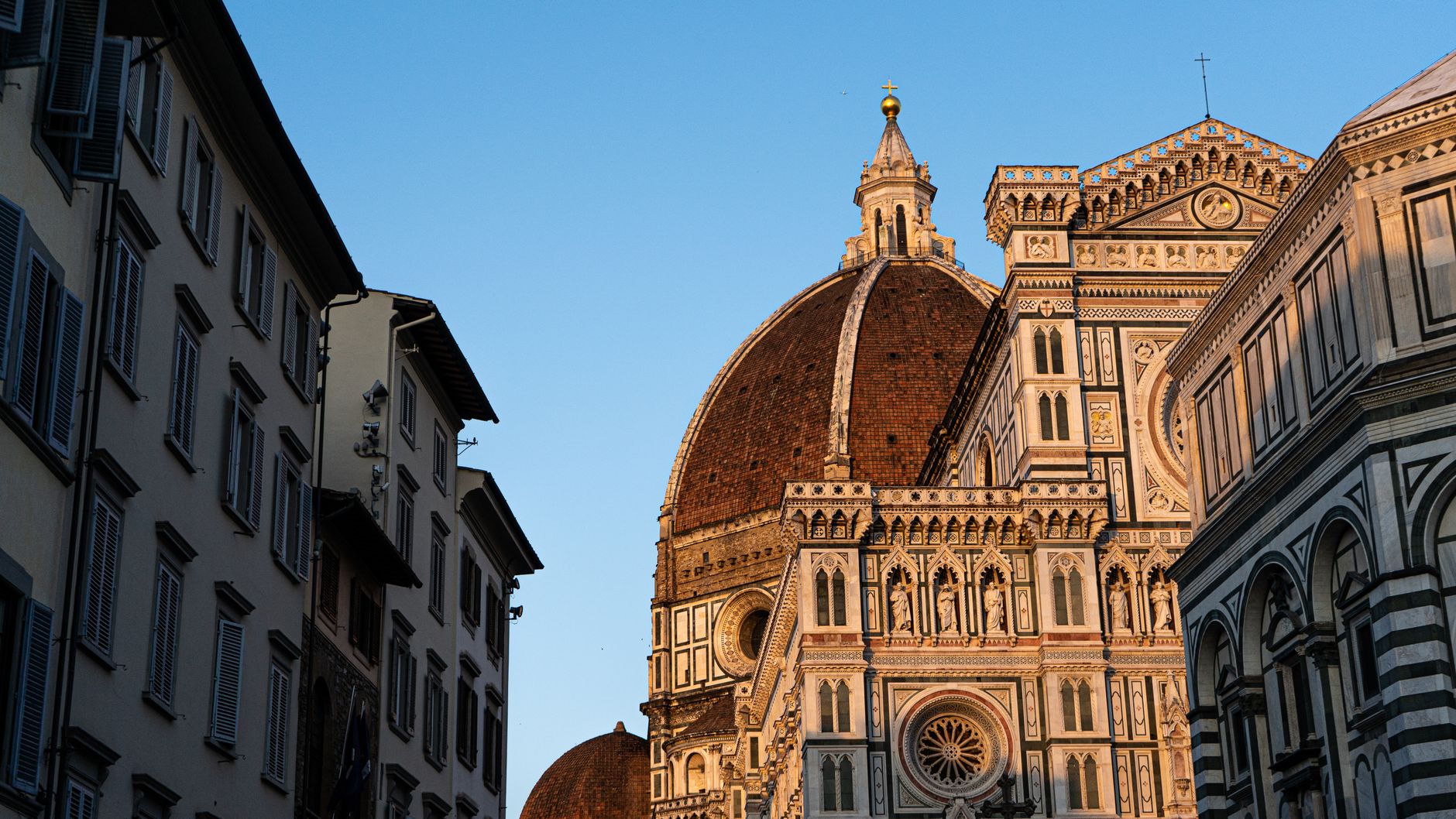
Florence is worth two nights, and the whole of it fits on foot. The historic centre walks end to end in half an hour, and the David at the Accademia, the Botticellis at the Uffizi and Brunelleschi's dome sit within fifteen minutes of each other. Eat bistecca alla fiorentina for two, lampredotto from a cart, and cross the Arno to the Oltrarno workshops. Most travellers give Florence 2 nights on Stippl, and it is the second most-planned place in Italy.
A Florence stop is the middle leg, never the door in or out. Florence opens only 8.0% of the Italy trips it appears on, planned on Stippl, and closes 6.4%, where Rome opens more than a third. 33.3% of Florence stops are exactly two nights, the clearest peak of any Italian city, which is what a leg between Rome and the north looks like.
Sleep in San Marco for value or across the river in the Oltrarno for a city with residents, and book the Uffizi, the Accademia and the dome before the room. All three run on timed slots and the dome has no walk-up at all. Give a third night to Siena or the hill towns, an hour out. Skip Florence in August, when the heat peaks and the family kitchens close for the holidays, and know that the core has banned outdoor tables since March 2026.
Plan Florence in Stippl
Day-by-day planning, stays and budget in one app, with every place from this guide already on the map.
Download the appWho Florence is for
Renaissance-art travellers
The David, the Birth of Venus and Brunelleschi's dome are within fifteen minutes of each other on foot, in the rooms they were made for.
Walkers
Florence is the one major Italian city where transport is genuinely optional, and the centre is largely pedestrian.
Meat eaters
Bistecca alla fiorentina, lampredotto and the Tuscan bread soups are a distinct kitchen from Rome's, and the steak is sold by weight for two.
Long-itinerary travellers
Florence trips carry more Italian stops than any other destination we measure, so this is the city long routes are built through rather than around.
Day-trippers into Tuscany
Siena, Pisa, Lucca and the hill towns are all inside an hour or two, with Pisa the commonest pairing.
Two-night planners
33.3% of Florence stops planned on Stippl are exactly two nights, the clearest peak in Italy, and two nights covers the art and the dome.
Maybe not for you: anyone coming in August, when the heat peaks and the family kitchens close for the holidays; and anyone who will not book slots, because the Uffizi, the Accademia and the dome all run on timed entry and the dome has no walk-up.
The best time to visit Florence
Cold and quiet
November to February
The wettest and cheapest months, with the shortest queues of the year at the Uffizi and the David. Bring a layer for the churches and the evenings.
The good months
March to May
Warm, long light, everything open, and prices below the peak until Easter. The Scoppio del Carro fills the cathedral square on Easter Sunday.
Peak heat
June to August
Hot and crowded, with the Calcio Storico in June and the city partly shut around Ferragosto in August. Book the early museum slots and keep the afternoons for the Oltrarno.
The second window
September to October
The heat breaks, the crowds thin, and the light is the best of the year. The slots still sell out, so book as if it were May.
- The Uffizi, the Accademia and the dome all run on timed slots, and the dome has no walk-up at all. Book the three before the room; a cheaper Uffizi slot exists after four in the afternoon if the budget matters.
- July is the month most travellers plan Florence for on Stippl, and 24.92% of Florence plans are made six months or more ahead. The summer weeks are the hardest for slots and rooms and the winter ones the easiest, in that order.
- Calcio Storico is played in Piazza Santa Croce in June, with the final on 24 June. Four teams for the four quarters, rules that permit most forms of violence, and the square closed for weeks either side; the same day is San Giovanni, with fireworks over the Arno.
- The Scoppio del Carro on Easter Sunday detonates a cart of fireworks in front of the cathedral. A mechanical dove lights it, the ritual has run since the twelfth century, and the square is full by mid-morning.
- Ferragosto on 15 August closes the family-run kitchens. Expect chiuso per ferie signs either side of it and plan the meals around the places that stay open, which are the ones aimed at visitors.
- Outdoor dining structures are banned in the UNESCO core from March 2026, Ponte Vecchio included. The tables inside stay, so a summer evening on a terrace means the Oltrarno squares or the hill up to San Miniato.
Add your Florence dates and we'll flag the weather
Stippl shows the season, crowds and prices for every stop on your route.
Describe your trip, get a Florence itinerary in seconds
Everything in this guide is already in Stippl. Tell the planner how long you have and what you like: it builds the route, the days and the travel times, and you edit whatever you want.
Things to do in Florence
 Photo by Jonathan Ansel Moy de Vitry via Unsplash
 Photo by Germán Rodríguez via Unsplash
 Photo by Simone Viani via Unsplash
The Uffizi
A purpose-built sixteenth-century office block holding the Botticellis in the room sequence they were arranged for. Take the first slot or the cheaper one after four; the middle of the day is the queue.
Michelangelo's David
At the Accademia, at the end of a corridor of unfinished slaves that is half the point of the visit. Book the slot; the David queue without one is the longest in the city.
Climbing Brunelleschi's dome
Four hundred and sixty-three steps inside a double shell, with no lift and a compulsory slot on the Brunelleschi Pass. Go early, before the stairwell warms up.
Piazzale Michelangelo at sunset
Free, twenty-five minutes uphill from Ponte Vecchio, and the view every photograph of Florence is taken from. Bring a bottle; the steps are the seating.
San Miniato al Monte
Further up the same hill, with Gregorian chant in the evening and almost none of the crowd. Time the walk so the chant and the sunset land together.
The Oltrarno workshops
Gilders, leatherworkers and restorers still trading in the streets behind Santo Spirito, ten minutes across the river and a different city. Go in the morning, when the doors are open.
The neighbourhoods of Florence
Duomo and Centro Storico
Cathedral streets, on foot
The cathedral and the streets around it, with the Uffizi, Palazzo Vecchio and Ponte Vecchio a few minutes' walk apart. For first-timers with the budget for the most expensive ground in the city.
Everything on foot, and the highest prices in Florence.
San Marco
Quiet, near the David
North, around the Accademia and the university: quiet at night, close to the David queue, and consistently the best value inside the walls. For budget travellers and light sleepers.
The best value inside the walls and the David next door, but a quiet evening.
Santa Maria Novella
Station streets
The station district: the most convenient arrival and departure, the tram to the airport, and the least charming streets in the centre. For early trains and one-night stops.
Every train and the airport tram at the door, but the streets nobody chooses for themselves.
Oltrarno
Workshops and residents
Across the Arno, around Santo Spirito and San Frediano: workshops, leather and gilding studios, the city's best evening square, and residents. For second visits and anyone who wants a Florence people live in.
The best evenings and a real neighbourhood, and ten minutes' walk to every sight.
Santa Croce and Sant'Ambrogio
Market and student bars
East of the centre around the basilica and the covered market: student bars, the lampredotto carts, and cheaper eating than the Duomo streets. For food travellers and nightlife on a budget.
Cheaper eating and the market at the door, but student bars under the window.
See every Florence neighbourhood on one map
Save the areas you like and Stippl plots your days so you're not crossing the city twice.
Where to stay in Florence
Sleep inside the walls in San Marco for value or across the river in the Oltrarno for a city with residents; the Arno is ten minutes wide on foot, so both put every sight in reach. Most travellers give Florence 2 nights on Stippl, and new short-term rentals are banned in the historic centre, so the apartment you find is an existing one and the hotels fill first in summer.
Duomo and Centro Storico
Restored palazzo hotels and B&Bs around the cathedral, €180 to €400 a double.
San Marco
Hostels and simple hotels near the Accademia, from €30 a dorm bed to €130 a double.
Santa Maria Novella
Business hotels and budget rooms by the station, €90 to €170 a double.
Oltrarno
Small hotels and existing apartments across the river, €120 to €250 a double.
Santa Croce and Sant'Ambrogio
Guesthouses and apartments near the market, €100 to €200 a double, lively at night.


What to eat in Florence
A thick T-bone from Chianina cattle, grilled rare over wood and sold by weight. Ordered for two or more, and never well done
The cow's fourth stomach, slow-simmered and served in a bread roll with salsa verde. Florence's own street food, from carts called trippai
Flat, salty, olive-oiled bread split and filled: the Florentine sandwich, and a different thing from focaccia
Bread and bean soup, reboiled, Tuscan peasant cooking built on stale bread
The summer version: tomato and stale bread cooked to a thick porridge
Chicken-liver pâté on toast, the standard Tuscan antipasto
Almond biscuits dipped in sweet wine, the way a Tuscan meal ends
Discover food spots in Stippl
Find restaurants and markets on the map, save them to your itinerary, works offline too.
Florence customs and what not to do
Bistecca comes rare
Bistecca alla fiorentina is served rare by definition, sold by weight and ordered for two or more, and asking for it well done is refused as often as it is accommodated.
Coperto is a cover charge
The per-person cover charge on the bill goes to the restaurant and is neither a tip nor a service charge; leave coins if the service was good.
Cover up for the churches
Shoulders and knees covered is enforced at the Duomo and at Santa Croce, so a scarf in the bag saves a refused entry in summer.
Say buongiorno first
Walking into a shop or bar without a greeting reads as rude, and buonasera takes over from late afternoon.
Groups are capped at forty
Guides may no longer use loudspeakers and tour groups are capped at forty people, both to thin the congestion in the core, so a small-group or private tour moves faster.
Do
- Book the Uffizi, the Accademia and the dome before you book anything else
- Take the cheaper Uffizi slot after four in the afternoon if the budget matters
- Walk up to Piazzale Michelangelo, and then keep going to San Miniato
- Eat lampredotto standing at a cart at least once
Don't
- Drive into the centre; the ZTL cameras are automatic and the fines follow you home
- Order the bistecca for one, or well done
- Expect to book a new apartment in the historic centre; only existing ones are allowed
- Queue for the dome without a slot; you will not get in
What a Florence trip costs
Budget
€60–95
A hostel bed in San Marco, schiacciata and lampredotto, one ticketed museum.
Mid-range
€150–240
A three-star or B&B in the centre, sit-down lunches, the Uffizi and the dome.
High-end
€400–900+
A hotel on the Arno or in a restored palazzo, booked restaurants, private guides.
Track what you actually spend
Set a daily budget per country and log expenses in any currency while you travel.
Fun facts about Florence
The dome Brunelleschi raised is still the largest masonry dome ever built. It was raised in the fifteenth century without a supporting framework, between two shells that the climb passes through.
Florence banned new short-term rentals in its historic centre in 2023. It was one of the first European cities to do so, and existing operators are protected only until the end of May 2028.
Outdoor dining structures are banned in the UNESCO core from March 2026. Ponte Vecchio is included, alongside bans on key boxes and on guides' loudspeakers, all aimed at the congestion in the centre.
Calcio Storico has been played in Piazza Santa Croce since the sixteenth century. Four teams for the four historic quarters, with rules that permit most forms of violence, and the final on 24 June.
Bread in Tuscany has no salt in it, by tradition. That is why the region's soups, ribollita and pappa al pomodoro, are built on stale loaves rather than fresh ones.
Lampredotto is the fourth stomach of the cow, sold from Florentine carts called trippai. Slow-simmered and served in a bread roll with salsa verde, it is the city's own street food and costs a few euros.
Local tips for Florence
Transport is optional
The historic centre is small and largely pedestrianised, so most visitors never take a bus; the one exception is the T2 tram from the airport, about €2 and twenty minutes to the centre.
Rome is eighty minutes away
The fast train does Florence to Rome in about an hour and twenty minutes, which is why seven Florence trips in ten carry Rome; book the train for the price, not the seat.
Pockets go at the station
Florence is a safe city and the real risk is pickpocketing, concentrated around Santa Maria Novella station, the Duomo and Ponte Vecchio; the bag goes in front in those three places.
Walk the centre at night
The centre is comfortable to walk after dark, including for solo travellers, with the station district the usual exception.
Pisa is the partner, not Rome
Pisa is the commonest pairing for Florence, an hour by regional train, and it is a half-day rather than a night; the tower is the visit and the station is the base.
Two nights, in the middle
Most travellers give Florence 2 nights on Stippl, and it opens only 8.0% of the Italy trips it is on, so it is the leg after Rome and before the north.
Florence questions, answered
Because the art fits in two days and the city sits between other stops: 33.3% of Florence stops planned on Stippl are exactly two nights, the clearest peak of any Italian city, and most travellers give it 2 nights. Day one is the Uffizi and the dome, day two the David, the Oltrarno and the hill at sunset.
The Uffizi, the Accademia and the Duomo dome, all on timed slots, and the dome has no walk-up at all. The cathedral itself is free and needs nothing; the dome, baptistery, campanile and museum sit on one pass with the dome slot compulsory, and a cheaper Uffizi entry exists late in the afternoon.
A middle, almost always: Florence opens only 8.0% of the Italy trips it appears on, of everyone who plans Florence on Stippl, and closes even fewer, where Rome opens a third. Put Rome first and Florence second in Stippl, give the north what is left, and then show the route to people who have been, in subreddits like r/ItalyTravel.
Only an existing one. New short-term rentals have been banned in the historic centre for several years and the existing operators are on borrowed time, so the apartment supply is fixed and the hotels fill first in summer. The Oltrarno and Santa Croce are where the existing apartments cluster.
Piazzale Michelangelo, free, twenty-five minutes uphill from Ponte Vecchio, and the view every photograph of the city is taken from. Keep climbing to San Miniato al Monte for the same view with a tenth of the people and Gregorian chant in the evening; time the walk so the chant and the sunset coincide.
Almost everyone does: seven Florence trips in ten carry Rome in the Italy trips people build on Stippl, and the fast train takes about eighty minutes. Rome takes three nights and Florence two, in that order, and 28.0% of Florence stops are a single night, which is the Rome-and-a-night version and the one to avoid if the art is the point.
Every guide is written by the Stippl editors and checked against the trips our travellers actually plan. Spotted something out of date? Let us know.
Plan Florence in Stippl
Day-by-day planning, stays and budget in one app, with every place from this guide already on the map.
Download the app