
The short version: a pickup from Ubud between 1:30 am and 2:30 am, about an hour and a half in the car each way, climbing from around 3 am, roughly two hours up in the dark, and a summit at 1,717 m on the rim of an active volcano. Call it four hours on the mountain and most of a night and a morning in total. Whether that is worth it comes down to three things, and the third one is the weather.
Plan Indonesia in Stippl
Day-by-day planning, stays and budget in one app, with every place from this guide already on the map.
Download the appWhat the Mount Batur sunrise trek actually involves
Here is the whole night, laid out. Every timing below assumes you are starting from Ubud, which is where almost everyone starts from.
| Pickup from Ubud | between 1:30 am and 2:30 am |
| Drive to the mountain | about 1 hour 30 minutes |
| Climb starts | around 3 am |
| Time to the top | roughly 2 hours, in the dark |
| Summit | 1,717 m, on the rim of an active volcano |
| At the top | breakfast cooked in the volcanic steam |
| On the mountain | about 4 hours round trip |
| On the way down | the hot springs, if your tour includes them |
| Drive back | about 1 hour 30 minutes |
The thing that surprises people is not the climb. It is that the whole night has to be spent to get four hours of mountain. You go to bed at nine, you are collected before two, and you are back in Ubud with the rest of the day gone to a nap. Build a soft day around it on both sides.
How hard is it, really?
Two hours up, four hours on the mountain in total. That is the honest measure, and it is a walk rather than a climb: no ropes, no scrambling, no technical anything.
What makes it harder than those numbers suggest is that you do it on no sleep, in the dark, by torchlight, with a group moving at one pace. The descent is the part people mention afterwards. It is done in full daylight after a night awake, on the flank of a volcano, and knees that grumble on stairs will grumble here.
Segmenting it honestly:
- If you walk regularly, this is a straightforward outing and the difficulty is the hour, not the gradient.
- If you never walk uphill at home, it is a real effort but a manageable one, and groups move slowly by design because they are pacing to the sunrise rather than to a finish line.
- With teenagers, fine. With small children, the 2 am start is the obstacle rather than the mountain.
- If your knees are the weak link, the descent is the bit to think about, not the ascent.
There is a second Balinese volcano worth knowing about while you are thinking in these terms. Mount Agung is the island's highest peak and it is active: its eruptions between 2017 and 2019 closed Ngurah Rai airport repeatedly. It is quiet at the time of writing, and it is checkable, which is more than can be said for most travel worries.
What it costs
A tour booked in Ubud typically comes to about €42. That is from what travellers who plan with Stippl actually paid, and it is a useful anchor because Ubud is where this trip is sold. Sights and tours in Ubud tend to run a fifth cheaper than the same category does across Indonesia as a whole, which is worth knowing before you accept the first price a villa desk quotes you.
Two costs sit outside the tour price.
The Bali tourist levy is €7.30 (150,000 IDR) per person, a one-off for the island rather than anything to do with the mountain. It is cashless and it is paid at lovebali.baliprov.go.id. Do it before you arrive rather than in a queue.
Getting yourself to Ubud if you are not already there. A private driver for a day runs €27 to €73 (550,000 to 1,500,000 IDR), a Grab or Gojek motorbike hop around Ubud is €0.75 to €1 (15,000 to 20,000 IDR), and a rented scooter is €2.45 to €4.90 (50,000 to 100,000 IDR) a day.
One warning on that last one, because it is the commonest way visitors get hurt on this island. Indonesia requires a motorcycle licence plus an International Driving Permit, Balinese traffic police check both at roadside stops in tourist areas, and rental shops do not. Fines start around €14.60 (300,000 IDR) per missing document, and far more consequentially, riding unlicensed voids most travel insurance. Whatever you decide about scooters in general, do not ride to a trailhead at two in the morning to save the transfer.
Do you need a guide?
You go with a guide. Every account of this climb describes it the same way, as a guided group climb starting around three in the morning, and that is how the trip is sold, so in practice the question is which tour rather than whether.
The reasons are not mysterious once you picture it. You are on the flank of an active volcano, in complete darkness, three hours before dawn, on ground you have never seen in daylight, moving to a schedule set by the sun. The guide carries the light, sets the pace and knows where the rim is.
We do not name operators here, and that is deliberate rather than coy. No Batur operator is corroborated in our own sourcing, and adventure operators on Bali are covered almost entirely by aggregators and by the operators themselves, which means every recommendation you read is advertising until proven otherwise. Book through your accommodation or through a platform, read recent reviews rather than the cheapest listing, and check what is actually included before you pay: the hot springs and the breakfast are sometimes in the price and sometimes not.
What to wear at 1,717 metres in the tropics
This is the part people get wrong, because everything else about Bali argues against it.
Ubud already sits at about 200 m and is a few degrees cooler than the coast, and that is the difference people notice when they arrive from Canggu in a t-shirt. The rim of Batur is roughly 1,500 m above Ubud, you get there in the dark, and then you stand still for the best part of an hour waiting for the light. Standing still in the dark at altitude is a completely different proposition from walking uphill in it.
So: something warm you can put on at the top and take off on the way down, and something windproof over it. Closed shoes with a sole that grips, because the descent is the demanding half. A head torch if your tour does not provide one. Water. And a bag you can climb with rather than carry.
Leave the flip-flops in the villa. That is not a style note.

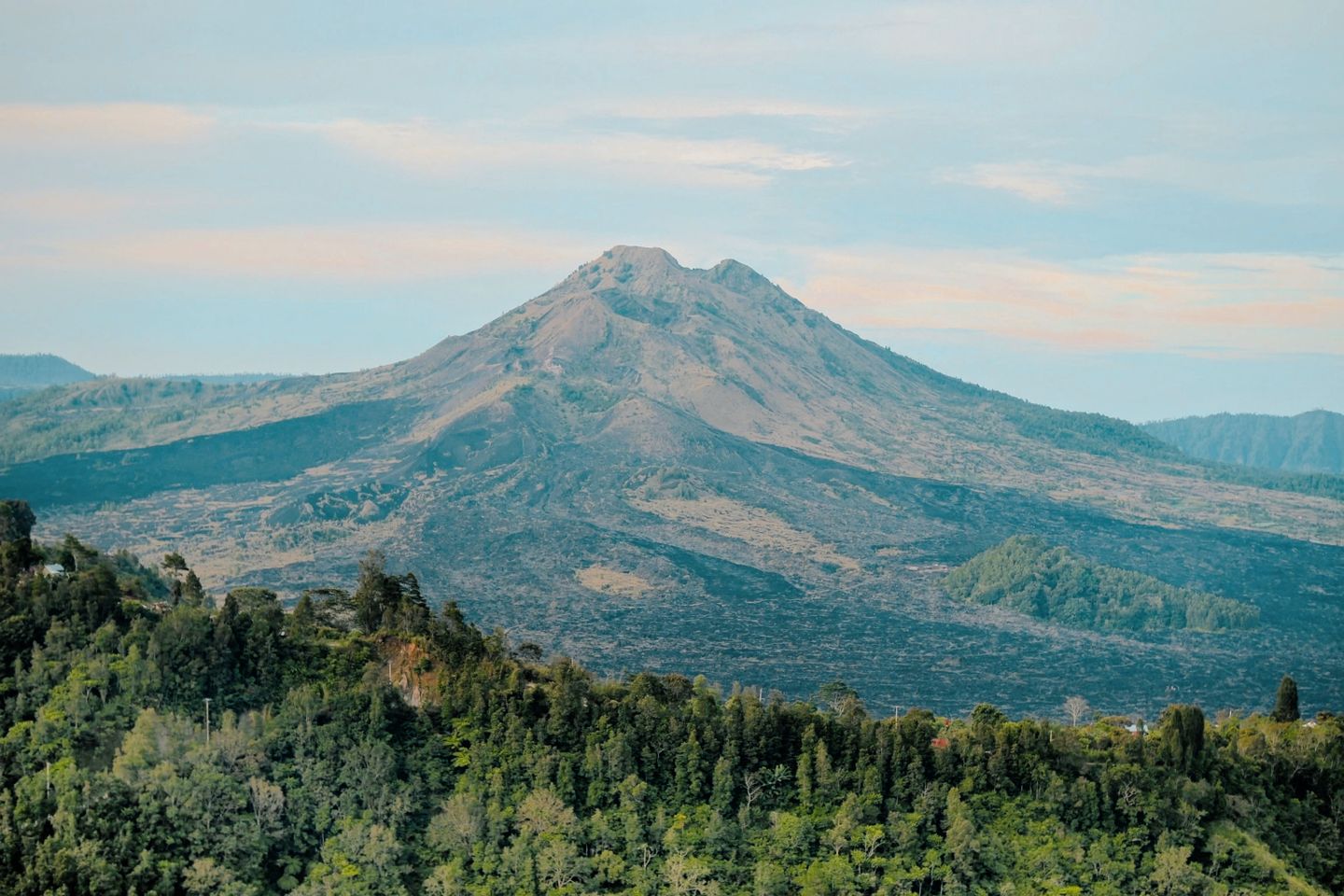
That photograph is the thing you are getting up for: the view from Batur across to Agung, with the cloud below you rather than above you.
Will you actually see the sunrise?
Sometimes not, and the month you go changes the odds more than anything else you can control.
The important fact is one that almost nothing written about this trek mentions: Bali's interior and Bali's coast have genuinely different weather, and Batur is in the interior. The interior takes around 2,400 mm of rain a year against the coast's 1,642. It turns wet a month earlier and dries out a month later. So a forecast for Seminyak or Canggu is not a forecast for the mountain, and a dry week on the beach can sit next to a cloudy fortnight up there.
Here is the interior's own rainfall, which is the number that matters:
| Month | Rain in the interior | What that means for a summit |
|---|---|---|
| December to February | 364 to 410 mm | the wettest stretch of the year, and the interior is at its worst |
| March | 336 mm | still firmly wet |
| April | 218 mm | the coast is dry by now, the interior is not |
| May to June | 75 to 111 mm | the interior comes good, and the crowds have not arrived |
| July to August | 41 to 63 mm | the driest of the year, and August is the floor |
| September to October | 62 to 99 mm | dry, quieter than August, prices coming down |
May, June and September are the sweet spot: dry on the mountain, and without July and August's crowds and prices. August gives you the best odds of a clear rim and the worst odds of having it to yourself.
None of that is a guarantee. Batur makes its own weather and a clear month still produces grey mornings. What the table gives you is a way to stack the odds rather than a promise, and a reason to book it early in your stay rather than late.
Read more: things to do in Bali
Where to book it from: Ubud, not the beaches
Ubud is the base for this, and the drive time is why. An hour and a half each way from Ubud is already a long night. From Canggu, Seminyak or the Bukit it is longer at both ends, on roads that turn a short distance into a long one, and you are adding that to a 2 am start.
Our own trip data says the same thing from a different direction. Mount Batur is one of the five places most strongly tied to an Ubud trip, and every one of those five is somewhere you reach from Ubud rather than somewhere you visit alongside it: Munduk, Batur, Amed, Sidemen and Lovina, the inland and eastern circuit. Ubud's real advantage over Canggu or Uluwatu is not the town, it is the radius.
An Ubud stop typically runs three nights, and only about one in eight is a single night against roughly one in four across Indonesia. People do not pass through Ubud, they settle in it, and three or four nights is exactly the shape that lets you put Batur on one morning and still have a day either side.
If the 2 am start defeats you, Ubud has two sunrise alternatives that cost nothing and need no tour. The Campuhan Ridge Walk is a 2 km path starting beside Pura Gunung Lebah, running above two river valleys and out into rice country, and it is free. The Tegallalang rice terraces are 20 to 25 minutes north, and the whole trick there is being on the path before 10 am, ideally at first light. Neither is a volcano. Both are worth the alarm.
Read more: things to do in Ubud
Describe your trip, get a Bali itinerary in seconds
Everything in this guide is already in Stippl. Tell the planner how long you have and what you like: it builds the route, the days and the travel times, and you edit whatever you want.
Frequently asked questions about Indonesia
It is worth it if you can be relaxed about losing a night's sleep and about the possibility of cloud. You get a 1,717 m volcano rim at first light, breakfast cooked in volcanic steam and hot springs on the way down, for around €42 and one broken night. If you have only three days on the island, skip it.
Moderate. Roughly two hours up and about four hours on the mountain in total, walking rather than climbing, with no technical sections. The difficulty comes from doing it in the dark on no sleep, and the descent asks more of your knees than the ascent asks of your lungs.
A tour booked in Ubud usually comes to about €42. On top of that sits Bali's tourist levy at €7.30 (150,000 IDR) per person, which is a one-off for the island rather than a mountain fee, and your transport to Ubud if you are staying elsewhere.
In practice, yes. The climb is sold and done as a guided group climb starting around 3 am, and there is no sensible version of walking up an active volcano in the dark on your own. Book through your accommodation or a platform, and check whether the hot springs and breakfast are included.
May, June and September, for dry weather on the mountain without July and August's crowds. August has the lowest rainfall of the year in the interior at around 41 mm and the best odds of a clear rim, but it is peak season. December to March is the wet season inland and the least reliable time to go.
Working out where a 2 am volcano fits in the rest of the trip? Put Ubud and Mount Batur into a Stippl trip and it works out the travel times, the nights in each place and which morning you can afford to lose. Free forever.