

Plan Indonesia in Stippl
Day-by-day planning, stays and budget in one app, with every place from this guide already on the map.
Download the appWhen is the best time to visit Bali?
May, June and September are the best months to visit Bali. All three sit inside the dry season, rainfall on the south coast drops to between 42 mm and 111 mm a month, and the July to August crowd has either not arrived yet or has just gone home. April and October are the good shoulders. December and January are the ones to avoid: the wettest weeks of the year land on the dearest.
Where you fly from changes the sting of that, not the answer. Bali sits eight degrees south of the equator, so it has no summer or winter of its own, just a wet half and a dry half. That dry half is the Australian winter and the northern hemisphere summer at the same time, which is lucky if you are flying from Perth and expensive if you are flying from Manchester.
What are Bali's two seasons actually like?

The dry season runs May to September, with April and October as the shoulders either side. This is the window every guide points at, and it earns it: August is the floor at 42 mm on the south coast and 41 mm inland, which is close to nothing.
The wet season runs November to March. It is not the all day drizzle a British or Melbourne winter trains you to expect. Rain here arrives as heavy bursts of thirty to sixty minutes, usually morning and evening, and the sky often clears in between. What makes January hard is not the intensity but the frequency: 21 rain days in the month, and at that rate "short shower" stops being much of a comfort.
Two details do more work than the headline seasons.
The interior is a different climate from the coast. Ubud takes about 2,400 mm of rain a year against the south coast's 1,642 mm, it turns wet a month earlier and it dries a month later. In April the south coast is already dry at 131 mm while the interior is still on 218 mm. If your trip is built around rice terraces and waterfalls rather than beaches, shift your dates a fortnight later than the beach crowd does.
Temperature is not the variable. Daytime highs sit between about 26°C and 29°C every month of the year, and the coolest month is July, in the middle of the dry season. Nobody picks a Bali month for the temperature. You are choosing between rain, sea state, crowds and price.
Does your own holiday calendar fit Bali's good season?
Mostly it does, and the exceptions are worth knowing before you book.
From Australia. The four NSW school holiday windows are a fair proxy for the country: a fortnight in April, the first half of July, the back end of September into early October, and the long break from mid December to late January. Three of those four are genuinely good Bali dates and one is the worst fortnight of the year. The flight is the short one, about six hours from Perth or Darwin, so a ten day trip works here in a way it does not from anywhere else on this list.
From the UK and Europe. The English school holidays and the Dutch, German and French summer breaks all sit between mid July and the end of August, and that lands you squarely inside Bali's driest, dearest, busiest weeks. The weather will be excellent and you will pay for it twice, once in the room rate and once in the airfare. If your dates move at all, June and September are the same season for noticeably less money. Easter is the other good one: April is dry on the south coast, low season rates are still in place, and the crowd has not landed.
From the US and Canada. Same calendar shape as Europe and the same trap: the June to August break is dry and expensive, and the late May weeks just before it are the best value in that half of the year. Thanksgiving lands in November, which is when the rains return properly.
Here is where our own numbers earn their place. Across 128,306 Indonesian trips planned in Stippl, September is the most planned month and December is the least, and the gap between them is 2.18 times. That curve was built from what travellers put in their planner, with no weather data anywhere near it, and it lands on almost exactly the same answer as the rainfall series: best in September, worst in December. Two things measured separately, agreeing.
The interesting part is where the two disagree. January is our second busiest planning month, and January is the wettest month on the island. That is not travellers getting it wrong. It is travellers buying the summer school holidays, which is a completely reasonable trade if you know what you are trading. If January is your only window, it is a different trip rather than a spoiled one, and we have written a full guide to what a Bali rainy season trip is actually like, publishing alongside this one.
One more planning number: most people book this trip about twelve weeks out, and nearly a quarter of Bali trips are on the calendar six months ahead. Twelve weeks is fine from Australia. It is late from Europe or North America in July and August, when the long haul fare is doing most of the damage. For those weeks and for the Christmas fortnight, six months ahead is the right instinct rather than an anxious one.
Bali month by month

Rainfall below is the modelled monthly average for the south coast first and the interior second, so you can see the gap between a Canggu holiday and an Ubud one.
| Month | Rain, coast / interior | Crowds and prices | Worth knowing |
|---|---|---|---|
| January | 296 / 410 mm | Busy early, holiday rates into the first week | The wettest month on both halves of the island |
| February | 244 / 364 mm | Quiet, and the cheapest rooms of the year | Still properly wet, but the best value on the calendar |
| March | 210 / 336 mm | Quiet | Rains taper late. Nyepi closes the island and the airport |
| April | 131 / 218 mm | Quiet, low season rates | The south is dry a month before the interior is |
| May | 74 / 111 mm | Quiet | The consensus best month: dry, calm seas, still cheap |
| June | 57 / 75 mm | Filling up | Dry and clear, and peak has not started |
| July | 53 / 63 mm | Peak, and dear | Driest and coolest, and the busiest roads of the year |
| August | 42 / 41 mm | Peak, and dear | The driest month by a distance |
| September | 53 / 62 mm | Quiet again, prices falling | The strongest shoulder month on the island |
| October | 68 / 99 mm | Comfortable | Hottest daytime highs, first rains late in the month |
| November | 154 / 248 mm | Quiet | The wet season arrives properly |
| December | 260 / 373 mm | Busy and expensive | Peak rain and Christmas rates at the same time |
Which month suits what you came for?

If you surf. Bali's two coasts run opposite seasons, which is the most useful sentence in this article for a surfer. The west and south west, meaning Canggu, Kuta and the Bukit, work in the dry season, with the most consistent swell from May to September. From December to February the wind at Uluwatu turns onshore and the swell goes flat. If you are learning rather than charging, the reverse applies: Kuta's beach break is more consistent in the wet season, October to April, and that is the one genuinely good reason to book a January surf trip.
If you dive or you are going to the Nusas. May to September. Calm seas, the best underwater visibility of the year, and the crossing from Sanur to Nusa Penida is a comfortable 35 to 45 minutes rather than a lottery. The mola mola window at Nusa Penida opens in July and closes in October, so a September trip catches the sunfish and the quiet at once.
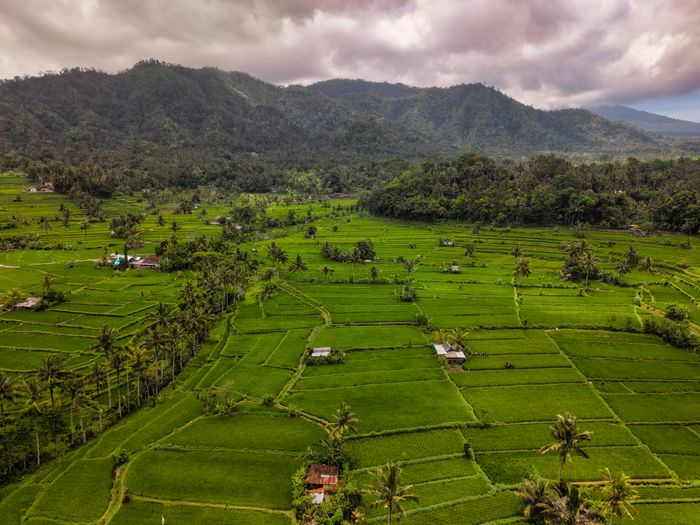
If you came for the green. Bali harvests rice about three times a year, so there is no single window when the terraces are green and no window when they are brown. April is the sweet spot anyway: the dry season is opening, the landscape has just had the wet season's water, and low season rates are still in place.
If you are watching the budget. February has the cheapest rooms of the year and the rain to explain them. September is the better trade, with prices already falling from the peak while the weather still holds.
If you want the island to yourself. There is no such month, but there is such a place. The tourist economy is concentrated in a triangle between Canggu, Ubud and Uluwatu that covers about a fifth of the island. Munduk, Amed and Sidemen are ninety minutes away and are quiet in every month on the table above.
Which dates override the weather entirely?
Three things on the Balinese calendar matter more than rainfall, and one of them can stop you flying.
Nyepi, the Day of Silence. For 24 hours in March the entire island stops. Nobody leaves their accommodation, the roads close, the shops and restaurants shut, and Ngurah Rai airport closes completely, with no flights in or out. Hotels cannot check anyone in or out that day either. The date is set by the Balinese Saka calendar and moves every year, and reputable sources currently disagree about the 2027 date, so confirm it before you book anything in March. Booking across Nyepi is fine. Booking into it is not.
The night before Nyepi is the opposite of it. Ogoh-Ogoh parades carry giant demon effigies through every village and burn them, and most people who have seen it rate it as the reason to be there rather than an inconvenience. Roads island wide are congested or closed, so travel in the morning if you have to travel at all.
Nyepi Laut, if you are crossing to the Nusas. The islands have their own sea silence day, when no boat sails to, from or between Penida, Lembongan and Ceningan and no diving or snorkelling is permitted. It is set by the Balinese calendar and moves, and the next occurrence falls in late September, which is squarely inside the best month of the year. Confirm the date with your boat operator before you book a late September crossing.
Two smaller ones: Galungan and Kuningan fall on a 210 day cycle and so land twice in most years, filling the roads with penjor bamboo poles and the temples with worshippers, and 17 August is Independence Day, with parades nationwide.
What does the season change about the cost?
Less than you might think on the fixed costs, and a lot on the moving ones.
The fixed ones do not care what month it is. Bali's tourism levy is €7.30 (IDR 150,000) per person, paid cashless before or during your stay at the official Love Bali portal, and it is separate from the visa. Visa on arrival covers Australian, British, EU, US and Canadian passports at €24.40 (IDR 500,000) for 30 days.
The biggest moving cost is the one that never appears in a Bali guide, because it is spent before you get there. From the Netherlands there is no direct flight: about 18 hours each way with one stop, and tickets quoted at €1,000 to €1,500 per person in the summer holiday weeks, which is roughly what a fortnight on the ground costs. February is the cheapest month to fly in and also the second wettest, the same trade the calendar keeps offering you. From Australia the fare barely moves, so it is the room your dates are really buying.
The other moving costs are the room and the car. February is the cheapest month of the year for accommodation and July, August and the Christmas to New Year fortnight are the dearest, and the gap is wide enough to be worth shifting dates for. A private driver, which is the island's real transport system because there is no useful public transport, runs €27 to €73 (550,000 to 1,500,000 IDR) for a ten hour day including fuel and parking, and rates go up twice a year: once for the July to September peak, and again in the rains, because the roads congest and the same trip takes longer.
Ten to fourteen nights is the right length for a first island trip whenever you go, split across two or three bases at three to four nights each. That last part matters more in the wet season than the dry, because a rainy afternoon in traffic is the worst hour of anybody's holiday.
Read more: things to do in Indonesia
Frequently asked questions about Indonesia
May, June and September, and September is the one we would pick. Rainfall sits at 53 mm on the coast and 62 mm inland, the July and August crowd has gone, room rates are falling, and it is the most planned month among travellers who plan their trip with Stippl.
December, and it is not close. It brings 260 mm of rain on the coast and 373 mm inland, the roads flood, and Christmas and New Year rates land on top of it. January is wetter still but slightly cheaper once the first week has passed.
Yes, if you plan for it rather than around it. Rain arrives in bursts rather than all day, February has the cheapest rooms of the year, and the island is genuinely quiet. What changes is the sea, the boats and the west coast beaches, which is enough to be worth reading up on before you commit to the dates.
February. It is the second wettest month and the quietest, and accommodation prices reflect both. If you want cheap without the rain, September is the compromise, with prices dropping while the dry season still holds.
Bali's dry season is the Australian winter, so April through October all work. Of the four school holiday windows, the late September to early October break is the best of them, April is next because the south coast is dry before the interior, and the July break lands inside the crowd and price peak.
Once you know your month, the rest is sequencing: which base first, how many nights each, and how much driving sits between them. Build it as a Stippl trip and you can move a stop around and watch the travel times redo themselves, or start from a prompt in the AI trip planner and edit from there. Free forever.