

Sidemen
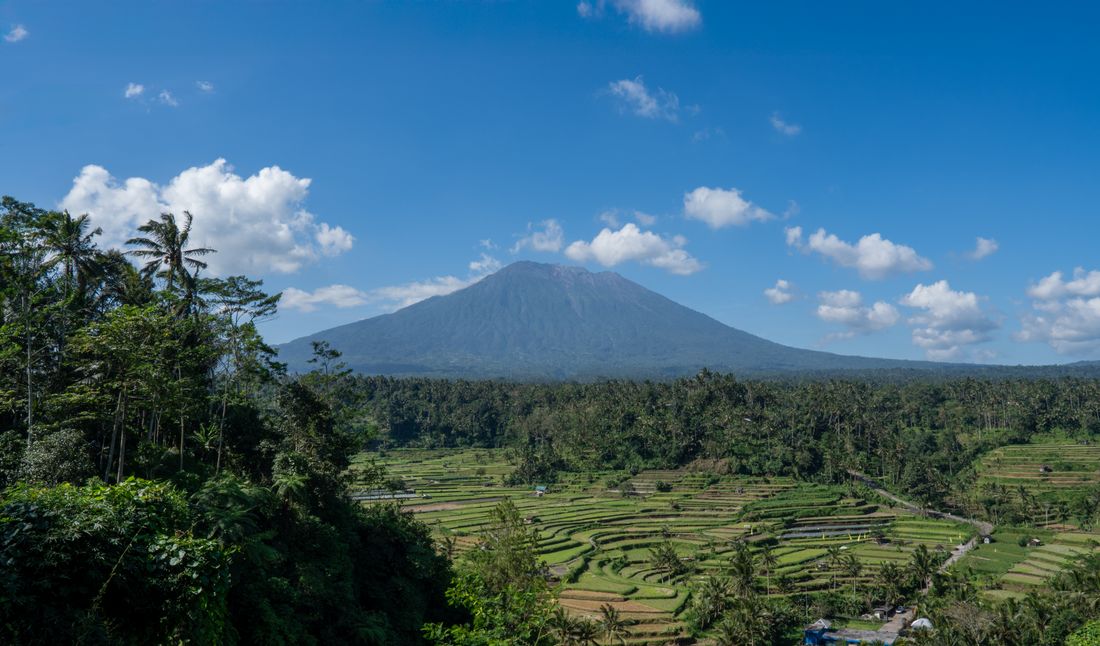
Sidemen is ninety minutes east of Ubud and a century behind it, with terrace walks that take hours and the finest view of Agung on the island. Gold thread still goes onto handlooms in the village.
Sidemen in a nutshell
Sidemen: what to expect
The figures here sit on 688,000+ planned stops across Indonesia on Stippl.
Sidemen is a working rice valley in east Bali, ninety minutes from Ubud, under Mount Agung. The terraces here are farms rather than a viewpoint with a ticket booth, and you walk the irrigation paths between them for hours rather than minutes. Songket, silk woven with gold and silver thread, is still made on handlooms in family workshops in the village. Gembleng waterfall is twenty minutes away, the morning market runs until about nine, and Agung stands over all of it.
Sidemen has the tightest rhythm in the country: almost nobody stays long. Fewer than two stops in a hundred here run five nights or more, against four on Nusa Penida, and one Sidemen trip in ten opens on the valley. Almost half of them also carry Munduk, four hours away on the other side of Bali, which makes the pairing one of the strongest in Indonesia.
Use 2 nights here as a base for east Bali. Tukad Cepung, Besakih on Agung's slope, Tirta Gangga, Taman Ujung and Pura Lempuyang are all twenty to sixty minutes by road and none of them is in the valley. Come April to October, when the paths are dry and the volcano is out. Skip Sidemen if you want restaurants, nightlife or a beach, because the valley has none of them.
Plan Sidemen in Stippl
Day-by-day planning, stays and budget in one app, with every place from this guide already on the map.
Download the appWho Sidemen is for
Walkers
The terrace paths are the attraction and they take hours rather than minutes.
Anyone who found Ubud too busy
Sidemen is where people go next, ninety minutes east, and most give it 2 nights.
Craft travellers
Songket weaving happens in the village itself, and there is silversmithing beside it.
Photographers
Agung over the terraces in the dry season is the finest view of the volcano on the island.
Families and slow travellers
Quiet, cheap, and nothing that needs booking, which is rarer in Bali than it sounds.
Maybe not for you: anyone wanting nightlife, restaurants or shopping, none of which exists; anyone on a tight schedule, because it is 1.5 hours from Ubud and further from everything else; anyone travelling November to March, when the paths are mud; and anyone who needs a beach.
The best time to visit Sidemen
Dry season
April to October
Clear views of Agung and dry terrace walking: the season for the volcano and the paths, and the one most travellers plan it for.
Wet season
November to March
The terraces at their greenest and the volcano behind cloud; the paths are mud, and the valley is at its emptiest.
- The terraces are greenest in the wet season and the volcano is visible in the dry one, and nothing resolves that. Decide what you came for: the mirror-flooded fields and the green are November to March, Agung over them is April to October.
- Sidemen is planned about 89 days ahead on Stippl, and September is its month. July to September take four in ten Sidemen trips; November and December take almost none, and that is when the valley is yours.
- The temple calendar is more visible here than on the coast, because the whole valley keeps it. Galungan penjor, odalan processions and the weaving that rises before big temple days; a ceremony week is the best week to be in a farming valley.
- The rice calendar is the valley's other clock. Flooded mirror, bright green, gold or cut stubble depends on where each field is in its cycle, and neighbouring fields are rarely in the same one; the walk changes month to month.
Add your Sidemen dates and we'll flag the weather
Stippl shows the season, crowds and prices for every stop on your route.
Describe your trip, get a Sidemen itinerary in seconds
Everything in this guide is already in Stippl. Tell the planner how long you have and what you like: it builds the route, the days and the travel times, and you edit whatever you want.
Things to do in Sidemen
 Photo by Sam Kolder via Pexels
 Photo by Edwin Petrus via Unsplash
Walking the rice terraces
Walk hours of irrigation paths between working fields with a local guide, about €18 for the morning, the thing every visitor and every guide leads with. Start at seven; the light and the farmers are both out.
Songket weaving
Watch gold and silver thread woven on handlooms in family workshops in the village, a living craft rather than a demonstration. Free to watch, and a piece takes a month to make.
Mount Agung from the valley
See the peak from the fields, among the finest views of the mountain on the island, from a lodge pool or the terrace path. Free, and clearest in the first hour after sunrise.
The morning market
Go before nine, when the village market is entirely local and at its best. A euro for breakfast, and gone by ten.
Gembleng Waterfall
Swim in the jungle pools twenty minutes' drive from the village, about €1, on a path down through the trees. Quiet on weekdays and full of local families at weekends.
Tirta Gangga and Taman Ujung
Take the half-day east to the former royal water palace with its stepping-stone pools and the second, larger one on the coast below, about €3 each. Forty minutes from the village, and the reason to stay two nights.
The neighbourhoods of Sidemen
Sidemen village
Market, warungs, the guides
The centre: the morning market, the warungs, a few shops and the guides who take you into the fields, with guesthouses along the road. For a practical base and for the market before nine.
The market and the guides on foot, and a road through the middle.
The valley floor
Homestays among the terraces
Homestays and small guesthouses on the valley floor among the working subak terraces, with the irrigation paths at the door. For walkers and for waking up in the fields.
The terraces from the bed, and a walk uphill for anything.
The weaving compounds
Family homes, handlooms
Family compounds in and around the village where songket is woven on handlooms and a few rooms are let to guests. For the craft and for a stay in someone's home.
A living craft at the door, and a family's hours.
The ridge lodges
Eco-lodges, Agung view, pools
Eco-lodges strung along the valley's edges, positioned for the Agung view, with pools looking over the terraces. For couples and for the panorama from the water.
The volcano and the terraces from a pool, and a ride down to the village.
See every Sidemen neighbourhood on one map
Save the areas you like and Stippl plots your days so you're not crossing the city twice.
Where to stay in Sidemen
Stay on the valley floor for a first visit, in a homestay among the working terraces; the ridge lodges above are for the Agung panorama and the price that goes with it. Position is the whole decision: a room facing the valley and one facing the road are different holidays. Most people give Sidemen 2 nights on Stippl. Book the lodges ahead for July to September.
Sidemen village
€12–50
Guesthouses along the road with a scooter and a guide on request, €20 to €50.
The valley floor
Family homestays and small guesthouses among the subak terraces, €15 to €45 with breakfast.
The weaving compounds
A few rooms let inside family compounds where the songket looms run, €15 to €35.
The ridge lodges
€40–200
Eco-lodges with infinity pools facing Agung, €80 to €200, and the adults-only ones from €150.


What to eat in Sidemen
Balinese ceremonial spit-roast pork, same as the rest of the island, at the valley's lower prices
Rice with a spread of small Balinese sides, the warung meal
Fresh produce from the morning market, open until about nine
Meals cooked by the lodge itself, common practice given the valley has only four warungs
Discover food spots in Stippl
Find restaurants and markets on the map, save them to your itinerary, works offline too.
Sidemen customs and what not to do
These are people's fields
Often their compounds too: ask before crossing, pay the donation where one is asked, and take a guide if you are unsure. It is the single most important local etiquette point.
The weaving workshops are homes
Watching the songket looms is welcomed; treat it as a visit rather than an attraction, ask before photographing the weaver, and buy something if you can.
Dress up from the coast
This is a farming village, not a resort area: shoulders and knees covered on the lanes and at the market, and a sarong for the temple at the top of the valley.
Processions use the roads
The temple calendar is more visible here than in the south and a ceremony will fill the road for an hour; pull over, switch the engine off and wait.
Do
- Take a guide for the terraces, and pay the field donations
- Go to the morning market before nine
- Choose a room facing the valley
- Do the drive from Ubud slowly
Don't
- Ride a scooter on the terrace paths
- Expect restaurants; there are four warungs and a market
- Expect the volcano to be visible in the wet season
- Walk into a compound without asking
What a Sidemen trip costs
Budget
€17–30
Homestay or guesthouse, warung meals, a scooter.
Mid-range
€43–85
Valley-view guesthouse with a pool, a guided walk.
High-end
€140+
A ridge eco-lodge with a terrace panorama.
Track what you actually spend
Set a daily budget per country and log expenses in any currency while you travel.
Fun facts about Sidemen
Sidemen is one of Bali's main centres for songket weaving. Silk interwoven with gold and silver thread for ceremonial dress, still woven on handlooms in family workshops you can watch.
Walter Spies spent time in the Sidemen valley in the 1930s. The German artist who shaped Western perceptions of Bali painted here, and the valley looks much as it did in his canvases.
The valley sits at the foot of Gunung Agung, Bali's highest volcano. Agung is 3,031 metres and sacred, and its eruptions from 2017 to 2019 closed the island's airport repeatedly.
The name Sidemen is pronounced see-da-men. It covers the whole locality including Selat rather than one village, and the hamlets are scattered up the slopes.
The terraces are working farms, not a viewpoint. Some landowners ask a donation to walk through their fields, which is the whole difference between Sidemen and Tegallalang.
Sidemen is ninety minutes from Ubud and gets a fraction of its visitors. It is the example every guide reaches for when they say most people leave large parts of Bali untouched.
Local tips for Sidemen
Cheap scooter rental
A scooter is the local transport and about €4 a day, the low end for Bali. The valley roads are narrow and steep in places, and the terrace paths are for walking, not riding.
The Ubud drive is the point
Do it slowly through east Bali's countryside, an hour and a half with stops at the rice villages. A driver for the transfer is about €25.
How long to stay
Most people give Sidemen 2 nights on Stippl: a terrace walk, the weaving and a water-palace day. Two is right; the valley has no evening.
Take a guide on the terraces
The paths are narrow, wet and often on top of an irrigation bund, and falls are the everyday risk. A local guide is about €18 for the morning and knows the dry route.
Agung is active
The volcano has been at Level I (Normal) since September 2021, after eruptions from 2017 to 2019 closed the airport repeatedly. Check the level before climbing; the valley and Besakih sit outside every zone used then.
Do not ride back after dark
The roads in and out are narrow, steep and unlit. Medical care is basic, and anything serious means Klungkung or Denpasar, an hour away.
Sidemen questions, answered
As a two-night pause in east Bali, an hour and a half from Ubud. Almost nobody starts here: 2.47% of trips including Sidemen open on it on Stippl. Put it into Stippl between Ubud and Amed and take the drive slowly, because the valley road is half the reason to come.
Two nights. Plans built on Stippl settle on 2 nights for Sidemen and hardly anybody goes beyond it. A walk through the terraces in the morning, a weaving workshop, the market and a long evening looking at Agung is what two nights holds.
24.45% of Sidemen stops planned on Stippl are a single night, and it is the wrong length for this valley. The whole point is the early morning, when the light is on the terraces and the volcano is out before the cloud builds. One night means arriving and leaving in the afternoon.
They are different things. Tegallalang is a ticketed viewpoint on the Ubud tour route, with swings, cafes and a queue at the rail. Sidemen is a working valley ninety minutes further east where the terraces are farmed and nobody charges you. Tegallalang for the photograph, Sidemen for the place.
Not to walk, because the paths through the terraces are obvious and safe. Hiring one is still worth it: you learn what is planted, how the water is shared and where the weaving happens, and the money stays in the valley. Ask your guesthouse rather than booking anything online.
In the dry season, roughly April to October, and usually early in the morning before the cloud builds over it. In the wet months the terraces are greener and the volcano is hidden most of the day. If Agung is why you are coming, get up early and accept that some days it will not show.
Every guide is written by the Stippl editors and checked against the trips our travellers actually plan. Spotted something out of date? Let us know.
Plan Sidemen in Stippl
Day-by-day planning, stays and budget in one app, with every place from this guide already on the map.
Download the app