Travellers bound for the Gulf
Surat Thani is the junction for Samui, Phangan and Tao, and most people give it 1 night on the way through.
 ThailandSurat Thani
1 night typical stay
Surat Thani is the junction for Samui, Phangan and Tao, and a night here costs a fraction of a night on the islands. An hour north, a forest monastery runs a ten-day silent retreat in English every month.
Plan your Surat Thani days with AI

 Surat Thani
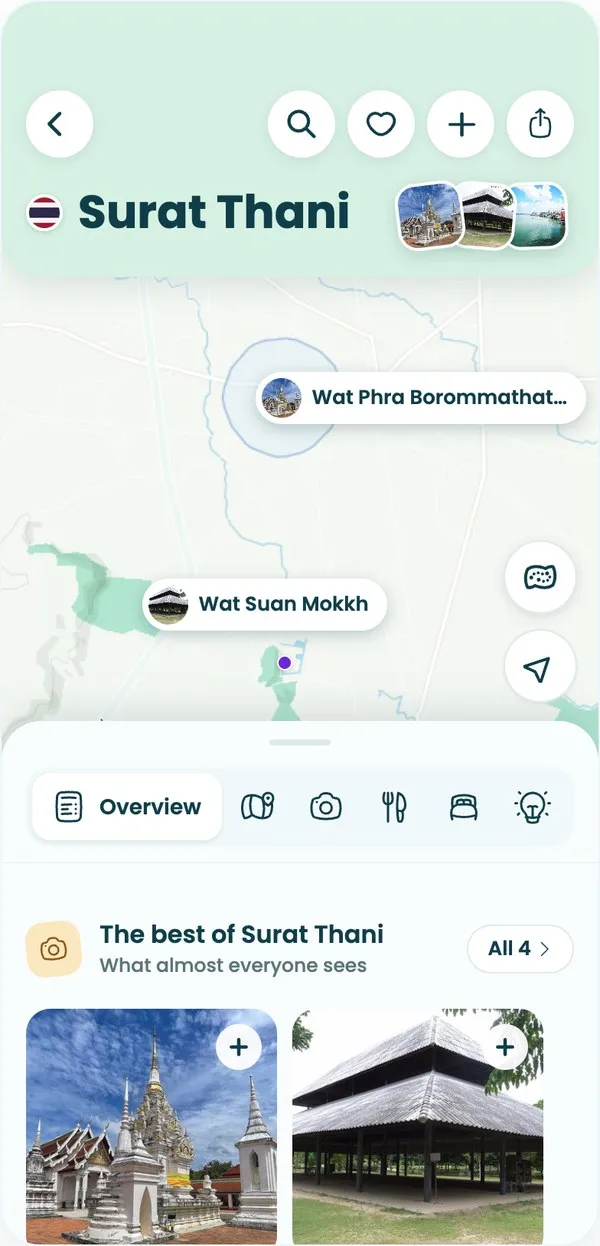
Surat Thani in a nutshell
Updated September 2026 · Written by the Stippl editorsEverything here is measured against 1,756,000+ planned stops in Thailand on Stippl.
Surat Thani is where you change for the Gulf islands, and the town is honest about being that. The boats to Koh Samui, Koh Phangan and Koh Tao leave from here and Khao Sok sits inland behind it, so almost everyone who sleeps in the city is doing it because a morning boat goes before they could arrive. The one trap worth knowing: the railway station is not in Surat Thani but fifteen kilometres west, at Phun Phin. Most travellers give the city 1 night on Stippl.
Almost nobody stays in Surat Thani on purpose, and the plans are unusually blunt about it. 82.6% of Surat Thani stops planned on Stippl are a single night and 34.04% carry no night at all, which is a change of transport recorded as a stop. Nothing else in the country reads like that.
Give it the one night and use the evening. The Ban Don night market on the riverfront is the city's actual evening and it is worth the hour you have. With longer, Wat Phra Borommathat Chaiya is a Srivijaya-era chedi fifty kilometres north and one of the oldest religious structures in southern Thailand. The one thing people travel here for on purpose is the ten-day silent retreat at Suan Mokkh in Chaiya, which runs every month in English. Otherwise, book the night train or the morning ferry and go.
 Surat Thani
Plan Surat Thani in Stippl
Day-by-day planning, stays and budget in one app, with every place from this guide already on the map.
Download the appTravellers bound for the Gulf
Surat Thani is the junction for Samui, Phangan and Tao, and most people give it 1 night on the way through.
Travellers heading for Khao Sok
The park is two hours inland, and this is where the road and the rail meet.
People doing a silent retreat
The International Dhamma Hermitage at Suan Mokkh runs ten-day silent retreats in English every month, and it is the one thing that brings people here deliberately.
Anyone on island prices
A night here costs a fraction of a night on Samui, and the boat leaves in the morning either way.
Anyone wanting an ordinary town
The night market and the riverfront are local life with no tourism layer on top, which is rare on this route.
Maybe not for you: anyone looking for a beach, since the coast here is mudflat and mangrove; anyone on a tight schedule in November or December; and anyone who booked a hotel in Surat Thani without checking whether it is near the station, the town or the pier.
Best time: January to April for the connection. November and
Dry and reliable
January to April
The season for both the islands and the connection to them.
Wet but workable
May to September
The southwest monsoon reaches the mainland here while the Gulf islands stay comparatively dry, and the connections are not usually affected.
Northeast monsoon
October to December
The Gulf's own rainy season, peaking in November. This is when the boats stop and the trains flood.
Add your Surat Thani dates and we'll flag the weather
Stippl shows the season, crowds and prices for every stop on your route.
Everything in this guide is already in Stippl. Tell the planner how long you have and what you like: it builds the route, the days and the travel times, and you edit whatever you want.
A silent retreat at Suan Mokkh
Sit the ten-day silent retreat at the International Dhamma Hermitage in Chaiya district, run every month in English in the tradition of Ajahn Buddhadasa, who founded the monastery in 1932. Register on the last day of the month before; the fee is a donation.
Wat Phra Borommathat Chaiya
Take the train or a songthaew fifty kilometres north to the Srivijaya-era chedi, one of the oldest religious structures in southern Thailand, from a period the rest of the country has very little of. Free, and the small national museum beside it explains the kingdom.

The Ban Don night market
Spend the evening at the riverfront market, the city's actual night out: grilled seafood, southern curries and the local oysters for a few euros. It is not remarkable by guidebook standards, and it is worth the hour you have.

The Tapi riverfront at dusk
Walk the river the city is built around at the end of the day, when the fishing boats come in and the ferries load. The city's one view, and free.

The night boat to the islands
Sleep on the deck of the overnight boat from Ban Don pier to Koh Tao or Koh Phangan, leaving around eleven and arriving at dawn, about €15. Slower than the catamaran and the one crossing people remember.
Khao Sok from Surat
Use the city as the door to Khao Sok: the park is an hour and a half by minivan from the bus terminal, and a lake raft house is booked from here for the next night. Most people leave the same day they arrive; this is the reason to.
Photo by samfotograf via WikimediaPhoto by Ainur Iman via UnsplashPhoto by Nadin Sh via Pexels
Ban Don
Old town, night market, pier
The old town on the Tapi river, where the night market, the pier for the slow boats and most of the cheap hotels are, walkable from the bus arrival points. For a night between the train and the islands.
Why visit: The market and the boats on foot, and a room that is a bed and no more.
The centre
Shophouses, markets, no visitors
The commercial town: markets, shophouses and the ordinary business of a provincial capital, with the mid-range hotels and no tourists at all. For a night that wants a real town and a decent hotel.
Why visit: Everything practical and nobody selling you anything, and nothing to see.
Phun Phin
Railway town, station beds
Not the city: the railway town fifteen kilometres west where the trains actually stop, with a handful of guesthouses beside the platform. For a train that arrives at three in the morning and nothing else.
Why visit: A bed by the platform, and a town with no reason to leave it.
Chaiya
Temple town, the retreat
A separate district town fifty kilometres north: the Srivijaya chedi, the forest monastery and the hermitage that runs the silent retreats, with plain guesthouses near the station. For a retreat and for the oldest thing in the south.
Why visit: The monastery and the chedi, and a town that closes at eight.
See every Surat Thani neighbourhood on one map
Save the areas you like and Stippl plots your days so you're not crossing the city twice.
Sleep in Ban Don, near the river, if you arrived by bus and leave by morning boat; beside the station at Phun Phin if you have a five o'clock train. 82.6% of Surat Thani stops planned on Stippl are a single night, and that is the right booking: insurance against a missed ferry. Book nothing near Don Sak, a terminal sixty kilometres out and no place to sleep.
Cheap hotels and guesthouses by the pier and the night market, €10 to €25, walkable from the bus drop.
Business hotels priced for salespeople, €20 to €45, with breakfast and a lift and nothing else to do.
A handful of plain guesthouses beside the platform, €8 to €20, for a dawn train.
Plain rooms in town and the monastery's retreat accommodation, €8 to €25, for the silent retreat.
Salted duck eggs from Chaiya district, the province's best-known product, cured in a paste of ash and salt
Surat Thani province farms oysters in the river mouths, and they appear grilled, raw and in salads
The fiercely hot and salty southern curry made from fermented fish innards, a southern speciality rather than a tourist dish
Fermented rice noodles with curry and a tray of raw vegetables, eaten at breakfast
The province claims the fruit's Thai origin at Ban Na San, and the season is roughly May to September
Discover food spots in Stippl
Find restaurants and markets on the map, save them to your itinerary, works offline too.
A town with no tourism layer
No tout economy, no English-language menu culture and no expectation that you are passing through, even though you are; the ordinary courtesies carry further here than on the islands.
Suan Mokkh has real rules
The retreats require silence, separation of men and women, no phones and no reading; it is a monastery running a discipline, not a wellness product.
A more conservative south
Dress away from the beach matters more here than in Bangkok, which on this route means the two hours before you reach one: shoulders and knees covered in town.
Chaiya is a point of pride
The Srivijaya connection is local identity and Wat Phra Borommathat is a working temple; treating the chedi as a photo stop reads badly, so shoes off and a quiet walk round.
Do
Don't
Budget
€15-25
A guesthouse room near the river, night-market food, local transport.
Mid-range
€35-60
A business hotel in the centre, restaurant meals, a taxi to the pier.
High-end
€80+
A business hotel with a pool, dinner at the night market, and a driver to Chaiya; there is little above this and no reason to look for it.
Typical prices
Track what you actually spend
Set a daily budget per country and log expenses in any currency while you travel.
A third of all planned stops in Surat Thani on Stippl carry no overnight stay. 34.04% of them, a signature no other Thai destination comes close to; people change boats and buses here and move on.
The railway station is in a different town, 15 km away. It has been at Phun Phin since the line was built, and the ferry piers are up to 80 km away at Don Sak.
Thailand's best-known silent retreat runs monthly an hour north of the city. Suan Mokkh forest monastery holds a ten-day retreat from the first of every month, in a city almost nobody visits.
The province's most famous product is a salted duck egg cured in ash. The eggs from Chaiya district are a national brand, sold at every stall between the station and the piers.
Surat Thani is the largest city in southern Thailand outside Hat Yai. It sits on the Tapi river a few kilometres from the Gulf coast, and the old riverside quarter is called Ban Don.
The station is not in the city
It stands at Phun Phin, about fifteen kilometres west, the single most useful fact about Surat Thani. Buses and songthaews link it to the town and the piers for a euro or two.
Nor is the Gulf ferry terminal
Don Sak, where Seatran and Raja sail, is sixty to eighty kilometres east of the city. Lomprayah's catamarans use the Tapee pier, which is much closer; know which boat you booked.
Book the through ticket
The combined bus-and-boat services make the transfer work, and doing it yourself saves little and risks the connection. Otherwise sleep here between the bus and the boat.
Most people do not stay
82.6% of stops are a single night and a third are none at all; Surat is a junction. Check the bus arrival time before booking: some overnight services arrive at three in the morning.
When one ferry stops, all stop
Southern Thailand floods in November and December and the operators cancel on the same days on marine warnings. Keep a spare day either side of an island stay in those months.
Keep valuables out of the hold
The night-bus luggage theft is the oldest scam in Thai backpacking and still reported. Documents, cards and electronics stay on your body; government buses from the terminal are the safer fleet.
Only if the boat leaves before you could get there. The ferries to the Gulf islands go in the morning, so an overnight train or bus arriving at dawn often removes the need entirely. Lay the connection out in Stippl against the boat times, then ask people who made the same crossing, in subreddits like r/ThailandTourism.
By the numbers, largely: 82.6% of Surat Thani stops planned on Stippl are a single night. The city is the mainland gateway to Koh Samui, Koh Phangan, Koh Tao and Khao Sok, and the plans treat it as the hinge between the overnight from Bangkok and the morning boat out.
Not in Surat Thani. It sits about fifteen kilometres west at Phun Phin, and the connecting bus or songthaew into the city takes another half hour on top of the train. Anyone booking a hotel by its distance to the station is measuring from the wrong place entirely.
About one in twenty: 5.36% of Thailand trips planned on Stippl include a Surat Thani stop. Almost all of that is the Gulf islands, because the ferries to Koh Samui, Koh Phangan and Koh Tao leave from the city and there is no quicker way onto them.
A forest monastery in Chaiya district that runs a ten-day silent retreat every month, in English, in the tradition of the teacher who founded it. It is the one thing people travel to this part of the country for on purpose rather than in transit, and it fills well ahead.
November and December, which is the opposite of the rest of Thailand. This coast takes its rain then and the ferries are most likely to be disrupted. January to April is the settled window, and travellers leave 75 days between planning a Surat Thani stop on Stippl and arriving.
Every guide is written by the Stippl editors and checked against the trips our travellers actually plan. Spotted something out of date? Let us know.
Day-by-day planning, stays and budget in one app, with every place from this guide already on the map.