
Marrakesh
Marrakesh is Morocco's easiest arrival and a whole trip on its own. Sleep in a riad courtyard behind a blank door, lose the day in the souks and eat at Jemaa el-Fna's stalls after dark.
Marrakesh in a nutshell
Marrakesh: what to expect
Every number below comes from 55,000+ planned stops in Morocco on Stippl.
Marrakesh is worth visiting, and how long you stay depends on whether it is the whole trip. For a quarter of the travellers who plan it, Marrakesh is all of Morocco, and they give it 4 nights on Stippl. The city was founded in 1062, its medina is UNESCO-listed, and the draw sits inside the walls: the souks, the riads, the palaces of the Kasbah and Djemaa el-Fna at the centre.
Everyone else treats Marrakesh as a hinge, not a base. On trips with other Moroccan stops, most travellers give the city 2 nights on Stippl, and 38.4% of those Marrakesh stops are a single night. The city opens a trip as often as it closes one, which is what an airport city looks like. The pairing that holds at every trip length is Essaouira, three hours away by coach.
Give it four nights for the city, two if you are passing through. Four covers the medina and the square after dark, the palace circuit and a hammam, the Majorelle garden and Gueliz, and a day out to Imlil in the Atlas or the Agafay desert. If selling pressure wears you down, start somewhere calmer such as Essaouira and finish here. July and August are hot enough to push the sightseeing into the early morning.
Plan Marrakesh in Stippl
Day-by-day planning, stays and budget in one app, with every place from this guide already on the map.
Download the appWho Marrakesh is for
First-timers to Morocco
Marrakesh is the easiest arrival in the country, with the best-connected airport and the densest mix of what people come to Morocco for.
History buffs
Six centuries of Almoravid, Almohad, Saadian and Alaouite building stand inside one city wall, from the palaces of the Kasbah to the Saadian Tombs.
Budget travellers
Marrakesh has the cheapest big-city beds in Morocco, and the stalls on the square are the best street food for the money in the country.
Long-weekenders
Marrakesh works as a city break on its own: travellers who come only for the city give it 4 nights on Stippl.
Food lovers
Tanjia, slow-cooked in the ashes of a hammam furnace, is the dish of Marrakesh, and the rooftops give you the square with it at café prices.
Maybe not for you: travellers who hate being sold to, because the pressure in the souks is constant and Essaouira is far calmer; and anyone arriving in July or August who cannot face afternoons spent indoors.
The best time to visit Marrakesh
The shoulders
March to May and September to November
Warm days and cool mornings keep the medina walkable from breakfast to dusk. Both of the city's busy seasons sit here, so book riads early.
High summer
July and August
The heat does not empty the city, it changes the day: sights at opening, the riad courtyard through the afternoon, the square after dark.
Winter
December to February
Sunny days and cold nights, and stone riads open to the sky feel it, so pay for a heated room. The Atlas is snow-capped and the ski runs are open.
- Travellers who come only for Marrakesh plan it about 42 days ahead on Stippl. Those touring the country plan further out, about 50 days, and favour September, while the city break peaks in June.
- Ramadan changes the day in Marrakesh rather than the trip. Many sights close around three in the afternoon, daytime restaurants in the medina thin out, and the square comes alive at iftar. Reschedule your days rather than your dates.
- Eid al-Adha is the biggest domestic travel week of the year. Transport books out and many small businesses close for several days, so check the date before you book trains or coaches out of Marrakesh.
- The Marrakech International Film Festival moves hotel prices. It runs in late November or early December, the city's one glamour week, so book the riad early if your dates overlap with it.
Add your Marrakesh dates and we'll flag the weather
Stippl shows the season, crowds and prices for every stop on your route.
Describe your trip, get a Marrakesh itinerary in seconds
Everything in this guide is already in Stippl. Tell the planner how long you have and what you like: it builds the route, the days and the travel times, and you edit whatever you want.
Things to do in Marrakesh
Djemaa el-Fna by day and by night
By day the square is a market with snake charmers; after dark it becomes a food theatre with four times the crowd. Go twice, and eat at a busy stall with locals at it.
The souks, without a plan
Aim for Souk Semmarine off the square and the spice souk at Place des Épices, then let the layout lose you. Download an offline map before you go in.
Jardin Majorelle at opening
The cobalt-blue garden Yves Saint Laurent rescued in 1980 runs timed entry and sells out. Book online at least a day ahead; the garden ticket is €16 (170 MAD).
The palace circuit
Bahia, El Badi and the Saadian Tombs sit within twenty minutes of each other in the Kasbah and the Mellah, and make one morning on foot at about €9 (100 MAD) each.
A hammam, chosen with care
A neighbourhood hammam costs a few dirhams and is the real thing, while a spa treatment runs two hours for about €55 (590 MAD). Read reviews rather than picking the nearest.
A day in the Atlas at Imlil
A grand taxi reaches the Toubkal trailhead in about an hour and a quarter, for €4 to €7 (40 to 70 MAD) a seat. It is the closest real mountain to the city.
The neighbourhoods of Marrakesh
Medina
Souks, riads, no cars
The walled old city, with the souks, the riads and Djemaa el-Fna at its centre, where everything is on foot. For first-timers who want the atmosphere on the doorstep.
The atmosphere outside your door, and alley noise and a walk with your luggage.
Kasbah
Palaces, tombs, quieter lanes
The southern royal quarter around El Badi, the Saadian Tombs and the Royal Palace, calmer than the souks. For history lovers who want the monuments close by.
The monuments on foot, and a longer walk to the square at night.
Mellah
Spice souks, old balconies
The old Jewish quarter from 1558, with overhanging balconies, spice and jewellery souks and a restored synagogue. For travellers who want specialist shopping and a quieter corner of the medina.
The best specialist souks, and a walk back from the square after dark.
Gueliz
Boulevards, galleries, pavements
The French-era new town of boulevards, galleries, art deco and restaurants that take a booking. For travellers who want pavements, pools and parking, twenty minutes' walk from the medina.
Quiet nights and a pool, and a walk or a taxi to the old city.
Hivernage
Hotels, rooftops, nightlife
A manicured, hotel-heavy quarter that is the nightlife address of Marrakesh and the closest to the airport. For couples and luxury stays who want rooftop bars and clubs.
Rooftops and clubs on the doorstep, and none of the medina's atmosphere.
Palmeraie
Date palms, walled villas
An oasis of more than 100,000 date palms north of town, lined with walled resort villas. For pool holidays and families who do not mind a taxi every evening.
Pool afternoons and calm, and a twenty-minute drive to everything.
See every Marrakesh neighbourhood on one map
Save the areas you like and Stippl plots your days so you're not crossing the city twice.
Where to stay in Marrakesh
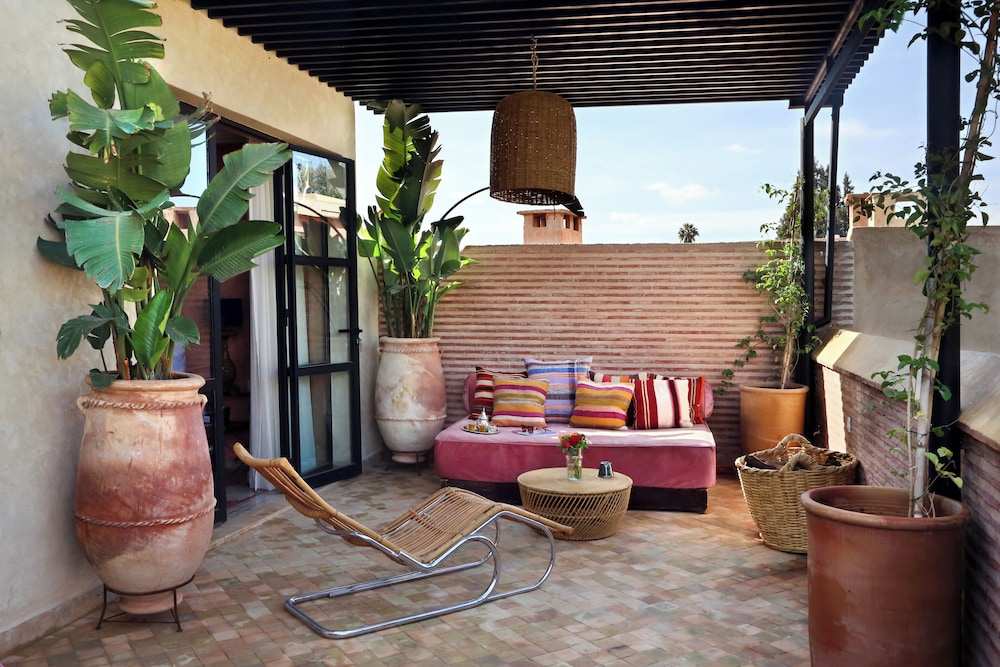
Stay in a riad inside the medina for a first visit: a blank door on an alley, a tiled courtyard and a roof terrace, with the souks outside. Book the riad's transfer with the room, because no car reaches the door. Travellers who come only for Marrakesh give it 4 nights on Stippl; pick Gueliz instead if you want a pool and quiet evenings.
Medina
€35–160
Riads from simple courtyard houses to plunge-pool boutiques, €35 to €160, with cheap beds in Kennaria from €20.
Kasbah
€40–150
Riads and small hotels near the palaces, €40 to €150, a little quieter than the northern medina.
Mellah
€30–100
Simple riads and guesthouses, €30 to €100, the cheapest rooms close to the palaces.
Gueliz
€50–180
Hotels with pools and grounds, €50 to €180, and parking if you arrive with a car.
Hivernage
€90–400
Large hotels and resort-style stays, €90 to €400, many with a rooftop bar on site.
Palmeraie
€80–500
Walled villas and resorts among the palms, €80 to €500, with a car or taxis needed.


What to eat in Marrakesh
Marrakesh's own dish: beef or lamb, preserved lemon and smen sealed in a clay urn and slow-cooked for hours in the ashes of a hammam furnace
The conical-lid stew, chicken with olive and lemon or lamb with prune
Steamed semolina under seven vegetables, the Friday family meal
Tomato, lentil and chickpea soup, the standard fast-breaker
Snails in a peppery broth of fifteen-plus spices, drunk from the bowl
Whole lamb slow-roasted in a pit oven, sold by weight with cumin and salt
The layered griddle flatbread and the thousand-hole semolina pancake
Gunpowder green tea, spearmint and a lot of sugar, poured from height
Discover food spots in Stippl
Find restaurants and markets on the map, save them to your itinerary, works offline too.
Marrakesh customs and what not to do
Photos are paid for here
Photographing people, stalls, snake handlers or monkeys in Marrakesh is a paid transaction, so agree it first or keep the camera down.
Refuse the offered guide
The men at the medina gates and the tanneries earn commission from the shops they lead you to, and a free tannery visit ends in a demand.
The Koutoubia is outside only
Non-Muslims cannot enter the Koutoubia or any working mosque in Marrakesh; the gardens and the minaret from outside are the visit.
Cover up in the medina
Locals do not wear shorts inside the walls, and covering shoulders and knees means less attention and less sunburn, for men and women alike.
Affection is a legal risk
Sex outside marriage and same-sex relations are criminal offences in Morocco, so keep affection private; this is the law, not manners.
Do
- Say no once, politely, and keep walking
- Learn salam, shukran and la shukran before your first haggle
- Agree the price and the time with a calèche driver before you climb in
- Book the Majorelle online at least a day ahead
Don't
- Fly a drone; flying one without permission is illegal and equipment is confiscated at the airport
- Stop for anyone who says a street or the tannery is closed
- Let henna go on your hand before a price is agreed
- Take out your phone in narrow alleys, where mopeds pass at speed
What a Marrakesh trip costs
Backpacker
€25–40
A medina dorm, dinners at the square's stalls, and two or three ticketed sights.
Riad and a restaurant
€70–120
A mid-range riad double with breakfast, a rooftop dinner and a hammam.
Comfortable
€200+
A design riad or a Hivernage hotel, a spa and a private day trip.
Track what you actually spend
Set a daily budget per country and log expenses in any currency while you travel.
Fun facts about Marrakesh
Djemaa el-Fna was the first place on UNESCO's intangible heritage list, in 2001. The listing covers the storytellers, musicians and healers who work the square, not the paving under their feet.
The Saadian Tombs lay walled up and forgotten for over 200 years. Sultan Moulay Ismail sealed them in the 17th century and they were only found again in 1917, which is why the mosaics survived.
Tanjia, the dish of Marrakesh, needs the neighbourhood hammam to be lit. The sealed clay urn cooks for hours in the ashes of the furnace that heats the bathhouse.
Yves Saint Laurent saved Jardin Majorelle from demolition in 1980. His ashes were scattered in the garden in 2008, among the plants and walls he had rescued.
Majorelle blue is a colour mixed by the painter Jacques Majorelle. He created it in the 1930s for his villa, and the garden's walls and pots still wear it.
The Red City owes its colour to local clay, not to paint. The ochre-pink walls have been built from the same earth for nearly a thousand years, and a municipal rule keeps new buildings in it.
Marrakesh gets more than 300 days of sunshine a year. The Atlas, 60 km away, is snow-capped from December to April and visible from the rooftops on clear winter days.
Local tips for Marrakesh
Book the riad's transfer
No car reaches a medina riad, so the taxi stops at a gate and you walk the rest. The riad's own driver meets you and walks you in for about €19 (200 MAD).
Download the map first
Offline Google Maps works well in the medina, souks included, and there is no reliable street signage to fall back on once you are inside.
Take bus 19 from the airport
The airport bus runs from 06:30 to 23:30 for €2.80 (30 MAD), and a return ticket stays valid for two weeks. Taxis ask five times as much.
Two nights on a circuit
Most travellers touring Morocco give Marrakesh 2 nights on Stippl: one full day in the medina, then out to the desert or the coast the next morning.
Mind your bag at the square
Pickpocketing and bag-snatching around Djemaa el-Fna and in the busiest souks is the most common trouble visitors meet, so carry little and keep it zipped.
Watch for mopeds in the alleys
Pavements come and go, crossings are decorative, and mopeds ride the medina alleys at speed, so step aside at the sound of an engine.
Marrakesh questions, answered
It depends on the trip. Travellers who plan Marrakesh as their only Moroccan stop give it 4 nights on Stippl, while on a longer circuit it gets two. Four nights covers the city properly; two is one full day in the medina and an early start the next morning.
June for a city break, September for a circuit. Of everyone who plans Marrakesh on Stippl, city-breakers go most in June and circuit travellers in September, and the city break is planned about 42 days ahead. March to May and September to November are the comfortable months; July and August are hot but the city stays full.
Either, since the airport is there, and one end is better than the middle. 38.4% of Marrakesh stops in the circuit trips planned on Stippl are a single night, which leaves no full day in the city. Lay the route out in Stippl to see what the drives allow, then show it to people who have been, in communities like r/Morocco, and say how you travel.
No. Merzouga is eight to nine hours from Marrakesh each way, so the Sahara is a tour of two or three nights. For a desert in a day, Agafay is 40 minutes out, with camps and dinner under the stars, but it is stony ground rather than sand dunes.
It is persistent rather than dangerous. In Marrakesh the pressure concentrates at Djemaa el-Fna, the souk entrances and the tanneries, where men offer to guide you for a commission. One clear no and continued walking handles most of it, and the tourist police at the sights deal with anyone who will not take no.
For the history, yes; for finding your way, no. In Marrakesh, book one through your riad or the tourist office rather than accepting an offer at a gate, and agree the price and the route before you start. An offline map is enough to find your own way back.
Every guide is written by the Stippl editors and checked against the trips our travellers actually plan. Spotted something out of date? Let us know.

Plan Marrakesh in Stippl
Day-by-day planning, stays and budget in one app, with every place from this guide already on the map.
Download the app