
Phnom Penh
Phnom Penh is Cambodia's only real metropolis, with the country's widest food range and the cheapest beds of its main stops. Tuol Sleng and Choeung Ek are the most complete account of the Khmer Rouge years anywhere.
Phnom Penh in a nutshell
Phnom Penh: what to expect
We looked at how travellers actually plan Phnom Penh on Stippl, across 164,000+ planned stops in Cambodia.
Phnom Penh is Cambodia's only real metropolis, and the two things people come for sit an hour apart. Tuol Sleng is the school the Khmer Rouge turned into an interrogation prison, left much as it was found, and Choeung Ek is where most of its prisoners were taken. The Royal Palace is still the King's residence, its throne-hall tower modelled on the Bayon and the Silver Pagoda floor laid with thousands of silver tiles. Psar Thmei's art-deco dome went up in 1937 and is one of the handsomest market buildings in Asia.
A Cambodia trip almost always starts in Phnom Penh, and it rarely finishes there. More than half the itineraries that carry the capital open on it and four in ten close on it, an asymmetry nothing else in the country has. And there is no third obligatory day: 37.8% of stays here run exactly two nights and nine in ten are three or fewer.
Sleep on Sisowath Quay for a first visit and in BKK1 for a longer one, and 2 nights is the shape of it. The sights are too far apart to walk, so a tuk-tuk or the local ride app is the answer, and keep your bag out of reach of passing motorbikes. What the capital really opens up is the east and the south rather than the temples: Kep, Kratie, Kampot and Mondulkiri are the places you can only practically reach from here. Skip it if you came to relax.
Plan Phnom Penh in Stippl
Day-by-day planning, stays and budget in one app, with every place from this guide already on the map.
Download the appWho Phnom Penh is for
History travellers
Tuol Sleng and Choeung Ek together are the most complete account of the Khmer Rouge period anywhere, set up to be understood rather than merely witnessed.
Budget travellers
The cheapest of Cambodia's main stops: hostels from about €7, local meals from under €2, and a tuk-tuk across town under €4.
Food travellers
The country's widest range by a distance, from riverside Khmer kitchens to BKK1's international scene and the Russian Market's stalls.
Nomads and long-stayers
BKK1 exists for exactly this: co-working, cafés, apartments and a large resident foreign community.
City people, not sight people
Phnom Penh simply has more to do than Siem Reap, which is centred on one thing, though most people still give it 2 nights.
Anyone bound for Vietnam
The city is the hinge: the Mekong crossing to Ho Chi Minh City, the road and rail south to Kampot, and the country's main international airport.
Maybe not for you: anyone travelling to relax, since the memorial sites are genuinely harrowing and the traffic is heavy; anyone unwilling to keep a bag out of reach of a passing motorbike; and anyone hoping to walk between the sights, which the distances do not allow.
The best time to visit Phnom Penh
Cool dry season
November to February
The only months a day of walking and tuk-tuks is comfortable, and the season everything is priced for. Bon Om Touk, the water festival, fills the riverfront in November.
Hot dry season
March to May
Hot, dry and the two memorial sites largely outdoors; start early and take the afternoon inside. Khmer New Year in mid April closes much of the city and sends the rest to the provinces.
Wet season
June to October
Afternoon storms, green countryside and thin crowds, with September the month to avoid: the Mekong is at its highest and the city's drainage does not cope. Late September to November is the underrated shoulder.
- January is the month most travellers plan Phnom Penh for on Stippl, about 88 days ahead. Only 11.6% of Phnom Penh plans are made inside a fortnight; the city has the hotel stock to take a late decision in any month but November.
- Bon Om Touk in October or November is the national event and it happens here. Three days of boat racing on the Tonlé Sap in front of the Royal Palace, marking the river reversing its flow; the crowds are enormous and the riverfront hotels are booked out.
- Phnom Penh floods after a wet-season storm and it is normal rather than exceptional. The streets around the markets go under for an hour or two; a tuk-tuk gets through, a plan with a fixed time in the afternoon does not.
- Khmer New Year in mid April is three days and much of the city closes. Cambodians go home to the provinces, the markets thin and the memorial sites stay open; it is a quiet time to be here and a bad one for the restaurants.
Add your Phnom Penh dates and we'll flag the weather
Stippl shows the season, crowds and prices for every stop on your route.
Describe your trip, get a Phnom Penh itinerary in seconds
Everything in this guide is already in Stippl. Tell the planner how long you have and what you like: it builds the route, the days and the travel times, and you edit whatever you want.
Things to do in Phnom Penh


Tuol Sleng, S-21
Spend two to three hours in the school the Khmer Rouge turned into an interrogation prison, left much as it was found, with the audio guide, about €5. Around twenty thousand passed through and a handful survived; one or two of them still sit in the courtyard.
Choeung Ek, the Killing Fields
Take a tuk-tuk fifteen kilometres south to where most of S-21's prisoners were taken: the mass graves, the memorial stupa holding thousands of skulls and the audio guide that is the reason to go, about €6. Do it on the same day as S-21 and nothing else.
The Royal Palace and the Silver Pagoda
Walk the King's residence, with the throne hall's fifty-nine-metre tower modelled on the Bayon and the pagoda floor laid with several thousand silver tiles, about €10. Covered shoulders and knees; closed at lunchtime.
Psar Thmei, the Central Market
Walk the 1937 art-deco dome and its four arms of stalls, one of the most beautiful market buildings in Asia in its own right, free. Mornings, and the jewellery is under the dome.
Sunset on Sisowath Quay
Walk the riverside promenade in the hour before dark, when the park fills with families and exercise classes and the light goes across the confluence, free. The rooftop bars along the quay take the second half of it.
The Russian Market
Shop the crammed, hot market that is the best in the city for actually buying things, then the neighbourhood's cafés and vinyl bars behind it. Mornings before the heat, and bargain from half.
The neighbourhoods of Phnom Penh
Riverside
Promenade, palace, bars
Three kilometres of waterfront promenade along the Tonlé Sap beside the Royal Palace and the National Museum, lined with restaurants, bars and hotels. For first visits and for the sunset over the confluence on foot.
The palace and the sunset at the door, and the touts and the traffic.
Daun Penh
French quarter, Wat Phnom, market
The colonial administrative district looping around Wat Phnom and the Central Market: French-era boulevards, government buildings and the art-deco market, with older hotels. For the historic core and for reading the city's layers in a walk.
The history on foot, and empty boulevards after dark.
BKK1
Expat calm, coffee, rooftop pools
The expat and NGO quarter: embassies, speciality coffee, wine shops, co-working and rooftop pools on quiet tree-lined streets, polished and low-rise. For long stays and for the best restaurant density in the city.
Reliable wifi and the best eating, and a district that could be anywhere.
Toul Tom Poung
Russian Market, vintage, vinyl
Built around the crammed Russian Market, with vintage shops, vinyl bars, vegan kitchens and tattoo studios in the narrow streets behind it, and cheap guesthouses. For budget travellers and for a slow day without a tuk-tuk.
Cheap and the market, and half an hour to the riverside.
Tonlé Bassac
Glass towers, rooftop bars
The new-money quarter between the Independence Monument and the Bassac: glass towers, rooftop bars, fine dining and a mall, with older shophouses behind. For a splurge and for cocktails above the city.
The rooftops and the shortest walk to the riverside, and the prices of the towers.
See every Phnom Penh neighbourhood on one map
Save the areas you like and Stippl plots your days so you're not crossing the city twice.
Where to stay in Phnom Penh
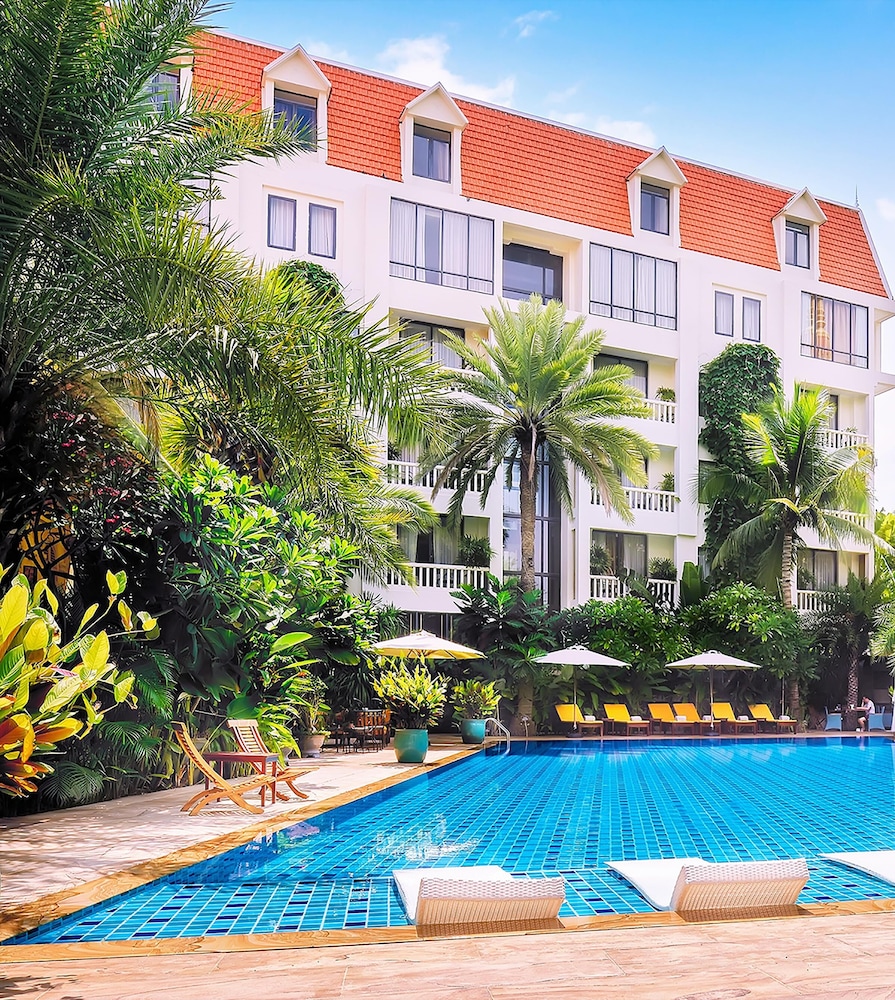
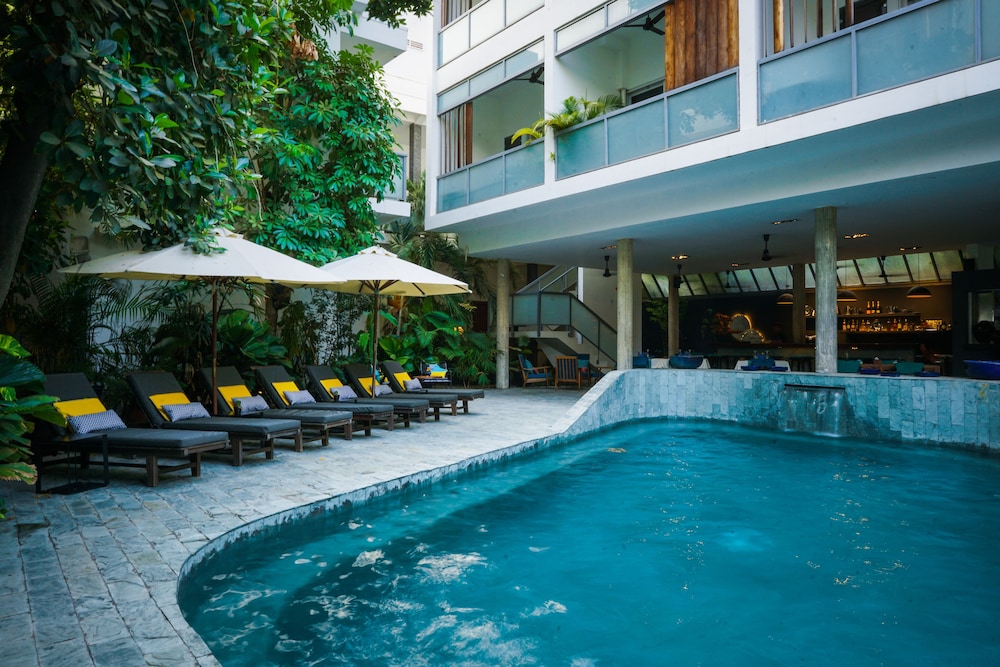
Stay on the Riverside for two nights and in BKK1 for two weeks: the waterfront puts you next to the palace and the museum, and BKK1 next to good coffee and a co-working desk. Most people give Phnom Penh 2 nights on Stippl. Book a pool; the middle of the day is unusable from March to May, and a four-star with one costs about €35.
Riverside
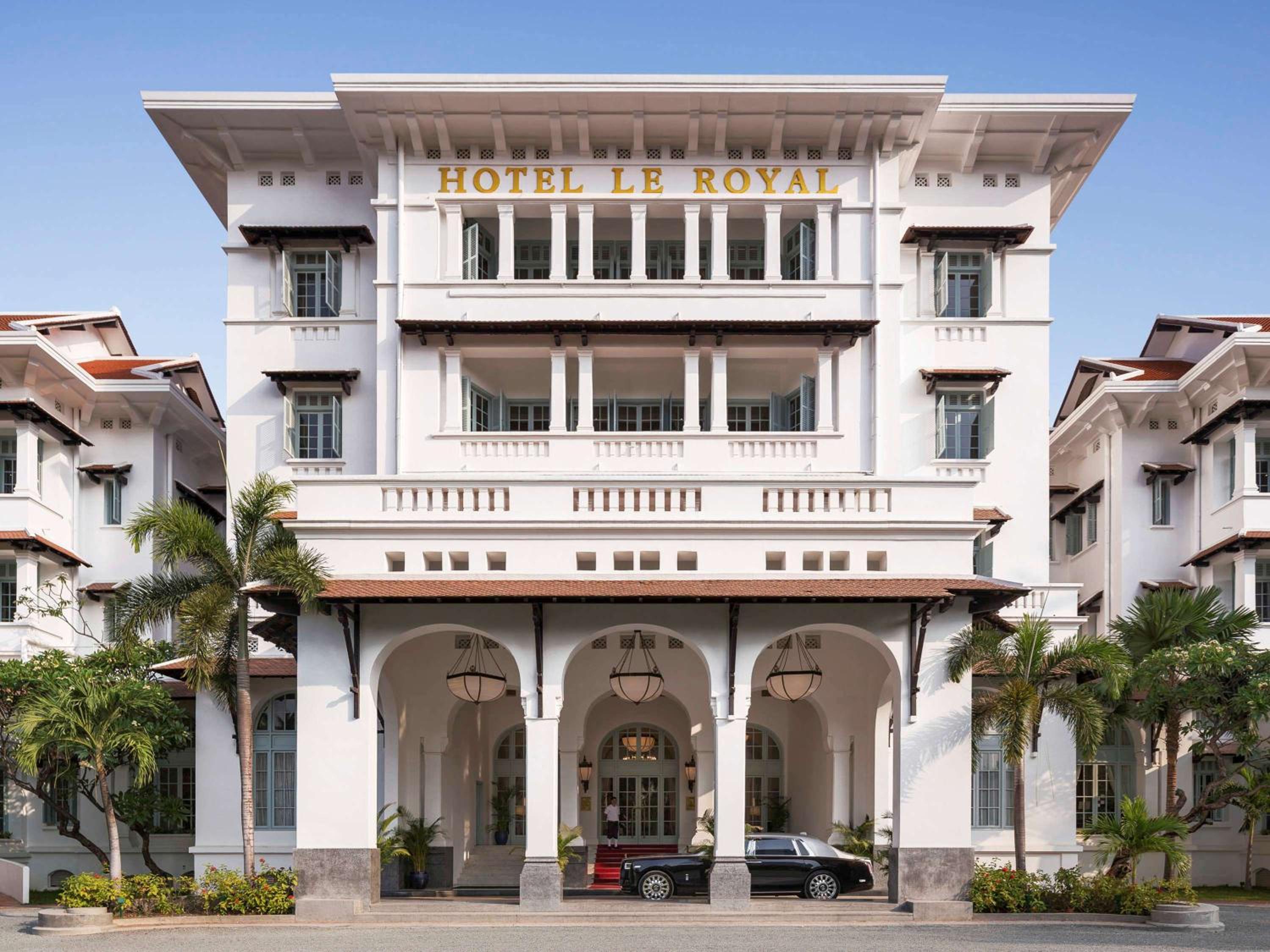
Hotels and guesthouses along the promenade, air-conditioned rooms from €14 and boutique places €40 to €90.
Daun Penh
Colonial-era hotels and pool hostels near the Central Market, €5 a bed to €60 a room.
BKK1
Serviced apartments and rooftop-pool hotels on quiet streets, €35 to €100, for longer stays.
Toul Tom Poung
Cheap guesthouses and hostels behind the Russian Market, €5 to €25, with a tuk-tuk to everything.
Tonlé Bassac
€30–120
The glass towers and international hotels, €80 to €200, with the rooftop bars on top.


What to eat in Phnom Penh
Freshwater fish steamed with coconut milk, kroeung and egg into a set custard, in a banana-leaf cup.
Pork-bone rice-noodle soup with the garnishes on the side. Breakfast, and the city's real morning meal.
The Cambodian banh mi: pâté, pickles and herbs in a French baguette. BKK1's carts are famous for it.
Seared marinated beef over lettuce and tomato with a lime-and-black-pepper dip.
Grilled pork over broken rice with pickles and a bowl of broth.
Fermented rice noodles under a green fish gravy, with a plate of raw herbs.
Fried sweet-potato-and-coconut doughnuts sold by the bag on the street.
Discover food spots in Stippl
Find restaurants and markets on the map, save them to your itinerary, works offline too.
Phnom Penh customs and what not to do
The Khmer Rouge is memory
Living memory, not history: a quarter of the population died between 1975 and 1979 and the average age on the street is about 25 as a result. Treat the memorials as memorials.
The Palace turns people away
Covered shoulders, covered knees, no vests; the rule is enforced at the gate and cover-ups are sold outside for a couple of euros.
The King is genuinely revered
Cambodia is a constitutional monarchy and disrespect toward the monarchy is not received as a joke; the portraits are everywhere and the anthem is stood for.
Bargain at the markets only
Central Market and the Russian Market expect it and price for it; the restaurants, the tuk-tuk apps and the shops on the riverside do not.
Do
- Take the audio guide at both memorial sites; at Choeung Ek it is included and it is the whole experience
- Split Tuol Sleng and Choeung Ek across two days if you can
- Agree the tuk-tuk fare before you get in, or use PassApp and let the app do it
- Cover shoulders and knees at the Palace and every wat
Don't
- Walk the riverside after dark alone
- Pay to release the caged birds at Wat Phnom; they are trained to return to the cage
- Photograph military installations or the airport
- Joke about the King
What a Phnom Penh trip costs
Budget
€16–24
A hostel dorm, local meals, tuk-tuks, the two memorial sites and a beer.
Mid-range
€30–48
A private air-conditioned room with a pool, restaurant meals, a driver for the day.
High-end
€69+
A boutique hotel behind the Royal Palace, BKK1 restaurants, rooftop bars in Tonlé Bassac.
Track what you actually spend
Set a daily budget per country and log expenses in any currency while you travel.
Fun facts about Phnom Penh
The Khmer Rouge emptied Phnom Penh within days in April 1975. Around two million people were forced out of the city, one of the largest forced urban evacuations ever carried out.
Of roughly 20,000 people imprisoned at S-21, about eight survived. The prison is now the Tuol Sleng Genocide Museum, and two of the survivors were still greeting visitors there in recent years.
Phnom Penh means Penh's Hill, after a fourteenth-century woman. Lady Penh is said to have found Buddha statues in a floating tree and raised a hill to house them; Wat Phnom stands on it.
The city sits on the Chaktomuk, the four faces of the river. The Mekong, the Bassac and the Tonlé Sap meet here, and the Tonlé Sap reverses direction with every monsoon.
Wat Phnom is 27 metres high, the tallest religious structure in the city. It sits on the artificial hill that gave the city its name, and the clock on its slope is a favourite meeting point.
Phnom Penh is roughly ten times the size of Siem Reap. About 2.3 million people against 200,000, which is why the sights here are not walkable from one another the way they are there.
Local tips for Phnom Penh
Do not plan to walk
Tuol Sleng, the Royal Palace, the Central Market and Choeung Ek are spread across the city and out of it. One driver for the day, about €15 including the waiting, is the standard.
Cambodia's best-connected point
International flights, the Vietnam land crossing, the only railway and the fastest road to the coast all start here. Nothing needs an overnight bus; the longest journeys are six to eight hours.
PassApp and Grab for tuk-tuks
Both show the price up front and end the fare dispute at the end of the ride, which is the routine scam. A ride across the centre is about €1.50.
How long to stay
Most people give Phnom Penh 2 nights on Stippl, and a quarter stay one. The memorial sites need a day of their own; the palace, the markets and the river the second.
Bag-snatching from motorbikes
The defining risk, common enough that visitors are regularly the victims. Bag on the inside arm, phone away at the kerb, and nothing across the neck on a tuk-tuk.
The riverside after dark
The one area the guides name for care at night; by day it is the city's best walk. Do not drink the tap water, and the motorbike is the everyday hazard on every road.
Phnom Penh questions, answered
Decide before you arrive whether you are doing both in one day or splitting them, because you will not be fit to decide at two in the afternoon. Together it is about five hours and it is heavy. Build it into Stippl as one full day with nothing planned after it, and take the audio guides at both.
Two. Travellers planning Phnom Penh on Stippl give it 2 nights, which is also what the guidebooks land on. One day for the Royal Palace, the market and the riverside; one for Choeung Ek and Tuol Sleng, and nothing else on it.
It is what 27.2% of Phnom Penh stops planned on Stippl come to, and it is not enough. The Killing Fields and Tuol Sleng between them are most of a day, and doing them on a travel day is the version people regret. Give the city two nights and the second day to the museums.
Rarely, which surprises anyone expecting an airport city. Only 2.27% of Phnom Penh stops planned on Stippl are same-day, so almost everyone passing through sleeps here. The city repays it: the riverside in the hour before dark is the best of Cambodia's urban evenings.
Yes, with one caveat everybody repeats: bag and phone snatching from moving motorbikes, including out of an open tuk-tuk. Keep the phone in a pocket rather than a hand at the roadside, wear a bag across the body and on the inside, and do not walk the riverside alone late at night.
Because it closes for a few hours in the middle of every day and reopens in the afternoon. Go first thing or after the break, and dress for it: covered shoulders and knees are enforced at the gate, and the sarong sellers outside do brisk trade off people who did not know.
Every guide is written by the Stippl editors and checked against the trips our travellers actually plan. Spotted something out of date? Let us know.

Plan Phnom Penh in Stippl
Day-by-day planning, stays and budget in one app, with every place from this guide already on the map.
Download the app