

San Francisco
San Francisco is seven miles by seven, steep, foggy in July and clear in October, with a landmark list that fits two days and hills that make two days tiring. Two or three nights, Alcatraz booked the day the dates are fixed, and a jacket in August.
San Francisco in a nutshell
San Francisco: what to expect
Our travellers have planned 450,000+ stops in the United States on Stippl. That is where the numbers here come from.
San Francisco fits two or three nights, because the city is small and the list is famous. Roughly seven miles by seven and steep, it holds the Golden Gate Bridge walked or cycled, Alcatraz with its audio tour, a cable car up Nob Hill, the Mission's murals and burritos, Golden Gate Park end to end and the coast path from Lands End to the Sutro Baths, with the fog over the western half from June to August as the one weather fact that changes a plan. Most travellers give San Francisco 2 nights on Stippl.
San Francisco is planned earlier than almost anywhere in the country, and it starts or ends the loop. The city opens 45.0% of the trips it appears on and closes 33.5%, of everyone who plans it on Stippl, and most travellers plan it about 124 days days ahead, longer than anywhere else in the country, because Alcatraz and Yosemite both sell out.
Sleep around Union Square or Nob Hill on the cable car lines, buy the Muni day pass, and pick the car up on the way out rather than the way in. A car is a liability inside the city and the break-in is the one crime a visitor meets. Skip the beach, since the ocean here is cold enough that swimming is discouraged outright, and skip building two days around the bridge photograph without a fog alternative, because July is often the coldest month a visitor sees.
Plan San Francisco in Stippl
Day-by-day planning, stays and budget in one app, with every place from this guide already on the map.
Download the appWho San Francisco is for
First-timers
The landmark list is short, famous and genuinely walkable, and two days covers it, with the third night the single most common stay.
Foodies
Four three-star restaurants and a burrito the city invented in the same square mile, with dim sum in the oldest Chinatown in North America.
Art-lovers
SFMOMA, the de Young and the Legion of Honor, plus the largest concentration of street murals on the west coast in the Mission's alleys.
History-buffs
The Gold Rush, the Beats in North Beach, the Summer of Love in the Haight and the oldest Chinatown on the continent, all still legible on the street.
Loop starters and enders
San Francisco opens 45.0% of the trips it appears on and closes 33.5%, of everyone who plans it on Stippl.
Early planners
Most travellers plan San Francisco about 124 days days ahead on Stippl, longer than anywhere else in the country, because Alcatraz and Yosemite both sell out.
Maybe not for you: anyone coming for beach weather, since the ocean is cold enough that swimming is discouraged outright and July is foggy; and anyone on a tight budget, because accommodation is among the most expensive in the country.
The best time to visit San Francisco
Fog season
June to August
The marine layer sits over the western districts, often burning off by mid-morning inland and not at all on the coast; cold grey mornings are normal and the crowds are at their peak.
The clear window
September and October
The warmest, driest and sunniest weeks of the year and the shoulder the locals name, with Fleet Week's air show over the bay in October.
The wet season
November to March
Eight to twelve rain days a month, mild at 14 to 18 degrees, the cheapest and quietest half of the year, and the Chinese New Year parade inside it.
Spring
April and May
Clearing, mild and green, with Bay to Breakers in May and the fog not yet settled in; the second-best window and the cheaper one.
- Most travellers give San Francisco 2 nights on Stippl, and three nights is the single most common stay. Two covers the landmark list; the third is the Mission, Golden Gate Park and a day for the fog to lift.
- Most travellers plan San Francisco about 124 days days ahead on Stippl, and only 9.1% inside a fortnight. Alcatraz goes on sale three months ahead and summer dates sell out weeks in advance, so the late plan is a plan without the island.
- Fleet Week in the first half of October closes the northern waterfront for days. The Blue Angels fly over the bay, the piers fill, and the hotels along the Embarcadero price for it.
- Pride on the last weekend of June brings the parade down Market Street on the Sunday. The Castro and the centre fill for the weekend, and the rooms go weeks ahead.
- The Chinese New Year parade is the largest of its kind outside Asia. Late January to March depending on the lunar calendar, and Chinatown is impassable on the evening.
- June to September takes 56.4% of San Francisco plans on Stippl, and that is the fog quarter. The people who come in September and October get the city the summer visitors were promised.
Add your San Francisco dates and we'll flag the weather
Stippl shows the season, crowds and prices for every stop on your route.
Describe your trip, get a San Francisco itinerary in seconds
Everything in this guide is already in Stippl. Tell the planner how long you have and what you like: it builds the route, the days and the travel times, and you edit whatever you want.
Things to do in San Francisco
 Photo by Luca Florio via Unsplash
 Photo by Airam Dato-on via Pexels
The Golden Gate Bridge on foot
1.7 miles, free, thirty to 45 minutes each way, and the single thing everyone comes for; check whether it is in cloud before setting off, and which walkway is open.
Alcatraz with the audio tour
The cellhouse audio tour is included in the ferry ticket, in eleven languages, and it is what makes the visit rather than the island; tickets go on sale 90 days ahead.
A cable car up Nob Hill
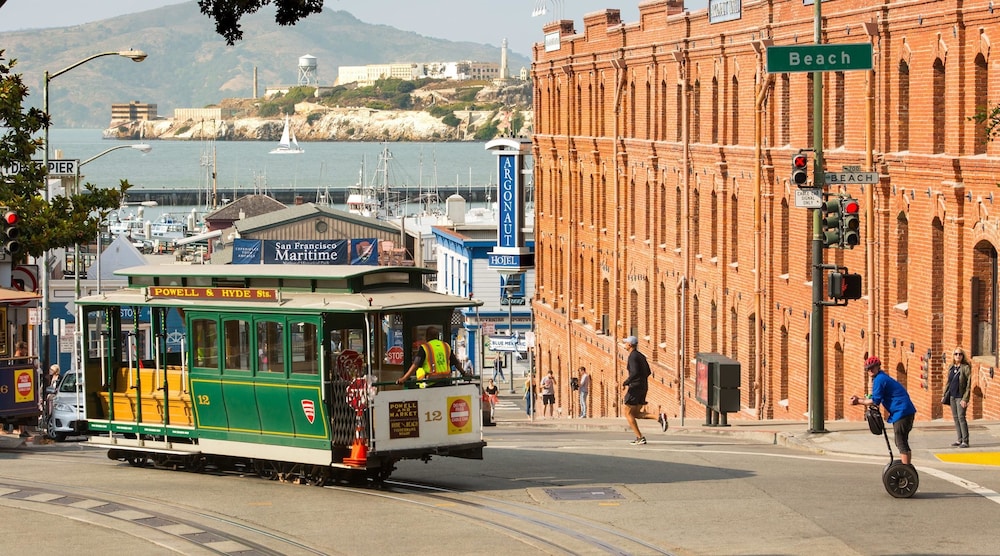
The last manually operated cable car system in the world, run as public transport rather than as a ride, boarded at a terminal kiosk with the day pass.
The Mission on foot
Clarion Alley and Balmy Alley for the murals, then a burrito and an ice cream within four blocks, on the sunny side of the city.
Golden Gate Park end to end
Larger than Central Park, with a Japanese tea garden, two major museums and a herd of bison in it, from the Haight to the ocean.
Lands End to the Sutro Baths
A coast path on the city's north-western corner with the bridge on one side and the ocean on the other, and the ruined baths at the end.
The neighbourhoods of San Francisco
Union Square and Nob Hill
Central and hotel-dense
The densest hotel supply in the city, on the cable car lines and walkable to most of the visitor list, with the shops around the square and the grand hotels on the hill. For first visits.
Central and on the cable cars, but the dearest rooms, with the Tenderloin a block away.
Fisherman's Wharf
The working pier turned waterfront
Sea lions at Pier 39, the Alcatraz ferry, the sourdough bakeries and the cable car turnaround, with hotels that have their own parking. For a first visit with a car.
The ferry and the parking, in the most touristy blocks in the city.
North Beach
The Italian quarter
City Lights bookshop, espresso bars, the Beat history and Coit Tower on the hill above, with Chinatown one block south. For evenings and history.
The cafés and the Beats, at a climb from everything and with few hotels.
The Mission
Murals, taquerias, the sunny side
Clarion and Balmy Alley murals, the burrito, the ice-cream institutions and the city's best bars, in the district the fog reaches last. For food and a second visit.
The sun and the food, and a Muni ride to every landmark.
Hayes Valley
Small, walkable, design-led
Boutiques and restaurants around Patricia's Green, with the concert halls and the civic centre next door and the Haight a walk west. For food and a quieter base.
Walkable and good for eating, and further from the sights than the map suggests.
Haight-Ashbury
Victorian streets, 1960s afterlife
Record and vintage shops, the painted ladies and Buena Vista Park's climb to a bridge view, with Golden Gate Park at the end of the street. For history and the park.
The park at the door and the Victorians, and a long ride to the waterfront.
See every San Francisco neighbourhood on one map
Save the areas you like and Stippl plots your days so you're not crossing the city twice.
Where to stay in San Francisco
Sleep around Union Square or Nob Hill for a first visit, the densest hotel supply, on the cable car lines and walkable to most of the list; Fisherman's Wharf suits a first visit with a car, and the Mission a second visit. Most travellers give San Francisco 2 nights on Stippl, and hotel parking is charged on top of the room.
Union Square and Nob Hill
€200–350
The city's hotel volume from chain rooms to grand hotels, €180 to €400 a double.
Fisherman's Wharf
€190–330
Mid-range hotels with their own parking near the ferry, €160 to €350 a double.
North Beach
€170–300
A few small hotels and guesthouses among the cafés, €150 to €300 a double.
The Mission
Apartments and a boutique hotel or two on the sunny side, €140 to €280 a double.
Hayes Valley
€180–310
Boutique hotels and apartments near the concert halls, €160 to €320 a double.
Haight-Ashbury
€140–240
Hostels and Victorian guesthouses by the park, €90 to €220 a double.


What to eat in San Francisco
A foil-wrapped burrito with rice, built in the Mission and now copied worldwide
A tomato and white wine seafood stew built from the day's catch
A sharply sour bread from a wild starter kept alive since the Gold Rush
A large, sweet Pacific crab, cracked and served cold or in cioppino
Steamed and fried small plates, ordered from trolleys or a card
An unusually serious local category, from a handful of Mission institutions
Discover food spots in Stippl
Find restaurants and markets on the map, save them to your itinerary, works offline too.
San Francisco customs and what not to do
Layers are not optional
The temperature swings eight to ten degrees between a sunny Mission afternoon and a foggy Ocean Beach evening, and locals carry a jacket in July.
Tipping is national
Fifteen to twenty percent in sit-down places and a dollar or two a drink, the same as everywhere else in the country.
Homelessness is visible
The city has a large street homeless population concentrated in specific blocks, and photographing people is the local faux pas.
Cannabis is legal, not public
Smoking it in the street or at public events is not allowed, the age limit is 21, and the dispensaries card at the door.
Tech is a job, not a sight
There is nothing to visit at any campus, and treating the industry as a sight reads as odd to the people who work in it.
Cable cars are transport
They run to a timetable as public transport, boarded at the terminal kiosks, and hanging off the side is allowed but the gripman decides.
Do
- Carry a windproof layer every single day, including in August
- Book Alcatraz the day your dates are fixed, and Muir Woods parking before you drive
- Buy a Muni day pass rather than single cable car tickets
- Ride the cable car from a terminal kiosk, where the fare is sold before boarding
- Have a fog alternative ready for the bridge day
Don't
- Leave anything at all visible in a parked car, including an empty bag
- Plan to swim at Ocean Beach; the rip currents are lethal and the fire department discourages it outright
- Assume summer means warm; July is often the coldest month a visitor experiences
- Build a two-day plan around the bridge photograph without a fallback
- Drive inside the city; pick the car up on the way out
What a San Francisco trip costs
Budget
€78–103
A hostel bed, a Muni day pass, taquerias and the free half of the sight list.
Mid-range
€129–189
A mid-range hotel room, the paid attractions, eating properly once a day.
High-end
€190+
A Nob Hill hotel, a car with its parking, a starred dinner.
Track what you actually spend
Set a daily budget per country and log expenses in any currency while you travel.
Fun facts about San Francisco
Golden Gate Park in San Francisco is larger than Central Park. About 1,017 acres against New York's 843, with a Japanese tea garden, two museums and a herd of bison inside it.
San Francisco's Chinatown is the oldest in North America. Settled from the 1850s Gold Rush and continuously inhabited since, it is one block south of the Italian cafés of North Beach.
Californios in the Mission is the first Mexican restaurant with three Michelin stars. The city holds four three-star kitchens and a burrito it invented, in the same square mile.
The San Francisco cable cars are the last manually operated system in the world. They run as scheduled public transport, and the gripman controls the car by clamping a cable moving under the street.
The Golden Gate Bridge is painted international orange to be seen in fog. The colour was chosen over the navy's grey and yellow stripes, and the painting never stops.
Alcatraz was a federal prison for only 29 years. From 1934 to 1963, and the island had been a fort and a military prison for eighty years before that.
Local tips for San Francisco
Flat below, cable car above
The waterfront, the Mission and Golden Gate Park are flat; Nob Hill, Telegraph Hill and Russian Hill are not, and that is what the cable cars and the Muni lines are for.
Buy the day pass
The one-day visitor passport covers Muni, the metro, the historic streetcars and the cable cars, against a single cable car ride that costs more than half of it.
Alcatraz sells out
Tickets go on sale 90 days ahead and summer dates sell out weeks in advance; people arrive to find nothing available for five weeks.
The break-in is the risk
It is the one crime a visitor actually meets, and the mitigation is absolute: leave nothing in the vehicle, including an empty bag, and park where the car is watched.
Crime has fallen sharply
The police department's own figures record crime down by a quarter and car break-ins down by nearly half in a year, and the older warnings have not caught up.
Two nights, or three
Most travellers give San Francisco 2 nights on Stippl and 28.5% of stops are exactly three, the single largest bucket, so the third night is the norm rather than the extra.
San Francisco questions, answered
Two to three nights covers the landmark list without rushing: most travellers give San Francisco 2 nights on Stippl, and 28.5% of stops are exactly three, the single most common stay. Two days for the bridge, Alcatraz and the cable cars, and the third for the Mission and the park.
Often, yes. The marine layer sits over the city from roughly June to August, July regularly feels colder than December, and the annual range downtown is only about 14 to 21 degrees. September and October are the warmest and clearest months, which is why the locals name them.
At the start or the end: it opens 45.0% of the trips it appears on, of everyone who plans it on Stippl, with Highway 1 and Yosemite in between. Put it into Stippl with three nights at one end, then ask people who have driven the loop, in subreddits like r/roadtrip, which direction to run it.
No, and one is a liability inside the city: parking is charged on top of the room, the hills are steep and the break-in is the crime a visitor meets. Walk, use Muni on a day pass, and pick the car up on the way out to Yosemite or the coast.
The day your dates are fixed. Tickets go on sale 90 days ahead and summer dates sell out weeks in advance, which is part of why most travellers plan San Francisco about 124 days days ahead on Stippl, longer than anywhere else in the country. The night tour is the one that goes first.
The realistic risk is a break-in to a parked car, so nothing stays in the vehicle, not even an empty bag. The police department's own figures put crime down by a quarter in a year and car break-ins down by nearly half, the visitor districts are safe by big-city standards, and the ocean's rip currents are the underrated danger.
Every guide is written by the Stippl editors and checked against the trips our travellers actually plan. Spotted something out of date? Let us know.

Plan San Francisco in Stippl
Day-by-day planning, stays and budget in one app, with every place from this guide already on the map.
Download the app