

Trincomalee
Trincomalee is dry when the south is under monsoon, with four kilometres of Nilaveli sand and almost nobody on it. Pigeon Island's reef, blue whales in the summer months, and a Shiva temple 130 metres above the sea.
Trincomalee in a nutshell
Trincomalee: what to expect
Read against 253,000+ planned stops in Sri Lanka on Stippl, this is how the east coast sits.
Trincomalee sits on a peninsula between one of Asia's finest natural harbours and the open sea, and the beaches are north of it. Nilaveli is four kilometres of wide golden sand fifteen kilometres up the coast and Uppuveli is the smaller, closer one where the evening happens. Koneswaram stands on a cliff 130 metres above the water inside Fort Frederick, which is still an army installation with a public road and a herd of spotted deer through it. Marble Beach round the harbour is the glassy, calm-water option.
Trincomalee is on a different loop from the rest of the country. Arugam Bay, Anuradhapura and Polonnaruwa all turn up on its trips far more than chance predicts, while the entire south coast turns up less. Doing both coasts costs both: a Trincomalee stay shortens when a southern beach is on the same trip, and the southern stay shortens too.
So come between May and September, when this coast is dry and the south is under monsoon, and give it 3 nights. That is the longest typical stay in the country and the town earns it, because it is six to seven hours from Colombo and three from Sigiriya. Rent a motorbike, because everything you came for is out of town and the tuk-tuk fares add up. Skip Trincomalee from October to January, when the northeast monsoon lands and much of the place closes.
Plan Trincomalee in Stippl
Day-by-day planning, stays and budget in one app, with every place from this guide already on the map.
Download the appWho Trincomalee is for
Summer travellers
Trincomalee's coast is dry when the south is under monsoon, and that is the whole case for the destination.
Anyone wanting an empty beach
Four kilometres of Nilaveli sand with almost nobody on it is not available on the south coast.
Divers and snorkellers
Pigeon Island is the draw, with reservations about which operators to use and where.
Whale watchers
The season runs in the summer months, and a careful operator makes the difference.
Long-loop travellers
Trincomalee sits on the longer Sri Lanka trips rather than the standard fortnight, and most people give it 3 nights.
Maybe not for you: anyone visiting October to January, when the northeast monsoon lands and much of the tourist infrastructure closes; and anyone on a short trip, because it is six to seven hours from Colombo and a long way from the standard loop.
The best time to visit Trincomalee
The season
May to September
Dry, calm, the whales, and the reason to come: this coast is open exactly when the south-west is under monsoon.
The shoulder
March, April and October
Workable, with real weather risk at both ends.
The monsoon
November to February
The northeast monsoon, and much of the tourist economy closed.
- From November to February much of the tourist infrastructure closes. Nilaveli's guesthouses and the dive shops shut for the monsoon; a winter visit is a visit to a town, not a beach.
- The whales are a summer sighting here, the opposite of Mirissa. Blue and sperm whales six to eight miles out from May to September; check the operator's distance policy before booking.
- Trincomalee is planned about 75 days ahead on Stippl, and 14.73% of its plans are made inside a fortnight. It sits on the longer loops, fixed with the east-coast leg.
- Pigeon Island's reef is a calm-sea plan. The boats run from Nilaveli in the season; from October the swell closes the crossing on many days.
Add your Trincomalee dates and we'll flag the weather
Stippl shows the season, crowds and prices for every stop on your route.
Describe your trip, get a Trincomalee itinerary in seconds
Everything in this guide is already in Stippl. Tell the planner how long you have and what you like: it builds the route, the days and the travel times, and you edit whatever you want.
Things to do in Trincomalee
 Photo by Ishan Kahapola Arachchi via Unsplash
Koneswaram Temple
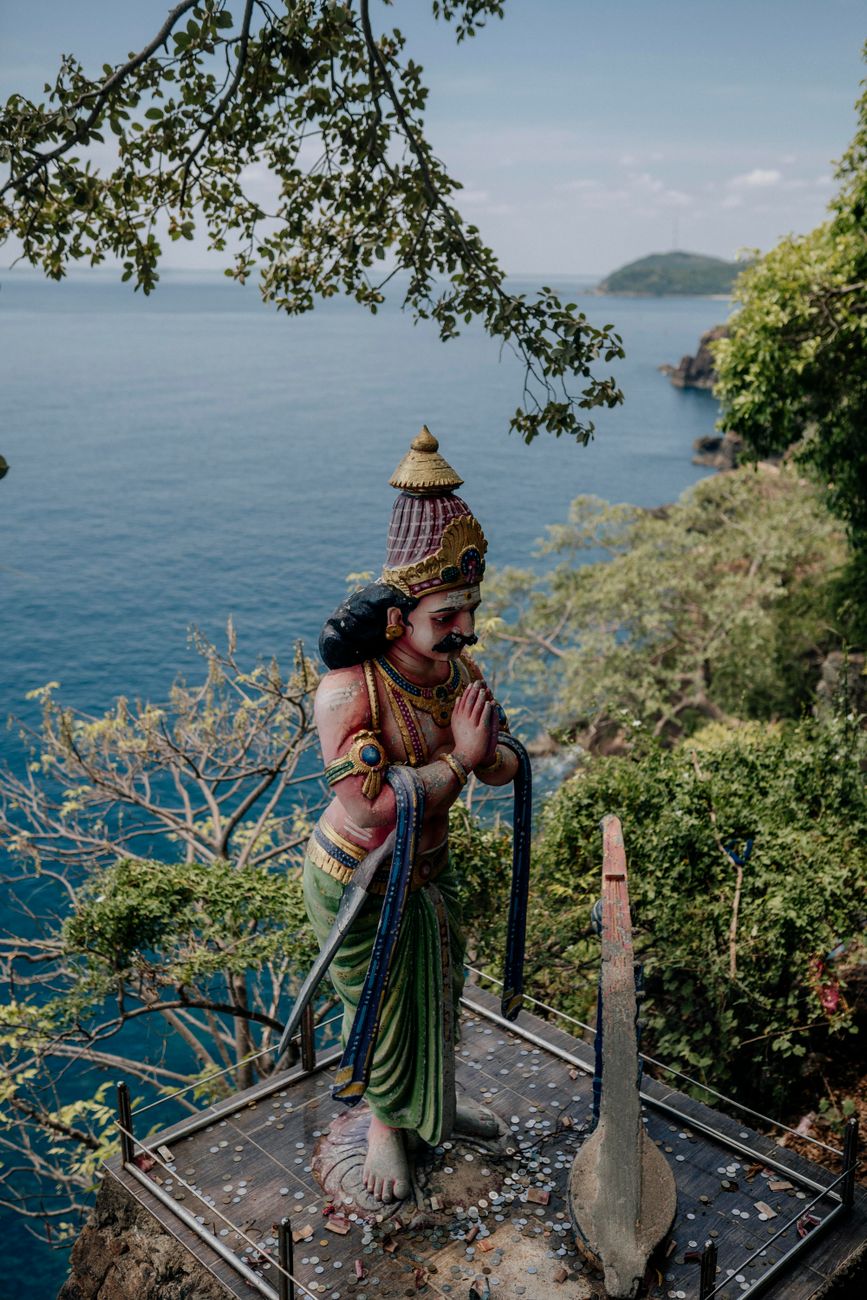
Climb Swami Rock to the Shiva temple on the cliff 130 metres above the sea, one of the five historic Shiva sites of the island, destroyed by the Portuguese in 1624 and rebuilt. Free, shoes off, and the lovers' leap is beside it.
Fort Frederick
Walk the public road through the fort, Portuguese, then Dutch, then British and still an army installation, with a resident herd of spotted deer. Free, open from six in the morning to ten at night.
Nilaveli Beach
Take the four kilometres of wide golden sand fifteen kilometres north, the reason most people come. Free, quietest midweek, and the tuk-tuk from town is about €5.
Uppuveli Beach
Spend the evening at the smaller beach closer to town, where the bars are and where a nightly local volleyball game welcomes visitors. Free, and the seafood restaurants on the sand grill from six.
Whale watching
Go six to eight nautical miles out for blue whales and sperm whales from May to October, about €40. Check the operator's distance policy; unethical boats are common here.
Pigeon Island
Take the boat from Nilaveli to the marine national park for snorkelling over the reef with blacktip sharks, about €25 with the park fee. The most-recommended and most-criticised trip here: go on the first boat, before the crowd and the coral damage.
The neighbourhoods of Trincomalee
Uppuveli
Beach bars, volleyball, default
Six kilometres north: guesthouses, beach bars, the evening volleyball game and the kitchens, on a good beach. For first visits and budget stays; the default base.
The beach and the evening on foot, and the busiest sand on this coast.
Nilaveli
Wide, empty, resorts thin
Fifteen kilometres north: a wider, emptier beach with resorts spread thinly along it and little else, and the boats to Pigeon Island. For families and for the sand without the bars.
Four kilometres of empty sand, and a tuk-tuk for dinner.
Trincomalee town
Fort, temples, market
The peninsula itself: the fort, the temples, the market and Dutch Bay, with a few plain hotels. For the sights on foot and for a night that nobody else takes.
Koneswaram on foot at dawn, and no beach and no bars.
Kuchchaveli
Private bays, isolated luxury
Twenty-five kilometres up: isolated resorts on private bays where the jungle meets the sand, and nothing else within reach. For a splurge and for silence.
The bay to yourself, and the resort's menu for every meal.
See every Trincomalee neighbourhood on one map
Save the areas you like and Stippl plots your days so you're not crossing the city twice.
Where to stay in Trincomalee
Stay in Uppuveli for a first visit: guesthouses, beach bars and the evening volleyball game on a good beach six kilometres from town, at prices Nilaveli's resorts do not match. Most people give Trincomalee 3 nights on Stippl, the longest typical stay in the country. Book fewer if the south coast is also on the trip.
Uppuveli
Beachfront guesthouses and the reliable mid-range resorts, €25 to €90, with hostels from €10.
Nilaveli
Resorts spread thinly along a wide empty beach, €60 to €180, with little else around them.
Trincomalee town
A few plain hotels near the fort and the market, €15 to €40, for the sights on foot.
Kuchchaveli
Isolated resorts on private bays where the jungle meets the sand, from €200.


What to eat in Trincomalee
The east coast's signature, cooked Tamil-style with more heat
The full spread, with the east's Tamil and Muslim inflections
Landed at the harbour and grilled on the beach
Chopped flatbread on a hot plate
Eggs, coffee, brunch plates, a real category here
Discover food spots in Stippl
Find restaurants and markets on the map, save them to your itinerary, works offline too.
Trincomalee customs and what not to do
Both great temples work
Koneswaram and the Pathirakali kovil are Hindu and in daily use: shoes off, shoulders covered, and the inner shrines are usually not for photographs.
Fort Frederick is military
The road through to the temple is open and the deer are the photograph; the outposts, the gates and the soldiers are not, and the guards will say so.
A Tamil-majority town
With a recent and violent history that people carry; the war is not a conversational topic to open, and the memorials are visited quietly.
Conservative beyond the beach
Beachwear stays on the beach at Uppuveli and Nilaveli; the town, the temples and the bus stand want covered shoulders and knees.
Do
- Rent a scooter; the coast road is empty and everything is spread along it
- Ask a whale operator about its distance policy before booking
- Check what is open before travelling between October and January
Don't
- Assume the south coast's season applies here; it is the exact opposite
- Touch the coral at Pigeon Island, what is left of it
- Plan to walk between the beaches; they are six and fifteen kilometres out
What a Trincomalee trip costs
Track what you actually spend
Set a daily budget per country and log expenses in any currency while you travel.
Fun facts about Trincomalee
Fort Frederick was built in 1624 from the stones of a destroyed temple. The Portuguese pulled down Koneswaram and reused it, and pieces of the original were recovered from the sea below the cliff in the 1950s.
Trincomalee's harbour is one of the finest natural deep-water anchorages in Asia. That is why the town has been contested since antiquity, and why it was a front-line position throughout the civil war.
Velgam Vehera carries Tamil inscriptions on a Sinhalese Buddhist monastery. Chola-era patronage of a site older than Christianity, a few kilometres from town, and almost nobody goes.
Trincomalee is planned with Arugam Bay more than any other pair in Sri Lanka. On Stippl the two east-coast stops appear together far more often than distance predicts, because they share a season.
This is a Tamil and Muslim town, not a Sinhalese one. The two great temples are Hindu, and the coast north of the town stayed undeveloped because of the war and the tsunami.
Most visitors sleep at Uppuveli or Nilaveli, not in town. The beaches are 6 and 15 km north, and the town is a half-day of temples and fort on a scooter.
Local tips for Trincomalee
Come from the cultural triangle
Sigiriya, Dambulla and Anuradhapura are all about three hours by road, about €40 by car; the train from Colombo exists and is slow. Most people come from the triangle, not the capital.
Rent a scooter
The roads are empty, hire is about €5 a day, and everything is spread along one coast: Nilaveli, Uppuveli, the springs and the ruins. Only the town itself walks.
How long to stay
Most people give Trincomalee 3 nights on Stippl, the east coast's beach base: Nilaveli, Pigeon Island and the temple. The next leg is usually Arugam Bay.
Calm only in season
The sea is calm from April to September and not outside it; October to January is the northeast monsoon on this coast, and the businesses thin out with the weather.
The beaches are unsupervised
No lifeguards, and the northern stretch is very lightly populated. Swim in front of the hotels, and take the usual care on isolated beaches after dark.
Out of season is thin
Fewer people, fewer open businesses and thinner transport, which is a practical safety matter as much as an inconvenience. Book the room and the boat before you come in the shoulder.
Trincomalee questions, answered
On the east coast, in the months when the south is under monsoon. Trincomalee carries 2.01% of everything planned in Sri Lanka on Stippl, the smallest of the main stops, because it only works from May to September. Put it into Stippl instead of the south, never alongside it.
Three nights. Across the Trincomalee stops planned on Stippl the usual is 3 nights, the longest of any stop in Sri Lanka, because people come here to stop moving. Whale trips, Pigeon Island and the hot springs fill it without any pressure at all.
It is a long way, and the people who go commit to it: only 15.25% of Trincomalee stops planned on Stippl are a single night, the lowest share on the island. Three hours from Sigiriya, six or seven from Colombo. Nobody drives that for one night on a beach.
Nilaveli for the better beach and the boats out to Pigeon Island; Uppuveli for the food, the bars and cheaper rooms, and it is nearer town. They sit a few kilometres apart on the same strip of coast, so a tuk-tuk between them takes minutes and costs almost nothing.
Three hours by bus from Sigiriya or Anuradhapura, which is how most people arrive, and six to seven from Colombo. There is a slow train from Colombo that eats most of a day. Coming off the cultural triangle it is the natural next move; from the south coast it is a haul.
For the snorkelling, yes, and go on the first boat before the day visitors land. It is a small national park island a short ride off Nilaveli, with reef close in to shore and blacktip reef sharks in the shallows. Bring your own mask if you have one, because the rental gear is tired.
Every guide is written by the Stippl editors and checked against the trips our travellers actually plan. Spotted something out of date? Let us know.
Plan Trincomalee in Stippl
Day-by-day planning, stays and budget in one app, with every place from this guide already on the map.
Download the app