Hikers
The peak ridge and the laurel-forest levadas are the draw, and 27.7% of Madeira trips on Stippl start in spring, the best walking season.
 PortugalMadeira
4 nights typical stay
Madeira stays mild when the rest of Europe turns cold, and a week works in January as well as June. Laurel forest on the levadas, lava pools for swimming and whales off Funchal all year.
Plan your Madeira days with AI

 Madeira
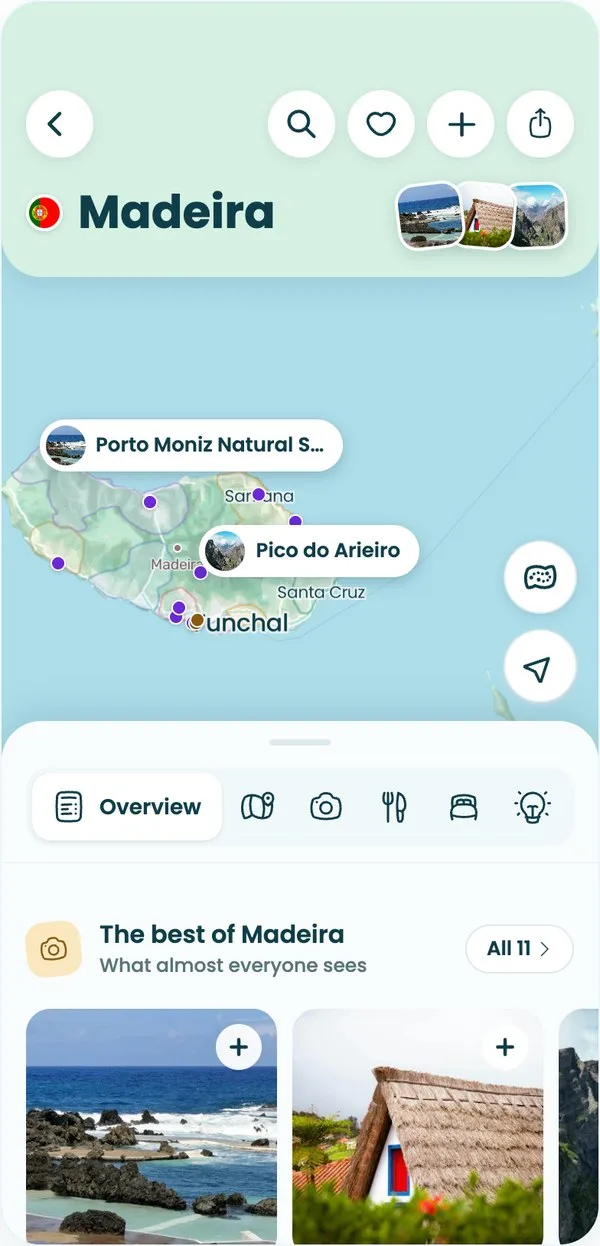
Madeira in a nutshell
Updated September 2026 · Written by the Stippl editorsThe island figures here come from Madeira's own plans on Stippl, which sit apart from the 127,000+ stops planned across the rest of Portugal.
Madeira is a full week for most people: 4 nights is the typical stay planned on Stippl, the longest of any Portuguese stop. You come for the walking: the ridge from Pico do Areeiro to Pico Ruivo, the levada paths through the Laurisilva laurel forest and the red cliffs of the São Lourenço peninsula. Between hikes there is Funchal's market, the cable car up to Monte and a wicker toboggan back down, and the coast stays mild all winter.
Madeira gets planned as a holiday, not as a leg of a longer route. 40.6% of the trips that include Madeira on Stippl carry no other stop at all. The stays bunch at a full week too: 13.1% of Madeira stops planned on Stippl run exactly seven nights, nearly three times the share that stop for two.
Fly in for seven nights and sleep in one place. From Funchal, or anywhere on the south coast between Caniço and Calheta, most of the island is half an hour to an hour away, so a single base covers a week. On a longer trip, give the last two nights to Porto Moniz or Santana for the lava pools and Fanal's fog forest before the tours arrive. When a second stop joins, it is usually the capital: 36.3% of Madeira trips on Stippl also carry Lisbon. Sand is the one thing the island lacks; the long beach is on Porto Santo.
 Madeira
Plan Madeira in Stippl
Day-by-day planning, stays and budget in one app, with every place from this guide already on the map.
Download the appHikers
The peak ridge and the laurel-forest levadas are the draw, and 27.7% of Madeira trips on Stippl start in spring, the best walking season.
Winter-sun seekers
Funchal stays around 20 °C from December to March while mainland Europe is cold, and winter is the cheapest season outside New Year.
Confident drivers
A car opens up the north coast, the pools and the trailheads, and the island rewards anyone happy to hill-start and park on a slope.
Families with children
The lava pools at Porto Moniz, the Monte cable car, the toboggan ride and the flat levadas all work with small children.
Food and wine lovers
Madeira cooks its own food, from beef espetada to scabbardfish with banana, and ages its fortified wine in lodges you can tour in Funchal.
Surfers off season
Porto da Cruz on the north-east coast holds the island's surf beach, best in the winter months when the walkers thin out.
Long-stayers and remote workers
Mild weather in every month and an established long-stay community make the island workable for a month or more.
Maybe not for you: beach-holiday travellers, since the island has almost no sand and the long beach is on Porto Santo; nervous drivers, as the roads are steep and narrow; and anyone with a fear of heights set on the famous ridge.
Best time: April-June and September-October
Spring
March to June
The best hiking months, with the trails drying out from May and the island in flower. The trails are quieter than in summer and the sea is still cool.
Summer
July and August
The warmest sea and the driest weather, and with them the crowds, the full trailhead car parks and the year's highest prices. August is also the wildfire season.
Autumn
September and October
A warm sea, thinner crowds and the wine harvest make September the strongest single month. The rain starts to return late in October.
Winter
November to February
Mild on the coast, wetter and often cloudy on the peaks, and the cheapest time to come, apart from the fortnight around Christmas and New Year.
Add your Madeira dates and we'll flag the weather
Stippl shows the season, crowds and prices for every stop on your route.
Everything in this guide is already in Stippl. Tell the planner how long you have and what you like: it builds the route, the days and the travel times, and you edit whatever you want.
The Pico do Areeiro to Pico Ruivo ridge
Walk the stairways, tunnels and knife-edge ridges between the island's two highest peaks. The far section runs one way only, the slot costs €10.50, and you need a lift back from Achada do Teixeira.
A levada walk in the laurel forest
Follow the irrigation channels through the UNESCO laurel forest, past tunnels and waterfalls. Caldeirão Verde above Santana and 25 Fontes from Rabaçal are the classics, each with a booked €4.50 slot.
The São Lourenço peninsula
Walk about 7.5 km there and back over red and ochre volcanic rock on the dry eastern tip. There is no shade, so start early; bus 113 runs to the trailhead from Funchal.

Monte by cable car and toboggan
Ride the cable car about 580 m up from Funchal, walk the Monte Palace gardens, then take the wicker toboggan 2 km down with two runners steering. The cable car is €22 return.
The lava pools at Porto Moniz
Swim in the volcanic rock pools on the north-west coast, with lifeguards and changing rooms at Porto Moniz and wilder pools at Seixal. All of them close when the sea is rough.
Whale and dolphin watching
Pilot and sperm whales live off Madeira all year and blue whales pass from about April to November. Boats from Funchal and Calheta run two to three hours, from about €30.
Photo by Colin Watts via Unsplash
Funchal Old Town
Market, wine lodges, late dinners
The capital's old core: the Zona Velha, the cathedral, the market and the wine lodges, with every bus and island tour starting close by. For first-timers and anyone not driving.
Why visit: Everything on foot and every tour from the door, but an uphill walk home.
Funchal hotel zone
Cliff-top hotels and sea pools
The newer west side of the city towards the Doca do Cavacas pools, lined with large hotels with pools on the cliffs. For families and resort stays with the centre a short taxi away.
Why visit: Pools and sea access, and the Old Town a taxi ride rather than a stroll.
Ponta do Sol and Ribeira Brava
Sunny coast, small harbour towns
Small towns on the sunniest stretch of the south-west coast, beside the tunnel road that crosses to the north. For couples and drivers who want a central base outside the city.
Why visit: The most sun on the island, and a car for everything.
Calheta
Sand, marina, resort pools
A south-west town with a marina, one of the island's few sandy beaches and several resorts on the dry side. For families and beach-minded travellers who will drive most mornings.
Why visit: Real sand and sunshine, but an hour to the eastern trailheads.
Machico and the south-east
Airport side, apartments, trailheads
Machico, Santa Cruz and Caniçal sit close to the airport and the São Lourenço trail, with apartments rather than big hotels. For hikers and anyone on a tighter budget.
Why visit: Cheaper beds and fewer crowds, but far from the western half.
Santana and Porto da Cruz
Green, wet, thatched houses
The greener, wetter north-east coast, with Santana's thatched houses, the forest trailheads and a surf beach at Porto da Cruz. For hikers who want early starts on the forest levadas.
Why visit: First on the forest trails, and more cloud than the south.
Porto Moniz and Seixal
Lava pools, black sand, fog
The remote north-west of lava pools, black sand and the Fanal forest, about an hour from Funchal through the tunnels. For a second base on a longer trip and for early swimmers.
Why visit: The pools before the tour buses, and a long drive to everything else.
See every Madeira neighbourhood on one map
Save the areas you like and Stippl plots your days so you're not crossing the city twice.
Stay in Funchal if you will not drive, and anywhere on the south coast between Caniço and Calheta if you will: from either, most of the island is under an hour away. 47.8% of Madeira trips on Stippl never leave the island, and one base covers a week; split ten nights and give two or three to the north coast.
Guesthouses, boutique hotels and hostels in old townhouses, €50 to €130 a night, and a hostel bed from about €15.
Large four- and five-star hotels with pools and sea access, roughly €120 to €300 a night.
Ponta do Sol and Ribeira Brava
Small design hotels and rental apartments with sea views, about €80 to €150 a night.
Resorts with pools by the marina and holiday apartments, about €90 to €200 a night.
Apartments and small hotels at the lower end of the island's prices, about €50 to €100 a night.
Rural quintas, simple beach hotels and a few spa hotels in the hills, €60 to €180 a night.
Small hotels and guesthouses by the pools and rural houses inland, about €60 to €130 a night.
Beef chunks grilled on a skewer, traditionally a bay-laurel stick, at grill restaurants across the island
Round flatbread with sweet potato in the dough, served hot with garlic butter, and as a sandwich, the prego no bolo do caco
Fried fillet of black scabbardfish with banana, the island fish, in Funchal and the fishing villages
Limpets grilled with garlic, butter and lemon, at seaside restaurants in Porto da Cruz and São Vicente
Fried cubes of cornmeal, the usual side dish with espetada
Bite-sized beef in a garlicky sauce, a sharing plate at tavernas across the island
Dense, spiced cake made with sugar-cane honey, from bakeries, above all in December
Sugar-cane spirit with honey and lemon, sometimes passion fruit or orange, at the poncha bars of Serra de Água and Funchal
Fortified wine aged by heat, from dry Sercial to sweet Malmsey, poured at the wine lodges of Funchal and Câmara de Lobos
Chestnut soup, cakes and liqueur in Curral das Freiras, the Nuns' Valley
Discover food spots in Stippl
Find restaurants and markets on the map, save them to your itinerary, works offline too.
Christmas is the big party
Madeirans abroad come home for December, so rooms, restaurants and the all-night market fill with families, not visitors.
Levadas are working water
The channels still carry irrigation water to terraces, banana plantations and vineyards, and the path you walk is the one the maintenance crews use.
Trail rules are enforced
Walkers who ignore a closure or leave the classified trails can be billed for their own rescue, helicopter included.
The toboggan is a tradition
The runners in white with straw hats steer the wicker sledge that once carried people and produce from Monte down to Funchal, and the ride is still theirs.
Weekends belong to families
The Queimadas forest park and the other picnic spots fill with local families and barbecues on Saturdays and Sundays, so walk the popular forest trails on a weekday.
Some Santana houses are homes
A few of the thatched A-frame houses in the centre are open to visitors, while the others are private homes or holiday lets, so look at those from the street.
Do
Don't
Backpacker
€75 to €95 pp
A hostel bed or cheap room in Funchal, buses and one or two trail slots, and market and snack-bar food.
Mid-range
€135 to €265 pp
A double in Funchal or on the south coast, a small hire car, restaurant dinners, a whale-watching trip and trail fees.
High-end
€265 to €360 pp
A resort on the Funchal cliffs or at Calheta, a private driver or guided hikes, fine dining and boat trips.
Typical prices
Track what you actually spend
Set a daily budget per country and log expenses in any currency while you travel.
Funchal's New Year fireworks set a world record in 2006. Guinness certified that display as the largest anywhere, a title other shows have taken since.
The island's airport is named after Cristiano Ronaldo. He was born in Funchal, and the city also has a museum of his trophies.
Heat is part of the recipe for Madeira wine. The estufagem process copies the warmth that improved the wine in ships' holds on long tropical voyages.
Winston Churchill painted the harbour at Câmara de Lobos in 1950. A plaque marks the spot, from a stay at a hotel on the Funchal cliffs.
The last Habsburg emperor, Charles I, is buried at Monte. He died in exile on the island and lies in the church of Our Lady of Monte above Funchal.
The levadas of Madeira run for about three thousand kilometres. They carry water from the wet north and the mountains to the dry south, and their maintenance paths became the walking network.
The Laurisilva of Madeira joined the UNESCO World Heritage list in 1999. It is the largest surviving area of laurel forest, and most of it is thought to be primary forest.
Rent a small automatic
The gradients are steeper than most drivers have met, with hairpins, tunnels and hill starts, so a small automatic with hill-start assist is worth the extra cost.
Stop to join the via rápida
The expressway has short slip roads or none, and traffic already on it has priority, so stop at the end of the ramp and wait for a gap.
Download the map first
Tunnels cut the signal, often just before a roundabout, and navigation apps send cars down steep village shortcuts. Set the car park as the destination, not the sight.
Trailheads fill by eight
In summer the car parks at the popular trails, pools and viewpoints are full by about eight in the morning, so arrive before then or late in the afternoon.
The 113 reaches São Lourenço
Bus 113 from Funchal runs to the peninsula trailhead, the one classic walk that works without a car.
Ten days means two bases
A typical trip with Madeira in it runs 9 days on Stippl. With ten or more, spend the last two or three nights on the north coast for the pools and Fanal early.
With the base, before any trail. Decide whether you will drive, pick Funchal or the south coast to match, then lay the days out in Stippl around the weather: the ridge and the levadas on clear days, Funchal and the pools on cloudy ones. That plan is worth showing to people who have been, in subreddits like r/Madeira or the Facebook groups, saying how fit you are.
A week, and more if you hike. A full week is the common length: 13.1% of Madeira stops planned on Stippl run exactly seven nights, the length that fits the ridge, two or three levadas, the eastern peninsula and a day each for Funchal and the north-west pools. Ten days adds a north-coast base or a ferry to Porto Santo.
Further ahead than for the rest of the country. Travellers planning Madeira on Stippl set the trip up about 80 days before they leave, against 67 days for Portugal as a whole. The Christmas to New Year fortnight and the summer go first, and hire cars run short in peak season, so reserve one with the flight.
It does, though it works best as a week of its own. 20.1% of the Madeira trips people build on Stippl carry ten or more stops, usually with Lisbon as the way in or out. Give the island several nights even then, because one day of cloud on the peaks can take out the ridge walk.
For most people on Madeira, yes. A car opens the north coast, the pools and the early trailhead starts, and the roads are steep enough to want a small automatic. Without one, base yourself in Funchal: city buses, the regional lines to both ends of the island, day tours, Bolt and private drivers cover the main sights, though buses are slow for trailheads.
Yes. Every classified trail on Madeira needs an online slot booked ahead, with a half-hour arrival window that rangers check, and the full ridge walk carries a higher fee than the rest. Children and residents walk free but still book. A trail missing from the booking portal is closed or not managed, so leave it out of the plan.
Every guide is written by the Stippl editors and checked against the trips our travellers actually plan. Spotted something out of date? Let us know.
Day-by-day planning, stays and budget in one app, with every place from this guide already on the map.