

Byron Bay
Byron Bay is where you learn to surf at Main Beach and graduate to The Pass, with whales watched free from the cape and yoga at any hour. The cape walk at sunrise passes koalas in the eucalypts.
Byron Bay in a nutshell
Byron Bay: what to expect
Our travellers have planned 366,000+ stops in Australia on Stippl. That is where the numbers here come from.
Byron Bay is the most easterly point of mainland Australia, and the lighthouse walk at sunrise is the reason to set an alarm. The loop runs three and a half kilometres past the cape, with koalas in the eucalypts if you are early enough, and it costs nothing. The Pass is the point break everyone is working towards and Main Beach is where the lessons happen. Whales pass between June and November, close enough to watch from the cape with binoculars and no boat at all.
Byron Bay is the closest thing Australia has to a destination people choose rather than pass. Barely one stop in a hundred here carries no night, the lowest rate of any large Australian destination and a tenth of Brisbane's. Byron Bay and Brisbane also function as one planning unit: a hundred and sixty-five kilometres apart, and each is the other's strongest ordinary partner.
Byron works at 3 nights, and at more than that if you want the shire behind it. Killen Falls has a cave behind the water, Minyon drops about a hundred metres in Nightcap, and Nimbin is the counterculture village that came out of the 1973 Aquarius Festival. You will want a car for any of it. Skip Byron in the January school holidays without a booking, and skip it entirely if you are counting money, because the town is not cheap.
Plan Byron Bay in Stippl
Day-by-day planning, stays and budget in one app, with every place from this guide already on the map.
Download the appWho Byron Bay is for
Surfers at every level
Beginner lessons at Main Beach, and The Pass as the point break once you are competent.
Wellness travellers
Yoga, pilates and bodywork are available essentially every hour, and the hinterland retreat scene sits behind it.
Whale watchers
Cape Byron is one of Australia's best land-based whale sites, so this works with no boat and no budget.
Backpackers
A dense, socially organised hostel scene with shuttles and free boards, and most people give it 3 nights.
Foodies
The hinterland and the Industrial estate carry more of the food story than the beachfront.
Maybe not for you: car-free travellers who want the hinterland, since public transport is thin; anyone visiting in the January school holidays without a booking; and travellers on a tight budget, because Byron is not cheap.
The best time to visit Byron Bay
Summer
December to February
Warm sea, the wettest months and a town that more than triples in January, with rooms booked months ahead and the streets full. Fine for the beach, hard for everything else.
Autumn
March to May
Warm water, thinning crowds and lower prices, with Bluesfest over Easter the one week that fills the town again. The consensus best.
Winter
June to August
Mild, drier and the value season, with the whales passing the lighthouse from June and the bigger surf swells arriving. Some businesses run reduced hours.
Spring
September to November
The driest month in September with the whales at their peak, the sea warming through November and the town quiet before the summer surge.
- January is the month most travellers plan Australia for on Stippl, and Byron Bay is planned about 94 days ahead. Only 11.1% of Byron plans are made inside a fortnight, and in January that share finds no room at all.
- January is the month to book months ahead or to skip. The town's population more than triples over the school holidays; a Christmas to Australia Day stay is planned the previous winter or it is planned in Ballina.
- Bluesfest at Tyagarah over Easter is the surviving major festival. Splendour in the Grass did not run in 2024 or 2025 and is not returning as an annual fixture; any guide that lists it as a July event is out of date.
- The whales are watched from the lighthouse walk for free from June to November. The Cape Byron headland is the easternmost point of the mainland and the humpbacks pass close; September is the peak.
Add your Byron Bay dates and we'll flag the weather
Stippl shows the season, crowds and prices for every stop on your route.

Describe your trip, get a Byron Bay itinerary in seconds
Everything in this guide is already in Stippl. Tell the planner how long you have and what you like: it builds the route, the days and the travel times, and you edit whatever you want.
Things to do in Byron Bay
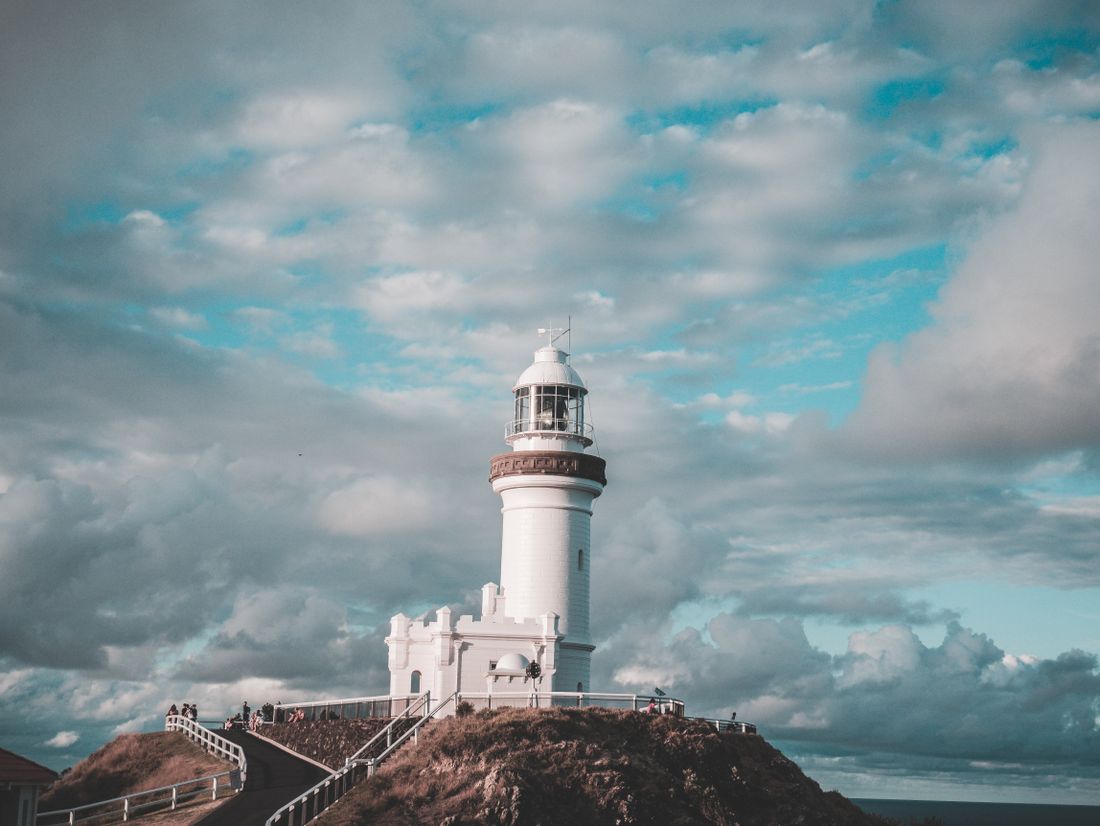
 Photo by Rachel Claire via Pexels
The lighthouse walk at sunrise
Walk the 3.7-kilometre loop to Cape Byron, the most easterly point of the mainland, one to three hours with koalas sometimes in the eucalypts. Free, and the whales pass close from June to November.
Whale watching
Watch the humpbacks from the cape, Captain Cook Lookout and Tallows Beach with binoculars for free, or take a boat with a hydrophone, about €80, from June to November. September is the peak.
Surfing The Pass
Ride the point break next to Clarkes Beach, the prize of the bay, or learn at Main Beach in a small-group lesson for about €40. The Pass on a small day is the most crowded wave in the country.
Sea kayaking from Main Beach
Paddle out with dolphins and turtles for two and a half to three hours, about €50; only two operators are licensed in the bay. Mornings have the flat water.
Julian Rocks
Snorkel or dive the marine reserve five minutes offshore for turtles, rays and leopard sharks in summer, about €60 for a snorkel trip. The visibility is best from April to July.
The hinterland waterfalls
Drive forty minutes to Killen Falls with its cave behind the water and Minyon Falls dropping a hundred metres in Nightcap National Park, free. No swimming below Minyon, to protect the barred frog.
The neighbourhoods of Byron Bay
Jonson Street
The dense strip, buskers
The town centre: cafés, bars, buskers and the backpacker hostels on the densest strip, with Main Beach at the end of the road. For first visits and nightlife.
Everything on foot and the beach, and the buskers from breakfast to bar close.
Fletcher Street
Hostel cluster, toward the beach
The hostel-dense budget zone running toward the beach, with shuttles into town and boards to borrow. For backpackers and anyone on a budget who wants the sand on foot.
Cheap beds by the beach, and a hostel's hours.
Wategos
Clifftop enclave, calm water
The small clifftop enclave under the lighthouse with the calmest swimming in town and Byron's priciest houses, and a few boutique stays. For a splurge and for couples who want the cove.
The best swimming and the quiet, and prices to match the address.
Belongil
Beach hostels, a walk from town
Beach and hostels a fifteen-minute beach walk from town, with the dog beach and the sunset side. For quiet with beach access and for people who like the walk.
Quiet and the sand, and a walk along the beach for everything.
The Industrial Estate
Bakeries, brewery, yoga studios
The Arts and Industry Estate: bakeries, the brewery, yoga studios and surfboard shops where locals eat, with a few apartments and the hostels' overflow. For value and for eating where the town does.
Better food for less, and a bicycle or a bus to the beach.
Suffolk Park
Residential, south of town
The residential suburb south of town with Tallow Beach behind it, holiday houses and a small shopping centre. For families with a car and for longer stays.
Space and value, and a car for every trip to town.
See every Byron Bay neighbourhood on one map
Save the areas you like and Stippl plots your days so you're not crossing the city twice.
Where to stay in Byron Bay
Stay on Fletcher Street or just off Jonson Street for a first visit: the hostels there run shuttles into town and lend boards, and Main Beach is at the end of the road. Most people give Byron Bay 3 nights on Stippl. Book far ahead for summer and any festival weekend; it is the most repeated instruction about this town.
Jonson Street
Backpacker hostels on the main strip, €35 to €55 a bed, and motels and boutique hotels €150 to €300.
Fletcher Street
The hostel-dense budget zone, dorms €30 to €50, with the surf shuttles at the door.
Wategos
A few boutique stays and the town's priciest houses under the lighthouse, from €400.
Belongil
Beach hostels and cabins a fifteen-minute walk along the sand, €30 to €50 a bed and cabins from €150.
The Industrial Estate
A few apartments and the hostels' overflow houses, €120 to €220, where locals eat.
Suffolk Park
Holiday houses and family rentals behind Tallow Beach, €200 to €450 a night, cheaper by the week.


What to eat in Byron Bay
dense, vegetarian-leaning café culture at premium prices
working farm with a restaurant, bakery and produce store
distillery tour built around native Australian botanicals
the town's sunset ritual, eaten on the grass
sunset barbecue on the sand
Discover food spots in Stippl
Find restaurants and markets on the map, save them to your itinerary, works offline too.
Byron Bay customs and what not to do
The hippie story is sold here
The town trades on it and what you meet now is a resort town with that inheritance; the markets, the buskers and the barefoot dress code are the surviving part.
Busking is the soundscape
It defines Jonson Street and Main Beach; drop a coin, do not stop the set to talk, and the drum circle on the beach at sunset is open to anyone who sits.
Photo ID gets you in
Any bar or club in Australia asks for it at the door, whatever your age looks like; a passport photo on a phone does not count, so carry the card.
Wollumbin must not be climbed
Mount Warning's summit trail is closed at the request of the Bundjalung custodians and the mountain is Aboriginal land; it is an etiquette fact before it is a safety one.
Do
- Walk the cape at first light; it is the town's own ritual, not just a tourist one
- Book everything for summer and festival weekends well ahead
- Respect the closure at Wollumbin
- Carry photo ID for the bars
Don't
- Swim at Tallow Beach; the sea there is rough
- Assume the hinterland is reachable without a car
- Treat Splendour in the Grass as an annual fixture
- Feed the wallabies at the lighthouse
What a Byron Bay trip costs
Track what you actually spend
Set a daily budget per country and log expenses in any currency while you travel.
Fun facts about Byron Bay
Cape Byron is the first place on mainland Australia to see each sunrise. It is the most easterly point of the continent, and the lighthouse on it is the country's most powerful, visible 26 nautical miles out.
The lighthouse had resident keepers until 1989. It opened in 1901 and was automated 88 years later; the keepers' cottages are now holiday lets.
Byron Bay was a swamp before it was a town. Cumbebin Swamp Nature Reserve preserves the wetland, and its 5 cm eastern long-eared micro-bat keeps the mosquitoes down.
Nimbin became Australia's counterculture capital after the 1973 Aquarius Festival. The hinterland village an hour inland kept the festival's crowd, and it is still the day trip from Byron for that reason.
The population roughly triples in the school holidays. From about 9,000 to over 30,000, which is when the traffic, the prices and the crowds every guide warns about arrive.
The town's Aboriginal name is Cavvanbah, the meeting place. The English name comes from John Byron, grandfather of the poet, and the Arakwal people co-manage the national park that holds Tallow Beach.
Local tips for Byron Bay
A car unlocks the hinterland
Without one you have the town and the cape, which is a real holiday; with one the waterfalls, Nimbin and the outer beaches open up. Parking in town is paid and scarce in January.
The campervan route
Van life is a standard way to arrive on the east coast and Byron is on the route. The council enforces the no-camping rules on the beach car parks; book a site.
Wollumbin is closed
The summit track has been shut since 2020 at the request of the Bundjalung elders and remains so. Any guide describing the climb as current is wrong; the lighthouse walk is the view.
How long to stay
Most people give Byron 3 nights on Stippl: the lighthouse at sunrise, a surf lesson and a hinterland day. The January crowd triples the town.
Check SharkSmart first
This coast has a documented incident history and an active drone and drumline programme. Avoid dawn, dusk and murky water, and stay out of Tallow's surf; The Pass is dangerous in winter swell.
The lighthouse walk is exposed
It climbs, it has no shade and people do it at midday. Water, a hat and the early morning, and the flags at Main Beach for the swim afterwards.
Byron Bay questions, answered
As a stop you deliberately slow down in. Trips that include Byron Bay run 53 days on Stippl, among the longest in Australia, because it belongs to working-holiday and long-run itineraries rather than fortnights. Put three nights into Stippl with a hinterland day among them.
Three. 3 nights is the normal stay in the Byron Bay stops planned on Stippl, which covers the lighthouse walk out to the cape, a surf lesson and one long slow beach day. Longer if the hinterland, Nimbin and the waterfalls are going in too.
Almost nobody does it: only 17.1% of Byron Bay stops planned on Stippl are a single night, one of the lowest shares in Australia. The town runs on a slow rhythm, sunrise at the cape and sunset on the beach, and one night gets you neither of them properly.
Yes, and it is one of the best land-based spots on the coast. Cape Byron, Captain Cook Lookout and Tallows Beach all look straight out over the migration route, and humpbacks pass from around June to November. Take binoculars and go in the morning, when the water is flattest.
Changed, developed, crowded and a great deal more expensive, and every guide says so. The energy is still there in the markets, the hinterland towns and the early morning beach, and it now sits alongside boutique hotels and a serious housing crisis. Go inland to Bangalow or Mullumbimby for the older version.
No. The summit track has been closed for years and the traditional owners ask that people do not climb it, regardless of what an article with a recent date on it tells you. There are alternatives with the same views inland: Minyon Falls and the Nightcap range are the usual answer.
Every guide is written by the Stippl editors and checked against the trips our travellers actually plan. Spotted something out of date? Let us know.
Plan Byron Bay in Stippl
Day-by-day planning, stays and budget in one app, with every place from this guide already on the map.
Download the app