| Length | 243 km, 4 hours nonstop one way |
| Route | Melbourne to Torquay to Lorne to Apollo Bay to Port Campbell |
| Ideal time | 2 to 3 days. One day works if you drive it in reverse |
| Best time | March to May and September to November. Whales off Warrnambool May to October |
| Budget per day | €43-81 (A$70-130) budget · €93-155 (A$150-250) mid-range |
| Book ahead | Coastal beds and campsites for late December to January and Easter |
| Stippl tip | Melbourne and this road pair more strongly than any other two places we measure |
Plan Australia in Stippl
Day-by-day planning, stays and budget in one app, with every place from this guide already on the map.
Download the appHow long do you actually need?
Three days is the version the road was built for, and it is the one below. You get the surf coast, the rainforest and the limestone stacks as three separate days rather than three blurred windows, and you sleep twice on the coast instead of driving home in the dark.
Two days is the sensible compromise and loses the least. Skip the Otways detour, sleep once in Apollo Bay, and give the whole of day two to the Port Campbell end. Almost everyone who has done both says this is the minimum that still feels like a trip.
One day is possible and it is a nine to ten hour day of moving. If it is your only option, do not drive the road the way the map suggests. Take the inland highway straight to Port Campbell, see the Twelve Apostles in the morning, and work back east along the coast in the afternoon. Every coach leaves Melbourne at roughly the same time and travels in the same direction, so running it backwards means arriving at the famous stops while everyone else is still on the way and leaving them as the buses pull in.
That direction rule is the single most useful thing on this page and no competing itinerary mentions it.
Our own numbers say the road matters more to a Melbourne trip than most people assume. The Great Ocean Road appears on 5.0% of Melbourne trips against 1.9% of Australian trips overall, which makes it the strongest pairing of any two places anywhere in our data. It is not a side trip that people bolt on. For a lot of travellers it is the reason Melbourne went on the list.
If you are still weighing this up against the Yarra Valley or Phillip Island, that comparison lives in our guide to the best day trips from Melbourne. This page assumes you have picked the road.
Describe your trip, get a Great Ocean Road itinerary in seconds
Everything in this guide is already in Stippl. Tell the planner how long you have and what you like: it builds the route, the days and the travel times, and you edit whatever you want.
Getting there: Melbourne to the start of the road

The road proper begins at Torquay, one hour south-west of Melbourne down the highway past Geelong. That first hour is the least interesting driving of the whole trip and it is worth getting out of the way early: leave the city before the morning traffic and you are at the coast before most people have finished breakfast.
Pick the hire car up on your way out of town rather than in the middle of it. Melbourne's CBD has trams with right of way, hook turns where you make a right turn from the left lane at signed intersections, and parking prices that argue against ever driving into the grid. Expect around €50 to €62 a day (A$80 to A$100) for a car with full insurance, and book it months rather than days ahead: Australian vehicle rates move sharply with demand and booking early can nearly halve them.
If you would rather not drive at all, take a tour. On this road that is a legitimate choice rather than a compromise, because the good bits are the views and the driver does not get to look at them.
Torquay, Bells Beach and Lorne
The surf coast day, and the gentlest of the three. Torquay is where Australian surf culture came from and Bells Beach is the name attached to it, a proper reef break with a wide amphitheatre of a car park above it that fills with people watching rather than paddling. It is a good first stop precisely because it sets the tone: this coast is wild rather than pretty.
From there the road starts doing what it is famous for, hugging the cliff between the sea and the hills, past the memorial arch that everyone pulls over to photograph. The road was built by soldiers returning from the First World War, which is where that arch comes from.
Lorne is the first town that feels like somewhere to stop rather than pass. It sits where the Otway hills come down to the water, and it is far enough from Melbourne that the day-trippers have not caught up with you yet.
One warning before you swim anywhere along here. These are ocean beaches, not bay beaches, and the difference matters more than it looks on a map. Bells, Ocean Grove and Point Lonsdale carry serious rips and a long fatality record, and a calm morning at St Kilda tells you nothing about what this coast is doing. Surf Life Saving Australia's 2025/26 report recorded 154 coastal drowning deaths nationally, every one of them away from the flags or outside patrol hours. Swim between the red and yellow flags on a patrolled beach, and nowhere else.
Sleep: Lorne is the night-one stop on a three-day run, and it is the priciest of the three coastal towns because it is the closest to Melbourne. Holiday parks are the standard here as they are all along this coast, cabins included, and a campsite runs about €42 (A$68) a night against €208 (A$335) for a hotel room, which is the widest gap between those two options anywhere in our Australian data. Two things to know before you plan around it: free camping is not legal at Victorian highway rest stops the way it is in New South Wales, and campground gates on this coast can close as early as 8 pm, so a late dinner needs checking first.
The Otways and Apollo Bay
Day two turns inland and it is the day most one-day trips lose. Behind Lorne the road climbs into the Otway ranges, and the landscape changes completely: temperate rainforest, tree ferns, waterfalls and a canopy thick enough that it goes dim at midday. Coming from the surf coast an hour earlier, it does not feel like the same state.
On the way through, Kennett River is the reliable place to see wild koalas from the road, which is a very different experience from a sanctuary and costs nothing.
Apollo Bay is the natural end of the day and the better of the two overnight towns if you are only stopping once. It sits at the point where the road leaves the coast to cross the ranges, which makes it the last easy sea view for a while and the obvious base for anything in the Otways. Check track and park status with Parks Victoria before you commit to a walk.
A weather note that is not a joke here. Melbourne's four-seasons-in-one-day reputation is a packing instruction, and the two places it bites hardest are Great Ocean Road walks and the Grampians. A warm start at the car park says nothing about a ridge two hours later. Carry a warm layer and a raincoat on any walk on this road, in any month, and check the forecast at bom.gov.au rather than the sky.
Sleep: Apollo Bay is the night-two stop, and it is the one worth booking first if you are travelling between late December and late January or over Easter. Those are the two windows where coastal campsites and cabins fill nationwide, not just here.
Port Campbell, Loch Ard Gorge and the Twelve Apostles
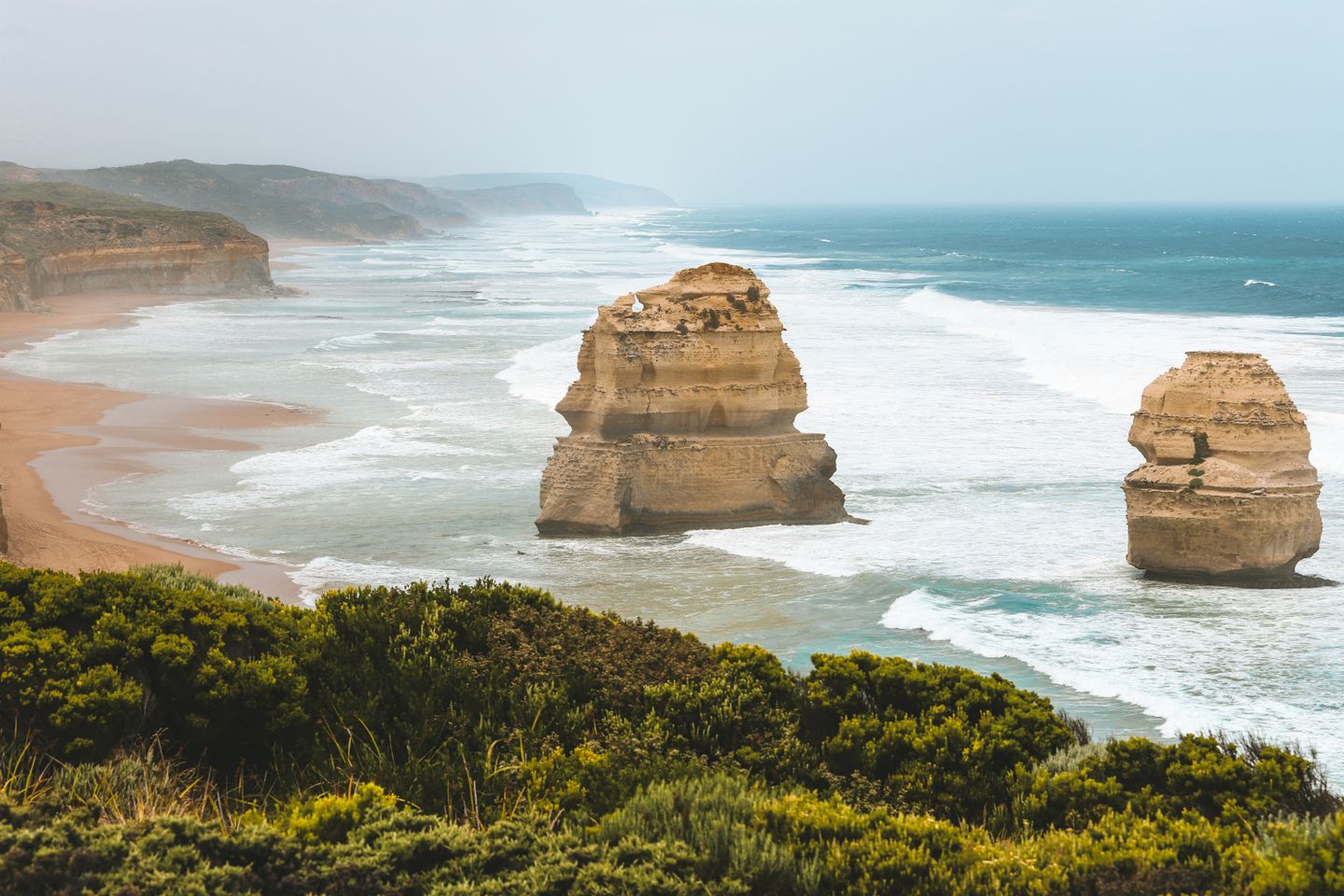
This is the day the postcards come from. The Twelve Apostles are limestone stacks standing off a cliff face that the Southern Ocean is still eating, and they sit about 275 km from Melbourne, which is why compressing this road into a day hurts.
One thing worth knowing before you count them: there have never been twelve. There were eight to begin with, and there have been seven since one collapsed in 2005. The name was marketing and the sea has been editing it ever since.

Loch Ard Gorge is a few minutes along the same stretch and is the stop most day trips skip for time, which is the argument for the extra night in one sentence. It is a beach at the bottom of a cleft in the cliffs, reached by steps, and it is the one place on this coast where you get down to sea level inside the rock rather than looking at it from above.
West of there the road runs on to Warrnambool, where southern right whales come in close between May and October and can be watched from shore. If you are travelling in those months, that is the reason to keep going rather than turn around.
Where the road actually ends is a small argument. One source puts the western terminus at Allansford, another at Warrnambool, on the same 243 km road. Allansford sits just east of Warrnambool, so both are nearly right and neither is worth a detour to settle.
Sleep: Port Campbell is the night-three stop and the reason people stay is the morning, not the town. Being ten minutes from the Twelve Apostles at sunrise is the whole point, and it is the only way to see them without a car park full of coaches.
The legs, and how long each one takes
| From | To | Distance | Note |
|---|---|---|---|
| Melbourne | Torquay | 1 hour | Highway past Geelong, the dull hour |
| Torquay | Twelve Apostles | About 275 km total from Melbourne | 4 hours nonstop, before any stops |
| Melbourne | Adelaide, coastal | 1,121 km over 5 days | Via the Otways, Warrnambool and Mount Gambier |
| Melbourne | Adelaide, inland | 4 days | Via Ballarat and the Grampians, the alternative |
Those are the legs our own dossier can stand behind. It does not carry town-to-town drive times along the road itself, so for the hop between Lorne and Apollo Bay or Apollo Bay and Port Campbell, trust your maps app rather than any number printed on a travel page, including this one.
Turn these stops into a route
Pick your favourites and Stippl orders them, adds travel times and builds the day-by-day.
Practical tips for driving the Great Ocean Road
Drive it in daylight, and mean it. Kangaroos are most active at dawn, dusk and overnight, they freeze or double back in headlights, and most rental and campervan insurance in Australia is void between dusk and dawn. That clause turns a bad evening into an expensive one. Plan every leg to finish before dark.
Expect to be breath tested. Random breath testing is routine on Victoria's tourist routes and this road specifically. The wine on the way back from lunch is not worth the licence.
Book the coastal beds before the car. Late December to late January and Easter fill campsites and cabins along this whole coast, and the road has a limited number of places to sleep. If you are travelling then, the accommodation decides the itinerary rather than the other way round.
Left-hand traffic, and an automatic makes it trivial. If you have never driven on the left, this is a good road to learn on outside the Melbourne CBD and a bad one to learn on inside it.
Fuel and food. A tank runs about €40 (A$64.18) on average, a supermarket shop about €17 (A$27.26), lunch about €14 (A$22) and dinner about €22 (A$36.11). Self-catering is normal rather than a sacrifice here: there are supermarkets in the coastal towns and free public barbecues in a lot of the parks and beaches.
What it costs, and where the money goes
A day on this road is cheaper than a day in Melbourne if you sleep in a campground and cook, and much more expensive if you do not. The two numbers that decide it are the bed and the activity.
On the bed: a campground comes to about €42 (A$68) a night against about €208 (A$335) for a hotel, across everything travellers log with us in Australia. Campgrounds outrank hostels here and both bury apartments, which is true of no other country we measure, and this road is exactly why.
On activities: a typical Australian "sight" comes to €89 (A$142.71), the highest of any country we measure, because the word means a day sail or a guided tour here rather than an entry ticket. The good news for this particular trip is that the Great Ocean Road's headline sights are lookouts, beaches and walks, and those cost nothing. Budget for the driving and the sleeping, not the seeing.
Track what you actually spend
Set a daily budget per country and log expenses in any currency while you travel.
Read more: things to do in Australia
Frequently asked questions about Australia
Two or three. Three gives you the surf coast, the Otways and the Twelve Apostles as separate days with nights in Lorne and Apollo Bay or Port Campbell. Two covers it comfortably if you skip the Otways detour and sleep once in Apollo Bay. One day is possible and is a nine to ten hour day of driving.
Yes, and drive it in reverse if you do. Take the inland highway straight to Port Campbell, see the Twelve Apostles first thing, then work back east along the coast. Every coach leaves Melbourne in the morning heading the same way, so going backwards puts you at the famous stops before the crowd rather than inside it.
Lorne on night one, Apollo Bay on night two, Port Campbell on night three. If you only sleep once, make it Apollo Bay for a two-day run or Port Campbell if the Twelve Apostles at sunrise are the priority. Holiday parks with cabins are the standard along the whole coast.
March to May and September to November, when the south of Australia is mild and the summer crowds and prices have gone. May adds southern right whales off Warrnambool, which stay until October. Whichever month you pick, pack for four seasons in one day, because on this coast that is literal.
Effectively yes, or a tour. There is no useful public transport along the road, and the whole appeal is stopping where you want to. A hire car with full insurance runs about €50 to €62 a day (A$80 to A$100). If nobody wants to drive, a tour is a reasonable answer rather than a downgrade.
Three days, one road, and a lot of decisions about where to sleep. Drop the stops into a Stippl trip and it will put them in driving order, add the travel time between them and lay the days out, so you can see before you book whether Lorne and Apollo Bay both earn a night or whether two days is genuinely enough. Free forever.