






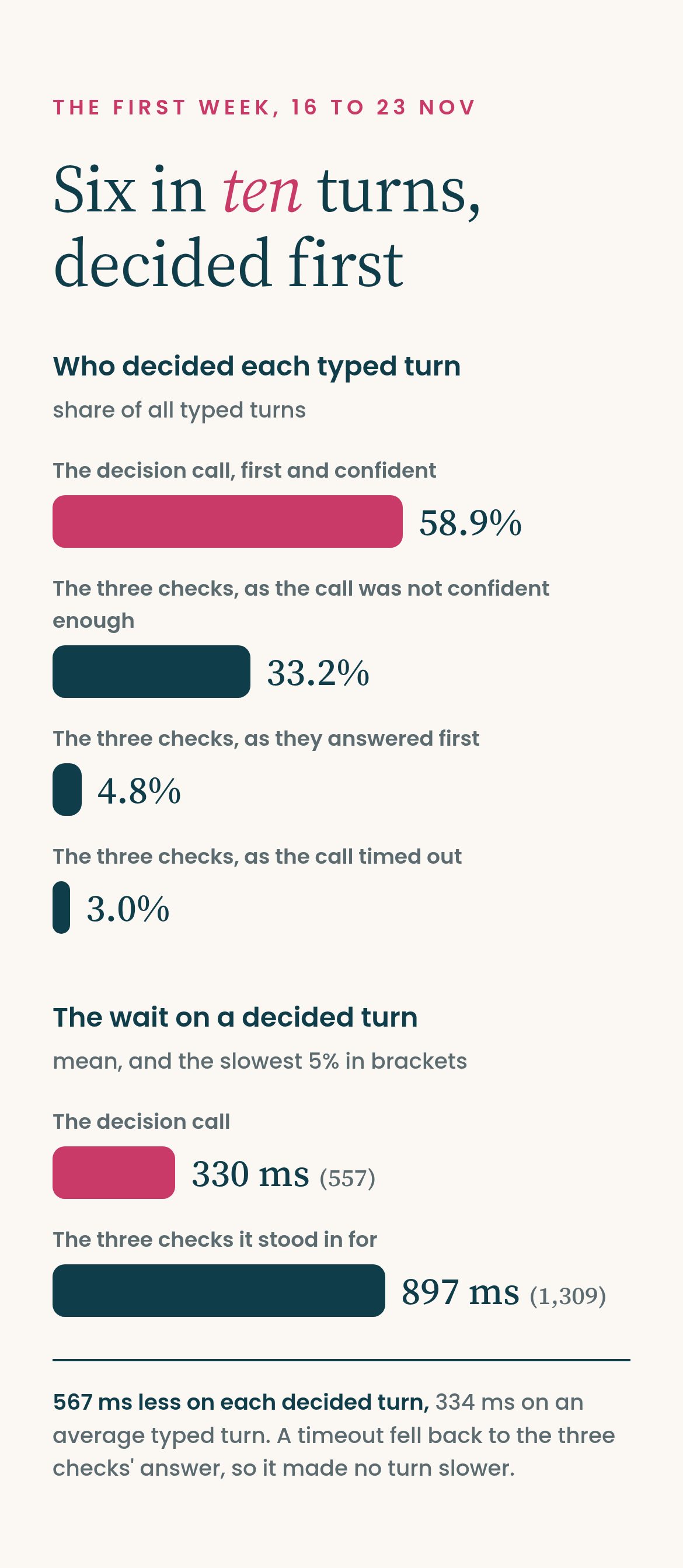
Stippl is the social AI travel planner. Every message to our AI chat first passes three model calls: an LLM router that picks the route, and checks for a health question and a crisis. Since 16 November one Gemini Decisions call races them and decides only when it answers first and is confident. In its first week that was 58.9% of typed turns, each 567 ms sooner.
Before our AI chat writes a word, every message a traveller types passes three model calls: an LLM router that picks the route the answer takes, and two guardrails, one for a health question and one for a traveller in crisis. On the turns this article is about, those three took 897 ms on average, and nothing appears on screen until they are done. Since 16 November, one call to Google's new Gemini Decisions API races them. In its first week it settled 58.9% of typed turns on its own, each one 567 ms sooner.
We did not replace the three checks. We race them, and the new answer counts only when it is first and confident. This is how the race works, the bar our first attempt failed and why that bar was wrong, a week of production numbers, and the cut-off I tried to lower and kept.
Three checks in front of the first word
The router is the big one. It gives each typed message one of four routes: answer with the traveller's trip in view, search for places, give a guide answer about a place, or decline politely because the message is not about travel. The other two checks are a yes or a no. A health question changes how the answer is written. A traveller who may be in crisis gets a message that points to real help instead of travel tips.
The three run side by side, so the slowest sets the wait. They sit in front of the answer in our AI travel planner, so their time is time a traveller spends looking at an empty reply. On the turns the new call settled, the three took 897 ms on average and 1,309 ms for the slowest 5%.
One call that writes no text
Google launched the Decisions API on 11 November. You send it a text and a fixed set of questions: a choice between labels, each with its criteria in plain language, or a yes or no. It sends back a probability for every answer and writes nothing else. The model is gemini-decision-1.
That shape fits our checks exactly: one call asks all three questions. In our first offline trial it answered in about a quarter of the time of the three calls, and it is cheaper per check. It also picked a different route from the live check more often than we would accept. So we did not build it. We ran it in the shadow first.
Agreeing with the old check was the wrong bar
The shadow run went live on 13 November. On every typed turn, one Decisions call ran beside the three checks, and its answer was recorded next to theirs and used for nothing. After three days it agreed with the live route on 89.2% of turns above its confidence cut-off. Our bar was 95%. It failed.
Then we read the disagreements, and the old check turned out to disagree with itself. Asked what to see in a city, it sent about two thirds of those questions to the place search, a quarter to the guide answer and the rest to the trip. One kind of question, three routes. A new check measured by how often it matches that is measured against noise.
So we wrote down the route each kind of question should get, and judged 117 of the disagreements against that key without seeing which check gave which label. The old check was right on 103, the shadow on 102. A tie, not a failure.
The shadow's misses had a pattern. Most were "what is this place known for", which our rules give to the guide answer and the shadow sent to search, some with near full confidence, so no cut-off would have caught them. It also missed a health question we test with on purpose: whether walking up a lot of hills is a problem at six months pregnant.
Three added sentences in the criteria fixed both. What a place is known for goes to the guide answer, even when the place is in the trip. A short reply to the chat's own question about the trip stays with the trip. And the health question now names conditions such as pregnancy. On 200 fresh turns, which the new wording was not written from, the reworded check was never worse than the live one at any cut-off, and the pregnancy question went from a miss to a clear yes.
The race
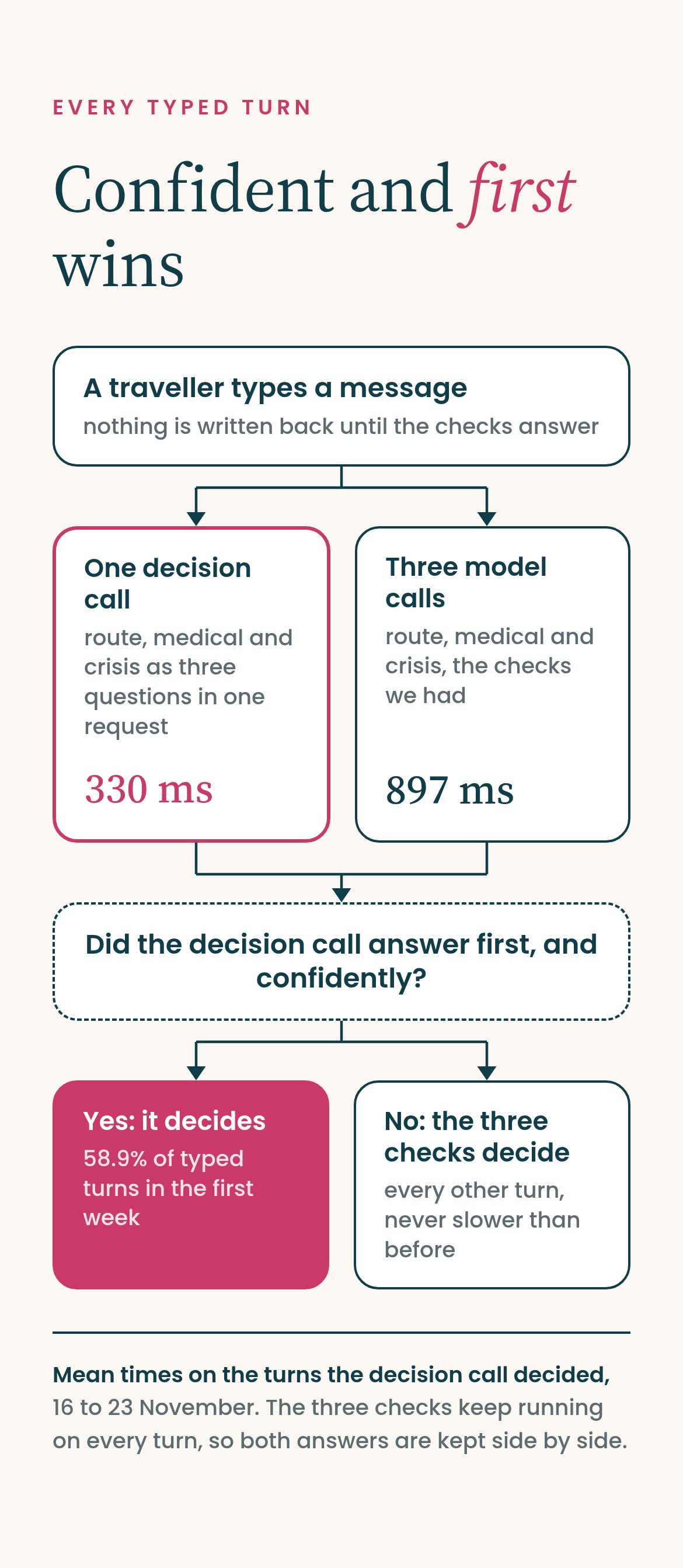
The new code starts both sides at the same moment and waits for whichever finishes first, with asyncio.wait(..., return_when=FIRST_COMPLETED). If the Decisions call is done, the old checks are not, and its most likely route is above the cut-off, it decides the route, the health question and the crisis question for that turn. In every other case the turn waits for the old answer, exactly as before.
Confident and first wins
There are four ways to lose the race: the call is not confident enough, the old checks finish first, the call fails or it times out. All four fall back to the old answer, so a turn never takes longer than the three checks would have taken on their own. And the old checks keep running even when they lose, so every turn records both answers and both times in our traces. That record is what the rest of this article is read from.
The fallback has to cover a bad answer, not only a missing one. Before release, review of the change found that a probability coming back empty or as text failed the whole turn instead of falling back. Now the parser refuses such an answer and the turn takes the old route. The change has 39 tests for the decide path, each checked by breaking the code it guards and seeing it fail. Messages with a photo skip the race, because the Decisions API takes text only.
The trade-off we took is cost. We could have started the old checks only after a low confidence answer. That is cheaper, and it adds about 0.3 s to every turn the call is unsure of. We chose to run both every time. One Decisions call is cheaper per check than the three it stands in for, but for now we pay for both, in exchange for no turn ever being slower and a full record of where the two disagree.
It went to production on 16 November behind a switch that was off, and I switched it on that evening.
The first week
We read the first week on 23 November, from the evening it went on to that morning, with our own accounts left out.
Six in ten turns, decided first
On a decided turn the traveller waited 567 ms less for the checks, and 981 ms less on the slowest 5% of those turns. Spread over every typed turn, decided or not, that is 334 ms. Both shares are a little under what the offline trial predicted, about 64% of turns and 0.46 s, and I would rather report the week than the prediction.
The 3.0% that failed were all timeouts, and most of them fell on two days, 17 and 18 November. Each one waited for the old checks' answer, which they were computing anyway. No traveller saw a difference.
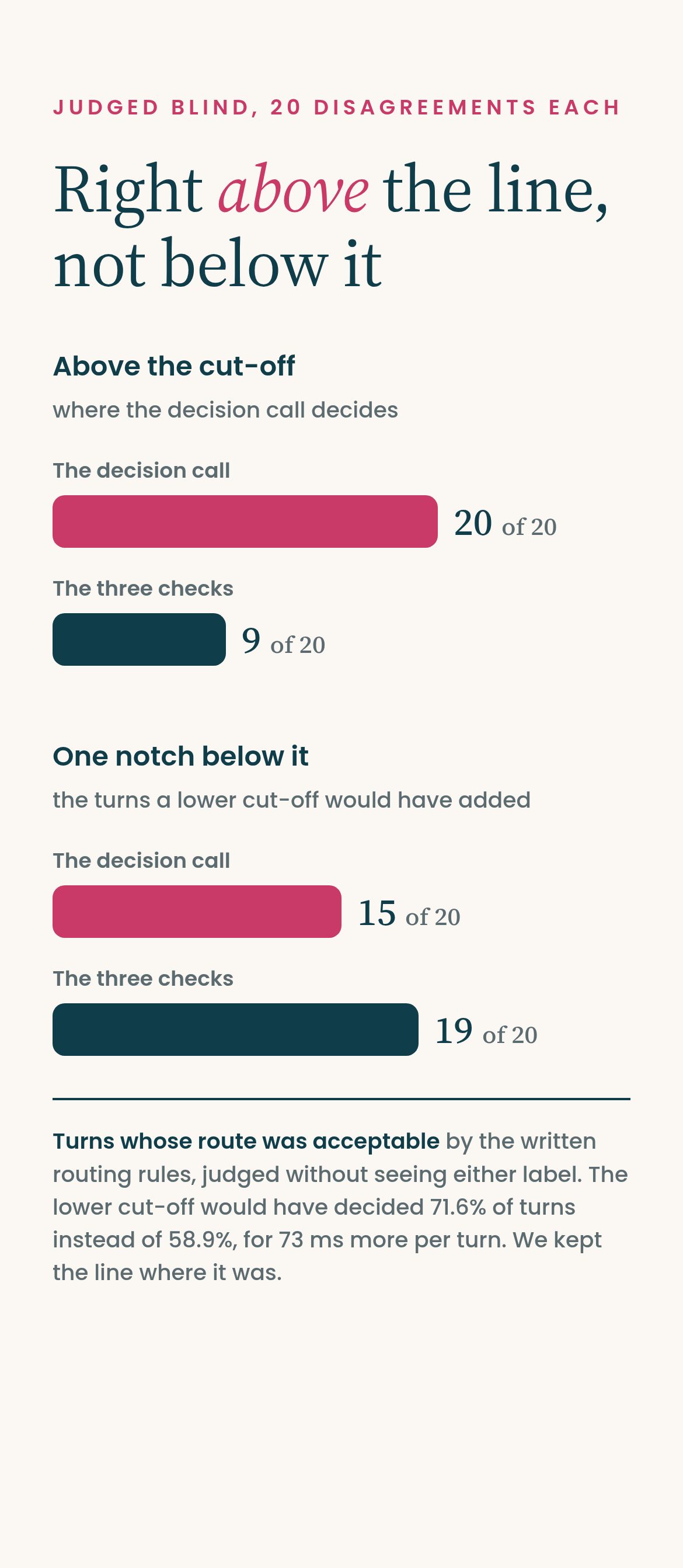
Speed only matters if the answers hold up. On the decided turns the two routes agreed 88.9% of the time, and the Decisions call never declined a message the old check let through. For the rest, we took 20 random disagreements and judged them the same way as before, against the written rules, without seeing either label. The Decisions route was acceptable on all 20. The old check's was acceptable on 9.
The health question disagreed three times on a decided turn, all three the same way: the old check said yes and the Decisions call said no. Reading them by hand, all three were the old check's false alarms. One was a one word follow up in a search for cheap restaurants. One was about our Pro plan. One asked about a rotating sculpture of a head in Prague, whose French name also means feeling dizzy.
Crisis is the check I care most about and can say least about. Neither side flagged a crisis all week, so there was nothing to disagree on. How often the Decisions call would miss one still rests on the cases we test it with offline, which it gets right.
The cut-off I tried to lower
The obvious next step was to trust the call a little more. One notch lower on the confidence cut-off, it would have decided 71.6% of turns instead of 58.9%, and saved 73 ms more per typed turn. The traces already held both answers for every turn in that band, so I could check it without changing anything.
Right above the line, not below it
Above the line, the call is the better router. One notch below it, the old check is: on 20 judged disagreements in that band, the old route was acceptable on 19 and the Decisions route on 15. Lowering the line would have swapped a good answer for a worse one on a share of those turns, for 73 ms. We kept the line where it was.
The confidence a model reports is only worth what you measure it against. Here it is well calibrated where it is high, and one step down it is not. Without the old answer sitting next to every turn, I would have had to guess.
What I would do differently
Two things.
I would write the answer key before the shadow run, not after it. The first read measured the new check against a check that sent one kind of question three ways, and called the result a failure. Agreement with the old system is a fine alarm. It is a poor bar.
I would put a broken answer in the first test list. Errors and timeouts were planned for from the start. An answer that arrives on time and well formed, with an empty probability inside it, was not, and only review before release caught it. A race is only as safe as its worst losing case.
The takeaway
Put a new model in front by racing it against the old path, not by replacing it: confident and first wins, everything else falls back, and keep both answers until the numbers say which is right.
I tried one notch lower on the cut-off for 73 ms a turn. Twenty judged turns talked me out of it.Robin, CTO of Stippl
Questions people ask
What does a router do in an AI chat?
It reads each message and picks the path that answers it. Ours chooses between answering with the traveller's trip, searching for places, a guide answer about a place, or declining a message that is not about travel, and because it runs before the first word, its speed is the traveller's wait.
What is the Gemini Decisions API?
A Google endpoint, launched on 11 November 2026, that answers a fixed set of questions about a text, a choice between labels or a yes or no, with a probability for each answer. It writes no text, and one call can ask several questions at once.
How do you replace an LLM check without making it slower?
Start the old and the new check together and let the new answer count only when it arrives first and is confident. Anything else waits for the old answer, so no turn takes longer than before.
Stippl is the social AI travel planner. Travellers describe a trip in their own words, the AI builds the plan, and the people they travel with join to plan, book and share it together. More than 1.5 million travellers have planned their trips with Stippl. It is free on iOS, Android and the web.