First-timers on a short break
The cathedral, the palace, the Gothic exchange and the Arab baths make one morning's walk, and three nights leaves room for a beach afternoon.
 SpagnaPalma de Mallorca
3 nights typical stay
Palma works without a car, which nowhere else on Mallorca does. La Seu stands over the bay, Santa Catalina pours wine at its market counters, and a wooden train runs to Sóller.
Pianifica le tue giornate a Palma de Mallorca con l'IA

 Palma de Mallorca
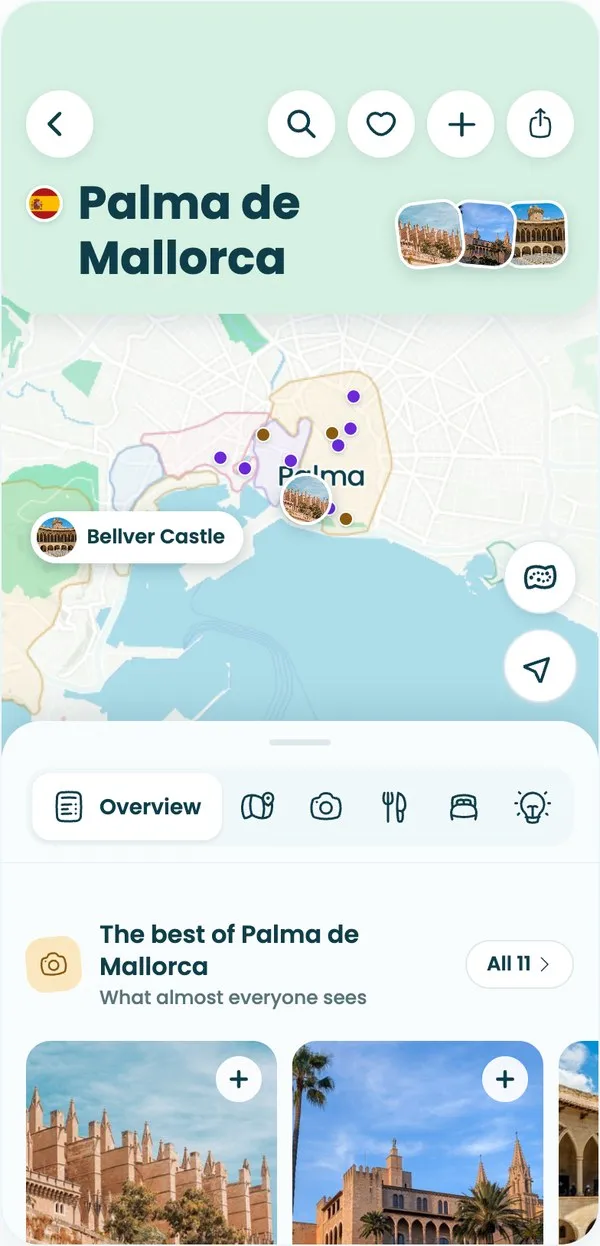
Palma de Mallorca in breve
Aggiornato ottobre 2026 · Scritto dalla redazione StipplPalma's figures here come from its own plans on Stippl, read beside 246,000+ stops planned across Spain.
Sleep in Palma de Mallorca rather than passing through it on the way to a beach. The Gothic cathedral, La Seu, faces the bay beside the Almudaina palace, and the Arab baths, the merchant exchange of La Llotja and the Passeig des Born are all a short walk from it. Santa Catalina's market bars, Bellver Castle on its pine hill and a city beach fill the rest. 51.9% of Palma stops planned on Stippl run to three nights or more.
Palma is decided late, and planned as a whole holiday in one place. A typical Palma trip is created 34 days before departure on Stippl, the shortest lead of any Spanish city we have measured. 24.2% of Palma trips have no other stop at all, and the mainland barely features: Madrid and Malaga turn up on Palma trips less than half as often as on other Spanish ones.
Base yourself in the old town or Santa Catalina, keep the car for the island, and give one day to the mountains. The A1 bus from the airport reaches Plaça d'Espanya in about twenty minutes, and the old town, La Llotja and Santa Catalina are a walk apart. The wooden train to Sóller or a drive to Valldemossa and Deià is the Tramuntana day. Silent coves are an hour away by car, so Palma is the wrong base for them, and in July or August see the city before noon.
 Palma de Mallorca
Pianifica Palma de Mallorca in Stippl
Pianificazione giorno per giorno, alloggi e budget in un'unica app, con ogni luogo di questa guida già sulla mappa.
Scarica l'appFirst-timers on a short break
The cathedral, the palace, the Gothic exchange and the Arab baths make one morning's walk, and three nights leaves room for a beach afternoon.
Food-led travellers
Santa Catalina's market counters, the Olivar market and the harbour fish restaurants make Palma the best place on Mallorca to eat.
Architecture lovers
Palma puts Gothic, Moorish and Gaudí work within a short walk of each other, with a Gothic castle on the hill above the bay.
Travellers without a car
Palma is the one base on Mallorca where the airport, the old town and the city beaches all sit on a bus route.
Anyone flying straight in
Palma is the first stop on 45.0% of the trips that include it on Stippl, because the island's airport is just outside the city.
Families on a beach week
Playa de Palma's long Blue Flag beach has lifeguards and a play area, and the cathedral is a bus ride along the bay.
Forse non fa per te: anyone after silent coves, which are an hour or more away and need a car; and anyone planning to walk the old town at midday in July or August, when the heat closes the afternoons.
Periodo migliore: April to June, September to October
Quiet winter
November to February
Mild, quiet and the cheapest beds of the year, with some seasonal businesses closed. Palma stays awake when the resorts shut, so it is the island's winter city break.
The spring window
March to June
The best weeks for walking the old town and the castle, warm and mostly dry. Hotel rates start to climb from April.
High summer
July and August
Hot by day and tropical at night, the busiest and dearest weeks of the year. Sightseeing works before noon, and the afternoon belongs to the shade or the sea.
The autumn window
September and October
A warm sea and thinning crowds, with the first autumn storms and October the wettest month. Check the forecast before a mountain day.
Aggiungi le tue date per Palma de Mallorca e ti segnaliamo il meteo
Stippl mostra la stagione, l'affluenza e i prezzi per ogni tappa del tuo itinerario.
Tutto questo guida è già in Stippl. Di' al pianificatore quanto tempo hai e cosa ti piace: costruisce l'itinerario, le giornate e i tempi di viaggio, e tu modifichi ciò che vuoi.
La Seu and its roof terraces
Book the cathedral online to use the priority queue, look up at the rose window and Gaudí's interior, and add the roof terraces, a separate seasonal ticket.
An old-town morning on foot
Walk La Llotja, Plaça Major, the old olive tree in Plaça Cort, the Arab baths and the Passeig des Born in one morning. The baths take cash only.
Santa Catalina's market bars
Take a counter stool at the Mercat de Santa Catalina for a glass of Mallorcan wine and tapas at market prices. Go early, since it shuts mid-afternoon and on Sundays.
Bellver Castle at sunset
Climb to the castle on the pine hill west of the centre for the bay and the cathedral below, and walk the woods behind it. Entry is free all day on Sundays.

The wooden train to Sóller
The vintage train leaves Plaça d'Espanya for an hour through the Tramuntana tunnels and orange groves, and a tram runs on to the harbour at Port de Sóller.
Valldemossa and Deià by car
Drive the mountain road to the two Tramuntana villages, 20 to 35 minutes from Palma, and stay for sunset after the day coaches have gone.
Photo by David Vives via Pexels
Old Town
Limestone lanes round the cathedral
The medieval core of La Seu, the Almudaina palace, the Arab baths and patrician courtyards, with boutique hotels in the lanes. The first-timer base, since nearly every sight is on foot.
Perché andarci: Every sight on the doorstep, but the dearest rooms in the city.
La Llotja and Born
Terraces and a Gothic exchange
The harbour-side quarter around the merchant exchange, with the Sant Joan bar street and the shops of the Born boulevard. It suits a short stay with long evenings out.
Perché andarci: The best nights out on foot, and noise until late.
Santa Catalina
Market bars and green shutters
A former fishermen's quarter with the covered market, tapas bars and cafés beside Es Jonquet. It suits food-led travellers who want a neighbourhood rather than a monument quarter.
Perché andarci: The best eating in the city, and a twenty-minute walk to the cathedral.
Son Armadans
Residential streets with sea views
A small district just west of Santa Catalina with bistros, an auditorium and hostels. It suits budget travellers and long stays who want the food quarter next door.
Perché andarci: Cheaper beds than the old town, but fewer sights on the doorstep.
Portixol
Fishing port turned seafront village
A converted fishing harbour three kilometres east of the cathedral, with a small marina, a promenade and paella restaurants. It suits couples and families who want a swim before breakfast.
Perché andarci: Seaside calm and a cycle path, but a bus or bike into town.
Playa de Palma
Long beach, party strip beyond
Nearly five kilometres of Blue Flag sand with big hotels, ten kilometres east of the centre, and a party zone at S'Arenal. It suits families on a beach week rather than a culture trip.
Perché andarci: A long lifeguarded beach, and a long bus ride to the cathedral.
Vedi ogni quartiere di Palma de Mallorca su un'unica mappa
Salva le zone che ti piacciono e Stippl organizza le tue giornate così non attraversi la città due volte.
The old town is the base for a first visit, Santa Catalina the one for the food, and Playa de Palma the one for a beach week. Palma needs no car, so one central base covers the stay. 36.8% of Palma stops on Stippl are a single night, and that night sees only the cathedral, so give it two or more. Book early for July and August.
Boutique hotels in converted palaces and apartments in the lanes, a double from about €130 to €200 a night in summer.
Small design hotels and apartments above the bars and shops, roughly €120 to €200 a night in season.
Boutique hotels and holiday flats on residential streets, from about €115 off-season to €180 in summer.
Hostels and small hotels, with a dorm bed from about €25 off-season and €50 in summer.
A handful of boutique hotels by the marina, roughly €150 to €250 a night in summer.
Big beach hotels and package resorts along the sand, roughly €90 to €180 a night.
The coiled Mallorcan pastry dusted with icing sugar, from the bakeries (hornos) of the old town and the island villages
Bread rubbed with tomato and oil, with ham or cheese, at casual bars in Son Armadans and the old town
Small plates and a glass of Mallorcan wine at the counters of Santa Catalina and Olivar, for less than an old-town terrace; both markets close on Sundays
Seafood rice, the speciality of the seafront at Portixol and Can Pastilla
The catch of the day from the bay, at the harbour and Paseo Marítimo restaurants
The soft cured pork and paprika sausage of Mallorca, from charcuterie counters and the markets
A set weekday lunch of two or three courses at local neighbourhood restaurants
Scopri posti dove mangiare in Stippl
Trova ristoranti e mercati sulla mappa, salvali nel tuo itinerario, funziona anche offline.
Catalan comes first on signs
Mallorcan Catalan is co-official with Spanish, so street names and menus often use Catalan, and Ciutat is the island's old name for Palma.
Cover up in the cathedral
Shoulders and knees are covered inside La Seu, so carry a shirt or a scarf if the morning was spent on the beach.
Swimwear stays on the beach
Walking through the old town in swimwear can bring a fine under the civic ordinance, which also bans group street drinking.
Markets keep morning hours
Santa Catalina and Olivar open early, shut by mid-afternoon and close on Sundays, so the market lunch is a weekday plan.
Playa de Palma has strict rules
On the resort strip shops stop selling alcohol at night, street drinking is banned, and jumping from balconies gets you expelled from the hotel.
Sì
No
Budget
€70-100
A hostel bed, set lunches, and free or cheap sights.
Mid-range
€120-180
A 3-star hotel, restaurant meals and a few museum tickets.
High-end
€250+
A boutique hotel in the old town or Portixol, booked dinners and a boat trip on the bay.
Prezzi tipici
Tieni d'occhio quanto spendi davvero
Imposta un budget giornaliero per paese e registra le spese in qualsiasi valuta mentre viaggi.
La Seu's rose window is about 14 metres across. It is made of more than a thousand pieces of glass and ranks among the largest rose windows in the world.
Gaudí spent eleven years on the cathedral, from 1903 to 1914. He reorganised the interior of a building that had been under way since the thirteenth century.
Bellver Castle is the only circular Gothic castle in Spain. It was built around 1300 on a pine-covered hill about three kilometres west of the old town, and holds a history museum.
The Arab baths are what is left of the Moorish city of Medina Mayurqa. The small domed room is one of the few surviving pieces of Islamic Palma.
Palma airport handles close to 34 million passengers a year. That makes it the third busiest airport in Spain, for a city of a little over 400,000 people.
La Seu's nave rises 44 metres above the floor. The cathedral was begun in 1229 and faces the bay across an artificial pond.
The A1 is the airport answer
The A1 bus runs from the airport to Plaça d'Espanya about every quarter of an hour, takes twenty minutes and costs less by card than in cash.
Leave the car for day four
The old town, La Llotja and Santa Catalina are twenty minutes apart on foot; hire a car only for the coves and the mountain villages.
Save the last night for Palma
43.8% of the trips that include Palma end there on Stippl, so keep the final night in the city, close to the airport bus.
Sundays are for the castle
Bellver is free all day on Sunday, but both food markets and many shops are shut, so swap the market lunch for the castle and the woods.
Cash for the Arab baths
The baths take cash only, and coins help at the bakeries for an ensaïmada; cards work almost everywhere else in the city.
Tap water is safe but hard
Palma's tap water meets EU standards but tastes of chlorine and salt, so restaurants serve bottled water by default and filtered fountains are spreading.
Three days is the right length for Palma de Mallorca, with a fourth for the mountains. 3 nights is the typical stay of everyone who plans Palma on Stippl, a night longer than the usual Spanish stop. That covers the cathedral quarter, Santa Catalina and a beach afternoon.
A stay, for nearly everyone who goes. Only 15.6% of Palma stops planned on Stippl carry no night at all, and the rest sleep in the city. It is the island's capital and its airport, so most holidays start and end here rather than dropping in for an afternoon.
Within a fortnight, for a good share of people. Travellers planning Palma on Stippl create 26.2% of their trips within two weeks of departure, because flights to the island are short and frequent. Rooms in July and August still go early, so a late plan works best in spring and autumn.
Three nights in the city, then the rest on the island: Sóller and the Tramuntana villages with a car, or a hop to Ibiza. Lay the days out in Stippl to see what the drives allow, then put the days in front of people who know the island, in r/Mallorca. Say how you travel when you ask.
Hot enough to change the day. Afternoons in Palma de Mallorca reach the low thirties as a long-term average, recent summers have gone far higher, and the nights stay tropical. See the old town and Bellver before noon, spend the afternoon in the shade or the sea, and come out again after dark.
Yes, on the vintage wooden train from Plaça d'Espanya in Palma de Mallorca, about an hour through the Tramuntana tunnels and orange groves. A tram carries on from Sóller town to the harbour at Port de Sóller, so the whole day works without a car.
Ogni guida è scritta dalla redazione di Stippl e verificata sui viaggi che i nostri viaggiatori pianificano davvero. Hai notato qualcosa di non aggiornato? Faccelo sapere.
Pianificazione giorno per giorno, alloggi e budget in un'unica app, con ogni luogo di questa guida già sulla mappa.